
Reviewed · MUSEUMS
Cartagena : Roman Theatre Museum Entry Ticket
Cartagena’s Roman Theatre was hidden beneath the modern city for centuries, which makes the visit feel like a surprise unfolding room by room. You begin with the Rafael Moneo-designed museum, then follow the story underground before arriving at a theater that once held about 7,000 spectators.
I like the clear progression from artifacts and excavation history to the open-air theater itself. I also like the low $8 price, especially when you use the audio guide to make sense of the ruins. The main caution is access: some open stairways lack handrails, and wheelchairs may not reach the lower stage area.
Key points to know
- Start inside the museum: The theater entrance is reached through the museum, not from the most obvious street-side viewpoint.
- See a 7,000-seat Roman theater: The scale becomes clear when you stand inside the preserved seating and stage area.
- Follow the Passageway of History: This section explains how the site developed from the 1st century B.C. and later disappeared beneath Cartagena.
- Look for the Roman house: Mosaic floors survive from a home destroyed when the theater was built.
- Add the audio guide: It is available in Spanish, English, French, German, and Russian, and helps explain the theater’s political and cultural role.
- Plan around the steps: The museum has lifts and escalators, but parts of the theater have open stairs with limited support.
Entering Cartagena’s Roman Theatre Museum
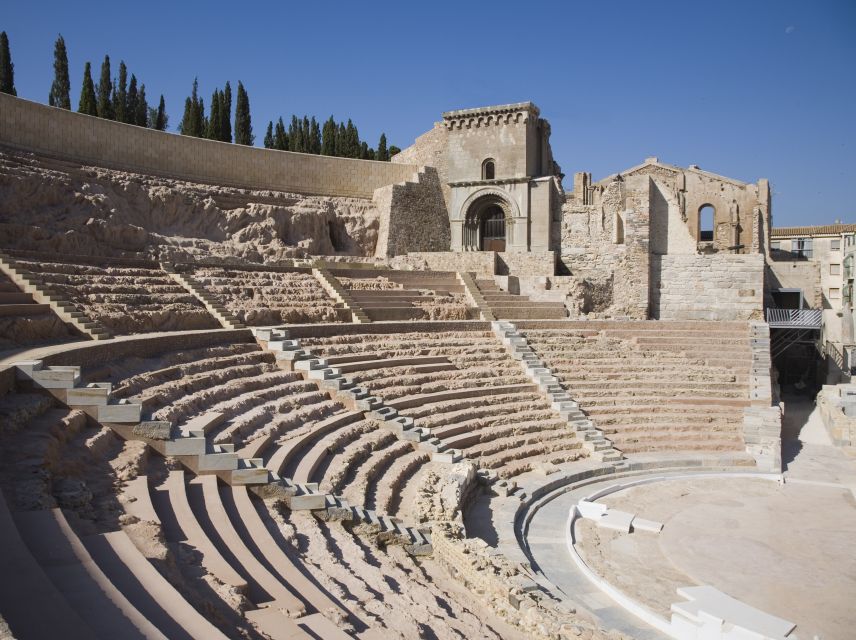
The first thing to understand is that the visible theater is not the starting point. You enter through the Roman Theatre Museum, designed by Spanish architect Rafael Moneo, and work your way toward the ancient remains.
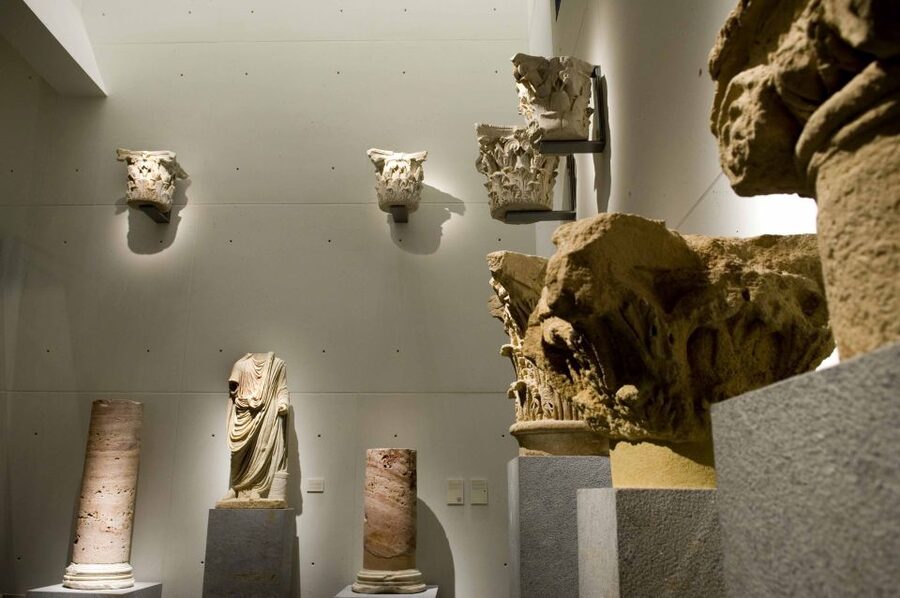
This arrangement is useful because the museum gives you the background before you see the stone seating and stage. Instead of arriving at a pile of old walls and trying to guess what you are looking at, you first learn how the site was found, how it was buried, and how archaeologists connected the remains to Roman Cartagena.
Allow time to find the entrance. This is one of the practical weak spots. Street signs can be easy to miss, and map directions may take you toward the museum exit rather than the entrance. If you see an aerial view of the theater from outside, do not assume that is where you go in. The public route runs through the museum.
The museum itself is arranged over several levels. Lifts and escalators help with much of the indoor route, and the displays are manageable for families because the story changes as you move along. Children may not care about every display case, but the shift from museum rooms to the large open theater gives the visit a strong sense of discovery.
A few more things to do in Spain worth a look
- Madrid: Prado Museum Entry Ticket
★ 4.6 · 17,509 reviews - Barcelona: FC Barcelona Museum “Barça Immersive Tour” Ticket
★ 4.4 · 10,944 reviews - Madrid: Reina Sofía Museum Entrance Ticket
★ 4.5 · 6,889 reviews
The Passageway of History and Cartagena’s buried past
The Passageway of History is the museum’s main storytelling device. It explains how the theater site changed from its Roman beginnings in the 1st century B.C. through later periods, when the remains were covered and forgotten beneath newer construction.
That burial is central to the experience. The theater was not simply abandoned in a clear field. It disappeared into the growing city, which explains why the discovery was so unexpected. You can follow the historical process that hid the building and the later work that brought it back to light.
The displays also place the theater within Roman Spain. You learn about the way performances worked, how the Roman art world carried political meaning, and why a theater was more than a place for entertainment. Public buildings helped display power, status, and Roman identity.
This is where the audio guide earns its small extra cost. The theater’s curved seating and stage walls are impressive, but the political meaning is harder to read from stone alone. An audio explanation helps connect the physical remains with the society that built and used them.
The guide is offered in Spanish, English, French, German, and Russian. You can listen at your own pace rather than keeping up with a live group. That makes the ticket a good fit if you like stopping at displays, moving on when you are ready, or keeping children from being locked into a fixed lecture.
The Roman house and its mosaic floor
One of the most revealing displays is the remains of a Roman house with mosaic tiles. The house was destroyed when the theater was constructed, so the museum lets you see two periods in the same place.
That detail gives the site a human scale. The theater was a major public project, but it did not appear on empty ground. Its construction changed the existing neighborhood and displaced earlier buildings. The mosaic floor is a quiet reminder that urban development has always involved choices about what gets removed and what gets preserved.
I would not rush past this section to reach the main theater. The seating and stage make the biggest visual impression, but the house helps explain the cost of building such a structure. It also gives you a closer look at domestic Roman life, rather than only public monuments and grand political ideas.
Seeing a theater built for 7,000 spectators
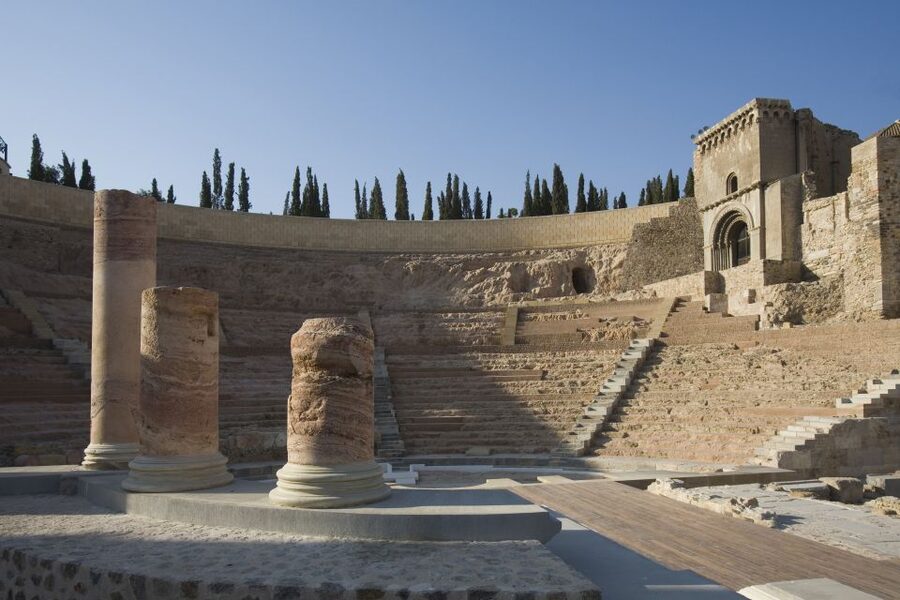
The final arrival at the theater is the payoff. Cartagena’s Roman theater could hold about 7,000 people, making it one of the largest ancient theaters in Spain.
From the upper viewing areas, the scale is easier to understand. You can look down across the curved seating and imagine how the audience would have been arranged around the performance space. The remains do not recreate a working theater, but the basic form is clear enough to show how carefully Roman public architecture handled sightlines and crowd space.
The route lets you walk around the theater and see the structure from different positions. The open-air setting also changes the mood from the more controlled museum displays. You are no longer looking only at labeled objects. You are standing among the surviving parts of the original building.
The lower stage area requires stairs. Some of these are open and have few or no handrails, so take care if you are unsteady on your feet. This is not just a minor comfort issue. Several parts of the site may be difficult to reach if you need firm support on stairs.
Wheelchair users can use the museum’s lifts and accessible routes, but the theater’s lower areas are limited. Wheelchairs and some mobility devices may need to remain at the upper level. Electric wheelchairs are not allowed under the stated rules. Assistance dogs are allowed, but other pets are not.
Same base, a different kind of day out:
- Barcelona: Sagrada Familia Entry Ticket with Audio Guide
★ 4.6 · 105,312 reviews - Barcelona: Park Güell Admission Ticket
★ 4.4 · 76,534 reviews - Seville: Royal Alcázar Entry Ticket
★ 4.6 · 28,378 reviews - Barcelona: Casa Batlló Entry with Self-Audioguide Tour
★ 4.7 · 25,359 reviews
Why the audio guide is worth considering
The basic ticket gives you access to the museum and theater. The optional audio guide adds a layer of explanation that is particularly useful here because the ruins are substantial but not fully self-explanatory.
I would choose it if you want to understand the excavation, the theater’s design, and the role of Roman performances in public life. It is also helpful if you do not read Spanish comfortably. The available languages are Spanish, English, French, German, and Russian.
The audio format suits this site better than a rushed commentary. You can pause near the mosaic, spend longer with the excavation story, or move quickly through a display that does not interest you. The visit is self-paced, so you do not need to match the timing of a guide or group.
A separate guided city experience with a guide named Bruno has also been associated with broader Cartagena visits, but do not assume that booking the museum ticket includes him. The theater ticket is primarily a museum and archaeological-site entry, with the audio guide offered as an option.
How long to allow and when to go
The ticket is valid for one day, with entry times based on availability. The exact visit length depends on how closely you read the displays and whether you use the audio guide, but you should not treat this as a quick photo stop.
The museum comes first, and the theater follows. If you hurry through the indoor route, you will miss the excavation story that makes the theater more meaningful. I would allow enough time to look at the archaeological displays, listen to the key audio sections, and walk around the theater rather than arriving just before closing.
Sunday planning needs extra care. The Roman Theatre Museum closes at 2:00 PM on Sundays, so a late-morning visit is safer than leaving it for the afternoon.
The site is especially worth considering on a hot day because parts of the visit are outdoors and refreshments are not available inside. There is no food or drink access during the experience, and food and drinks are not allowed in the site. If you are visiting with young children, plan that break before entering.
Is the $8 ticket good value?
At about $8 per person, this is one of Cartagena’s easier cultural purchases to justify. You get both the museum and the theater, not just an exterior view or a small display room.
The value comes from the order of the visit. The museum explains the excavation and displays artifacts, the Passageway of History adds the wider timeline, and the theater gives you the physical scale at the end. Each part supports the next.
The audio guide may cost extra depending on the option you select, but I would consider it money well spent if you want more than a quick look. The Roman theater is visually strong, yet the political meaning of Roman performances and the process of burial and rediscovery are not obvious without help.
You can also see an aerial view from outside without buying admission, which is useful if you only want a photograph. That free viewpoint does not replace the paid visit, though. It cannot give you the indoor museum displays, the mosaics, or the route into the theater.
Buying ahead is sensible if your schedule is tight. The entrance can be hard to identify, and buying on site may involve a long line. Bring the required voucher in its proper form. A screenshot of the QR code is not accepted, so keep the valid voucher available.
Family visits and practical comfort
This is a good choice for families who can handle stairs and who enjoy a clear before-and-after story. The theater is large enough to catch a child’s attention, and the route changes from indoor objects to an open archaeological site.
The museum’s lifts and escalators help with the indoor portion, but the theater itself is less forgiving. Young children may need close supervision on the open steps, especially in hot weather. There is no refreshment stand inside, and you cannot bring food or drinks into the site.
For older adults or anyone with limited balance, the upper viewing areas may be more comfortable than trying to reach the stage level. The lack of handrails is worth taking seriously. You can still see the theater well from above, but the experience is not equally accessible at every point.
The site is wheelchair accessible in general terms, but not every part of the ancient structure can be reached by wheelchair. Electric wheelchairs are specifically not permitted. Check the details of your booked option if mobility access is essential to your visit.
What to bring and what to leave behind
Bring your valid voucher, comfortable shoes, and the patience to follow the museum route before reaching the theater. If you choose the audio guide, make sure your selected language matches your needs when booking.
Leave food and drinks outside. Pets are not allowed, except assistance dogs. Alcohol, drugs, and explosive substances are prohibited, and electric wheelchairs are not accepted.
Do not plan on using a screenshot of your QR code. The entry rules require the proper voucher, and this is an easy detail to overlook when you are moving between several Cartagena sights.
Who should book this Cartagena experience?
I would book this ticket if you want a compact look at Roman Cartagena that combines architecture, archaeology, and museum interpretation. It works especially well for first-time visitors who want one substantial historic site without committing to a full-day tour.
It is also a smart choice for families, provided everyone is comfortable with heat and stairs. The museum gives younger visitors a change of scene, while the theater provides the visual moment that makes the ancient site memorable.
I would be more cautious if you need handrails throughout a historic site or if you want complete access to every level by wheelchair. The museum is better equipped than the theater itself, and the lower stage area may not be reachable.
FAQ
What does the Roman Theatre Museum ticket include?
The ticket includes admission to the Roman Theatre Museum and the Roman Theatre archaeological site. An audio guide is included only if you select that option.
How large was Cartagena’s Roman theater?
The theater could hold about 7,000 spectators, making it one of the largest ancient theaters in Spain.
Is an audio guide available?
Yes. Optional audio guides are available in Spanish, English, French, German, and Russian.
Where do I enter the Roman Theatre?
You enter through the Roman Theatre Museum. The entrance can be difficult to identify, and map directions may lead you toward the museum exit instead.
Is the site wheelchair accessible?
The museum has lifts and escalators, but parts of the theater have open steps and limited handrails. Wheelchairs may need to remain at the upper level, and electric wheelchairs are not allowed.
Does the museum open all day on Sunday?
No. The Roman Theatre Museum closes at 2:00 PM on Sundays.
Should you book it?
Yes, if you are spending time in Cartagena and want a well-priced historic site with more substance than an exterior viewpoint. The museum, mosaic house, excavation story, and 7,000-seat theater make the $8 admission good value, especially with the audio guide.
Book ahead if possible, since the entrance can be confusing and lines may be long. Choose another activity, or set modest expectations, if stairs and handrails are a serious concern. For most visitors, though, this is an easy and worthwhile way to connect Cartagena’s modern streets with its Roman past.
Just added in Spain
- The Red Canyon Tour – Small Group Trip with Local Food Tasting ツ★ 5.0 · 798 reviews
- Full Day Rainforest Tour with Tasting and Swimming Time ツ★ 5.0 · 607 reviews
- Arucas, Teror, Viewpoint Roque Nublo – Highlights Gran Canaria★ 4.5 · 170 reviews
- Full Day Ticket at Perchel Beach Club with Lunch★ 5.0 · 316 reviews
- 3 Wheel Motorcycle like Quad/Buggy Tour Gran Canaria (Maspalomas)★ 5.0 · 237 reviews
- Gran Canaria Highlights Private Tour VIP★ 5.0 · 106 reviews
- Full day Hiking Gran Canaria Peaks of Gran Canaria★ 5.0 · 130 reviews
- Coastering in Gran Canaria (Aquatic Route in the ocean cliffs)★ 5.0 · 135 reviews
Museums, compared.

FC Barcelona Museum “Barça Immersive Tour” Ticket
Read our review →

Park Güell and Gaudí House Museum Entry Ticket
Read our review →
Puro Flamenco Show with Optional Museum Ticket
Read our review →
Girona & Dali Museum Small Group Tour with Pick-up from Barcelona
Read our review →
Oceanogràfic, Hemisfèric & Science Museum Combo
Read our review →Browse the lists this tour appears in