
Reviewed · MUSEUMS
Figueres: Dalí Theatre-Museum Entry Ticket
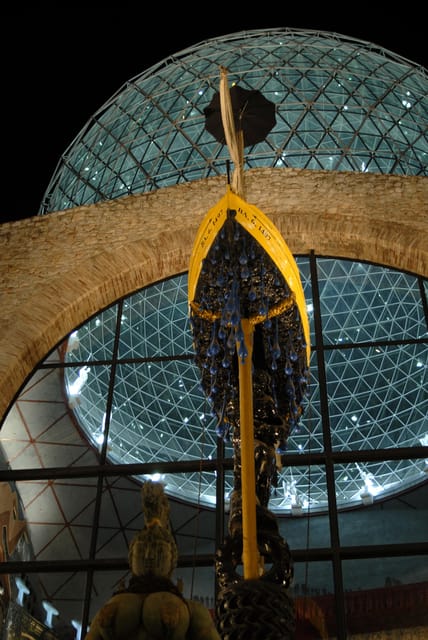
The strangest thing about the Dalí Theatre-Museum is that the building is part of the artwork. Giant eggs perch on the roof, golden figures catch the light, and the famous geodesic dome gives the museum an instantly recognizable shape. Inside, paintings, sculptures, and optical tricks turn a normal museum visit into a walk through Salvador Dalí’s imagination.
I like the museum’s sheer variety, especially the dedicated jewelry section and the clever 3D displays. I also like that you can see Dalí’s final resting place beneath the dome, an unusual and quietly memorable stop. The main drawback is crowding. Entry is timed, but the rooms can still feel packed, and the layout is not always easy to follow.
Key points to know
- The building is part of the experience: Giant eggs, golden statues, and the dome begin the visit before you even enter.
- You’ll see more than paintings: Sculptures, installations, optical illusions, 3D displays, and jewelry fill the museum.
- Allow at least two hours: One visit can easily stretch longer because the collection is large and the displays invite close looking.
- Timed entry matters: Arrive for the date and time on your ticket. Missing it can mean cancellation and no guaranteed entry.
- It is self-guided: No guided tour or audio guide is included, so bring your own background knowledge or plan to explore at your own pace.
- Pack light: Large bags, backpacks, umbrellas, pushchairs, and objects larger than 35 x 35 x 25 centimeters may need to be left at the consignment office.
Why Figueres Is the Right Place for Dalí’s Museum
Figueres is not simply the address of a Dalí collection. It is the town where Salvador Dalí created a museum designed around his own ideas about art, illusion, and spectacle. That matters because this is not a neutral gallery with white walls and neatly separated periods. The building has a personality, and the visit works best when you treat it as one complete artistic creation.
The exterior gives you an immediate lesson in Dalí’s sense of humor. Giant eggs sit above the building, while golden figures and other theatrical details make the museum look unlike anything else in town. You do not need to understand every painting to appreciate the setting. The museum announces its mood before you reach the entrance.
Once inside, the experience becomes less orderly than a conventional art museum. Rooms lead you through paintings, sculptures, installations, and visual puzzles. Some works reward careful study, while others are built for surprise. You may find yourself moving back and forth to make an image appear, looking at a sculpture from several angles, or trying to work out how a 3D display functions.
That playful design is one of the museum’s strongest features. It also explains why the visit can feel confusing. The route is not always easy to follow, particularly when the museum is crowded. If you prefer a clearly numbered sequence of galleries, you may need to accept that this is more of an artistic maze than a tidy timeline.
A few more things to do in Spain worth a look
- Madrid: Prado Museum Entry Ticket
★ 4.6 · 17,509 reviews - Barcelona: FC Barcelona Museum “Barça Immersive Tour” Ticket
★ 4.4 · 10,944 reviews - Madrid: Reina Sofía Museum Entrance Ticket
★ 4.5 · 6,889 reviews
The Exterior: Eggs, Gold, and a Geodesic Dome
Before you enter, spend a few minutes looking closely at the outside. The giant eggs are the most obvious feature, but the golden statues and unusual decorations help set the tone for what follows. This is not a plain container for art. It is a piece of Dalí’s visual world.
The exterior is also useful for understanding the museum’s purpose. Dalí wanted the building to feel theatrical and surprising, not merely practical. That approach continues indoors, where the displays often ask you to participate rather than simply stand and read.
The dome is the museum’s most famous architectural feature. It gives the building its distinctive profile and serves as a visual marker from outside. Beneath it, you can see Dalí’s final resting place. The tomb is a quieter moment in a visit that can otherwise feel loud, playful, and visually busy.
I recommend pausing here rather than treating the tomb as a quick box to check. It gives the museum a sense of closure and connects the artist’s life directly to the place he helped shape.
Inside the Largest Collection of Dalí’s Work

The collection covers much more than the familiar melting clocks and dreamlike images associated with Dalí. You will encounter paintings, sculptures, installations, and other forms of experimentation. The range is important because it shows an artist who was not confined to one style or one medium.
You can expect the collection to move between serious, strange, funny, theatrical, and technically inventive. Some works may be instantly appealing. Others may require more patience, particularly if you want to understand the visual trick or idea behind them.
The museum is especially good for showing Dalí’s interest in perception. Optical illusions and 3D installations encourage you to change your position and look again. A work may appear to be one thing from a distance and another when viewed from a different angle. These displays give the visit a hands-on quality without turning it into a children’s attraction.
That said, the museum does not provide a guided tour with this ticket. An audio guide is not included either. If you want detailed explanations of each work, you may find the experience less satisfying than a guided visit. If you enjoy forming your own impressions, the lack of commentary gives you freedom to linger where you want.
The Museum as a Labyrinth of Optical Illusions
The layout is part of the challenge. Rooms do not always feel like a simple chronological path through Dalí’s career. You may encounter a familiar work beside an installation, then move into a space designed around an optical illusion or a three-dimensional effect.
I like this arrangement because it matches Dalí’s approach. The museum is not asking you to move through a textbook. It is asking you to follow your curiosity. You can stop for a painting, turn toward a sculpture, and then spend several minutes figuring out how a visual effect works.
The tradeoff is crowd control. When many people enter close together, it can become difficult to follow any intended sequence. A timed ticket does not guarantee a quiet visit. One useful approach is to move with patience rather than trying to see every room in strict order. If a gallery feels too crowded, continue to another area and return later if the route allows.
The displays are best enjoyed when you give yourself room to look twice. A quick walk-through will show you plenty, but it may miss the small shifts in perspective that make several installations effective.
Same base, a different kind of day out:
- Barcelona: Sagrada Familia Entry Ticket with Audio Guide
★ 4.6 · 105,312 reviews - Barcelona: Park Güell Admission Ticket
★ 4.4 · 76,534 reviews - Seville: Royal Alcázar Entry Ticket
★ 4.6 · 28,378 reviews - Barcelona: Casa Batlló Entry with Self-Audioguide Tour
★ 4.7 · 25,359 reviews
Dalí’s Jewelry: A Smaller Section Worth Seeking Out
The jewelry collection is easy to overlook if you arrive expecting only paintings and sculptures. Make a point of finding it. These pieces reveal a different side of Dalí’s imagination, one that works on a small scale and depends on materials, shape, and ornament.
The jewelry section is valuable because it expands your idea of what Dalí made. His creative energy was not limited to canvases or large public displays. Jewelry allowed him to build compact objects with their own theatrical character.
If you have already seen Dalí’s paintings elsewhere, this section can give your visit a fresh angle. It also provides a change of pace after the larger installations. You move from grand visual effects to carefully made objects that reward close inspection.
I would not rush through it simply because the pieces are smaller. The jewelry helps explain why the museum feels broader than a greatest-hits collection. It presents Dalí as a designer and maker as well as a painter.
Rotating Exhibitions and Changing Reasons to Return
The museum also presents rotating exhibitions featuring Dalí and other artists. These displays can add context to the permanent collection or offer a different way to think about his work.
For a first-time visitor, the rotating section may help break up the more famous pieces. You get a chance to see work that is not always part of the same presentation. Repeat visitors may find this area particularly useful, since a new exhibition can change the emphasis of a return visit.
The exact content changes, so you should not book this ticket for one specific temporary display unless you have checked what is scheduled for your date. The permanent collection remains the main reason to visit, but the changing exhibitions give the museum some freshness.
How Much Time Should You Allow?
The ticket is valid for one day, but your booking is tied to a stated date and time. Think of the one-day validity as permission to visit on that date, not as an open ticket that you can use whenever you like.
A visit of two or more hours is a sensible starting point. One person spent more than two hours and still found plenty to see, while another wished for more time. That difference makes sense: the museum can be walked through fairly quickly, but the installations and visual puzzles reward a slower pace.
I would allow extra time if you enjoy art museums, photography without flash, or interactive displays. Families and younger visitors may also need longer because the optical illusions invite discussion and repeated looks.
Do not schedule the museum so tightly that you must leave after an hour. The building itself deserves attention, and rushing will make the visit feel like a checklist. At the same time, you do not need an entire day inside unless you plan to study a large number of works in detail.
Crowds, Timed Entry, and the Best Way to Visit
The museum admits ticket holders at set times, with groups entering at short intervals. This helps organize access, but the interior can still become crowded, particularly during busy periods.
Earlier entry times are a smart choice if you have flexibility. They give you a better chance of seeing the first rooms without as many people around you. You should also arrive at the museum with enough time to find the entrance and be ready for the checkpoint.
The queuing system may feel confusing. The route through the galleries is not always easy to read, and crowds can make it difficult to follow the rooms in order. Try not to let that spoil the visit. Dalí’s museum is not designed like a linear exhibition, so a little wandering is part of the experience.
Keep your ticket details handy and use the exact date and time reserved. If you miss the slot, the reservation can be canceled, and entry depends on availability at that moment. This is one of the most important practical points.
What You Can and Cannot Bring Inside
Food and drinks are not allowed in the museum. Smoking indoors is prohibited, and flash photography is not permitted. Assistance dogs are allowed, but other pets are not.
Security staff search handbags and backpacks at the entrance. Knives, penknives, and other objects considered dangerous may be collected and returned at the end of the visit.
Large bags, luggage, umbrellas, pushchairs, rucksacks, and objects larger than 35 x 35 x 25 centimeters may not be admitted. A consignment office is available for many such items, but you should not plan to store valuables, jewelry, money, living beings, or dangerous objects there.
The simplest plan is to arrive with a small bag and only what you need. Light packing saves time and avoids uncertainty at the checkpoint.
Is the $27 Ticket Good Value?
At $27 per person, this is not a cheap museum admission, but it buys access to a large and highly unusual collection rather than a single gallery. The ticket includes the permanent museum, interactive displays, rotating exhibitions, and the jewelry section. It also includes the booking fee.
The value is strongest if you already enjoy Dalí or want a museum experience unlike a standard art collection. You are paying for the building, the setting, the installations, and the range of material as much as for individual paintings.
The value is less clear if you expect a guided explanation or a quiet, carefully ordered gallery visit. No transportation, food, drinks, guided tour, or audio guide is included. You must make your own way to the Dalí Theatre-Museum and explore independently.
For many people, the price is justified by the sheer amount of creative material and the fact that the museum itself is part of the attraction. I would consider it a reasonable splurge during a visit to Figueres, especially if you can give it two or three unhurried hours.
Who Will Enjoy This Most?
I would recommend this ticket to anyone curious about Dalí’s full range, not just his most famous paintings. It suits adults, families with older children, design fans, and museumgoers who like optical illusions and unusual presentation.
Children under 12 must be accompanied by an adult. The visual effects and sculptures may keep younger visitors interested, but the lack of a guided explanation means you will need to help them make sense of what they are seeing.
The museum is also wheelchair accessible, which makes it a practical choice for visitors who need accessible entry. Because crowds and the irregular layout can still affect movement, you may want to allow extra time and take the visit at your own pace.
This is not the best choice for someone who wants a short, quiet stop with a clear room-by-room explanation. It is also a poor fit if you dislike surreal art or find crowded museums frustrating. The experience asks you to accept some confusion and enjoy the surprises.
Should You Book the Dalí Theatre-Museum?
Book it if you want to see Dalí’s art in a place shaped around his own visual instincts. The giant eggs, golden figures, dome, optical illusions, sculptures, jewelry, and installations make this much more than a standard painting collection.
Choose an early timed entry if possible, arrive with a small bag, and plan on at least two hours. If you want expert commentary, arrange a separate guide because this ticket is self-guided.
I would skip it only if your schedule is extremely tight, you dislike crowds, or you want a traditional museum with a clear chronological route. For most visitors interested in Dalí, the unusual building and wide range of work make the $27 admission worthwhile.
FAQ
Where is the Dalí Theatre-Museum?
The museum is in Figueres, Catalonia, Spain. You should go directly to the Dalí Theatre and Museum for entry.
How much does admission cost?
The listed price is $27 per person, including the booking fee.
How long is the ticket valid?
The ticket is valid for one day, on the stated date and reserved time. It is not an open admission ticket for any date.
Is a guided tour or audio guide included?
No. The ticket includes museum entry and access to the displays, but it does not include transportation, food, drinks, a guided tour, or an audio guide.
Is the museum wheelchair accessible?
Yes, the activity is listed as wheelchair accessible.
Can I bring a large bag or food inside?
Food and drinks are not allowed. Large bags, luggage, umbrellas, pushchairs, rucksacks, and items larger than 35 x 35 x 25 centimeters may not be admitted. Bags can be subject to a security search, and some items must be left at the consignment office.
Just added in Spain
- Bizkaia Bridge, Gaztelugatxe, Bermeo and Gernika from Bilbao★ 4.5 · 299 reviews
- Benalmadena: City Sightseeing Hop-On Hop-Off Bus Tour★ 3.5 · 379 reviews
- Welcome to Barcelona: Private Tour with a Local★ 4.6 · 200 reviews
- Barcelona: White Rabbit Catalonia’s Top Immersive Experience★ 4.7 · 359 reviews
- Bean to Bar Chocolate Workshop in Barcelona★ 5.0 · 172 reviews
- Barcelona: Welcome to Barcelona Segway Tour★ 4.9 · 153 reviews
- Barcelona: Walking tour with Montjuic Castle & Cable Car★ 4.7 · 832 reviews
- Barcelona: Helicopter Flight with Optional Yacht Cruise★ 4.7 · 224 reviews
Museums, compared.


FC Barcelona Museum “Barça Immersive Tour” Ticket
Read our review →

Park Güell and Gaudí House Museum Entry Ticket
Read our review →
Puro Flamenco Show with Optional Museum Ticket
Read our review →
Girona & Dali Museum Small Group Tour with Pick-up from Barcelona
Read our review →
Oceanogràfic, Hemisfèric & Science Museum Combo
Read our review →Browse the lists this tour appears in