
Reviewed · E-BIKE & BIKE TOURS
Málaga: Highlights, Hidden Gems and Coast Vintage Bike Tour
Málaga reveals itself quickly from a bicycle. In three hours, you can move from Plaza de la Merced and the Alcazaba to the harbor, beach, bullring, cathedral, and market without wearing out your feet. The route mixes old streets with the cool air of the Promenade, and the guide fills the gaps with local stories rather than a long string of dates.
I especially like the easy pace and the chance to cover several parts of Málaga in one morning. I also like the personal touch at the end: a digital map with tapas and restaurant suggestions, plus a stop at Antigua Casa de Guardia. One thing to consider is the vintage bike itself. It is comfortable and well maintained, but its brakes and handling may feel different from a modern bicycle, and any uphill stretch depends on your own legs.
Key points to know
- Three hours, nine notable stops: The route links the historic center, coast, port, cathedral, market, and traditional wine bar.
- Flat, relaxed riding: Most of the route is easy for beginners, with frequent stops to rest, take pictures, and listen.
- Guides who shape the experience: Ariel, Lourdes, and Alexis are praised for their friendly style, clear English, local tips, and ability to adjust to the group.
- Vintage bikes with an electric option: Standard bikes suit many riders, but an electric bike can help if you dislike hills or want extra comfort.
- A useful first-day activity: You get a quick sense of Málaga’s layout and can return later to the places that catch your eye.
- Good value at $33: The price covers the guide, bike, helmet option, luggage storage, and food recommendations, making it a practical introduction to the city.
Why a vintage bike is a smart way to see Málaga
Málaga is a good cycling city for a sightseeing tour. The central route is mostly flat, and a bicycle lets you connect places that are close enough to visit but spread out enough to make walking tiring. You can see the old center, the sea, the port, and La Malagueta in one outing.
The vintage style adds charm without turning the ride into a costume show. The bikes are described as comfortable, maintained, and photogenic. They are city bikes, not racing machines, so you sit upright and ride at a calm pace.
You should still pay attention to the bike fitting. Arrive about 10 minutes early so the staff can adjust your bicycle and explain the controls. The standard bikes are human powered. One rider pointed out that the brakes and movement felt different from a newer bicycle with disc brakes. That is not a problem for a confident cyclist, but it matters if you have not ridden for years.
An electric option is available. One rider found the regular route easy, while another suggested an electric bike for a fuller sense of ease. My advice is simple: choose the standard bike if you ride occasionally and feel comfortable with traditional brakes. Pick the electric option if you want help on any incline, have lower stamina, or simply prefer to save your energy for sightseeing.
More rides around Malaga:
- Malaga Bike Tour – Old Town, Marina & Beach
★ 4.7 · 1,150 reviews - Malaga: Castle Hill and Fisherman Village E-Bike Tour
★ 4.8 · 506 reviews - Malaga: Guided E-Bike Tour
★ 4.8 · 428 reviews
Plaza de la Merced and the start near the old center
The meeting point is at Pl. de Montaño, 4, about a five-minute walk from central Málaga and near Plaza de la Merced. This is a useful location because you begin close to the old center without meeting in the middle of a packed pedestrian street.
Plaza de la Merced gives the tour an immediate sense of place. It is tied to Málaga’s public life and to the city’s artistic identity, with Picasso’s birthplace nearby. The guide uses the square as a starting point for stories about daily life, local customs, and the people of Málaga.
This is also where the relaxed style becomes clear. You are not expected to race behind the guide. The group stops for explanations and pictures, and the guides are used to checking that everyone is comfortable. Ariel is repeatedly praised for being friendly and easy to talk to, while Lourdes and Alexis are also noted for their warmth and clear explanations.
The small-group format helps here. A compact group is easier to manage on city streets, and you can ask questions without shouting across a crowd. Solo visitors fit in especially well. Several people found the tour comfortable when traveling alone, and one solo rider originally wanted an electric tour but ended up finding the regular bike more than suitable.
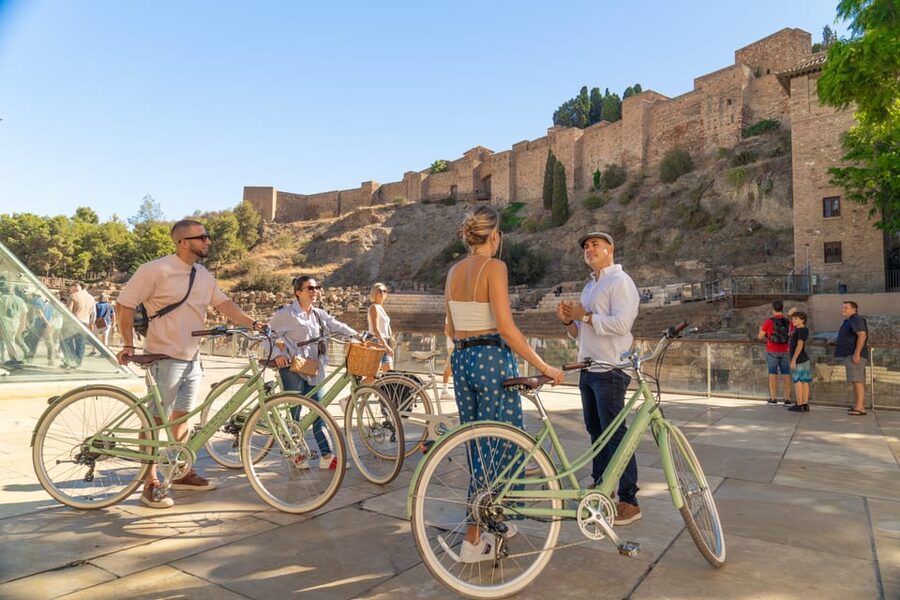
Alcazaba and the Roman Theatre
From Plaza de la Merced, the route heads toward the Alcazaba and Roman Theatre. This is one of Málaga’s strongest pairings: Roman remains at street level, with the later Islamic fortress rising above them.
You stop around the Alcazaba for about 15 minutes, with time for pictures and a short guided visit. The tour does not function as a full interior visit of the fortress, so you should not book it if your main goal is to explore every courtyard and rampart. Instead, you get context, a good exterior view, and a chance to mark the Alcazaba for a longer visit later.
That distinction is important. A bike tour works best as an introduction. You see how the major sights fit together, learn what deserves more time, and avoid spending the whole morning inside one monument. If the Alcazaba interests you, return on another day with a dedicated admission ticket and several hours to spare.
The Roman Theatre adds another layer to the stop. The guide can connect Málaga’s Roman past with the fortress above it, making the city’s long timeline easier to understand. You get history, but in short sections tied to the street in front of you. That keeps the tour moving and avoids the heavy lecture style some sightseeing groups fall into.
La Malagueta bullring and the beach
The route then shifts from monuments to the modern coastal side of Málaga. At La Malagueta bullring, you stop for photographs and an explanation of the building and its place in local culture.
This is a good example of the tour’s broad approach. You are not only ticking off famous sights. You are seeing the city’s different identities, from Roman and Moorish remains to bullfighting tradition, beach life, restaurants, and port redevelopment.
A short ride brings you to Playa de La Malagueta. The beach stop offers a change of pace and a chance to take in the Mediterranean air. One rider felt there was more time spent at the beach than expected, so keep your expectations realistic. This is a sightseeing stop, not beach time. You will not be settling in for a swim or a long rest.
The coastal section is one of the most appealing parts of the route. It gives your morning some breathing room after the old center, and the flat promenade makes cycling pleasant. In summer, an early start is a smart choice. A 10 a.m. tour can finish around 1 p.m., before the hottest part of the afternoon becomes too strong for some riders.
Same base, a different kind of day out:
- Málaga: Alcazaba and Roman Theatre Guided Tour With Entry
★ 4.8 · 5,792 reviews - Malaga: Teatro Flamenco Malaga Live Flamenco Show
★ 4.7 · 4,254 reviews - From Málaga: Ronda+Setenil de las Bodegas with Little Train
★ 4.6 · 4,115 reviews - From Malaga: Granada Full-Day Trip with Alhambra
★ 4.6 · 3,235 reviews
The port and La Farola views
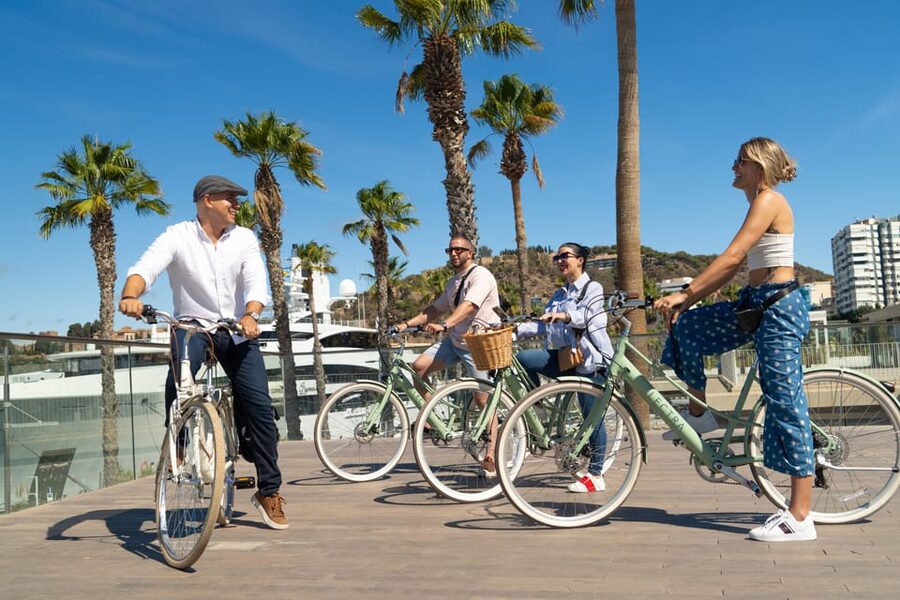
The ride continues along the Port of Málaga, with views toward the harbor and La Farola lighthouse. This is where the bicycle earns its keep. The port is close enough to the center to reach easily, but far enough away that a walking route can feel repetitive or take too long.
The harbor section is well suited to photographs. You have open views, palm-lined paths, boats, and the contrast between Málaga’s old streets and its waterfront. One rider called the marina the favorite stop, and it is easy to understand why. The water and broad views give the tour a visual lift.
The guide also points out how Málaga works as a coastal city today. You can ask about local life, Spanish customs, food, and places to return later. The guides are not limited to memorized facts. Ariel is known for answering questions about the city and Spanish culture, while Alexis is praised for offering small details that can change how you see the rest of your stay.
You should remember that the port and promenade are public spaces. At busy times, you will share the route with pedestrians and other cyclists. The guide controls the pace, but you still need to stay alert and follow instructions.
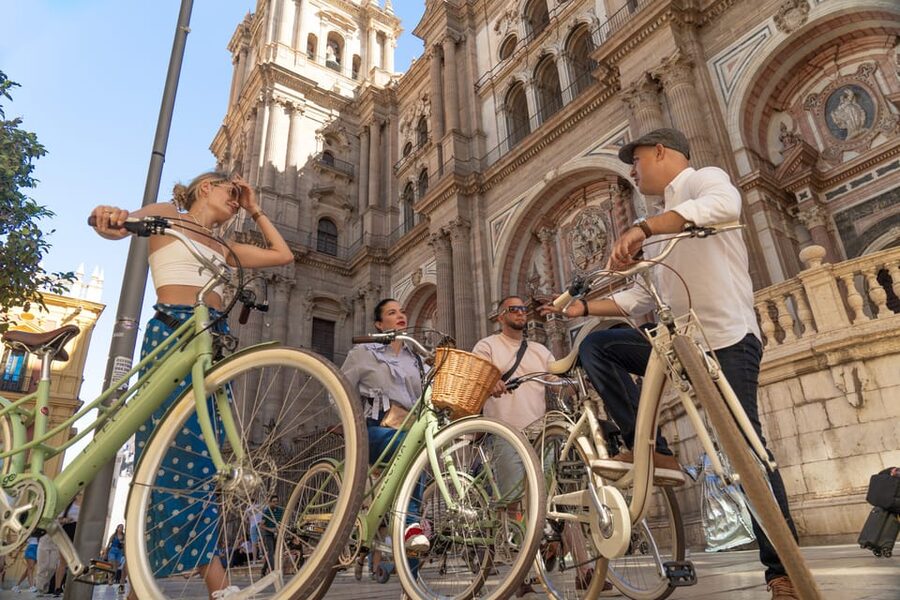
Málaga Cathedral and the walk through the center
The cathedral is visited on foot rather than by bicycle. That small change is practical. Central streets around major monuments can be too crowded for comfortable cycling, so leaving the bikes briefly lets you look around without worrying about handlebars, pedestrians, or parking.
You get roughly 15 minutes here for a photo stop and a short explanation. The cathedral is one of the city’s key landmarks, and its size makes more sense when you see it in relation to the surrounding streets. If you want to go inside, check the time available and any admission arrangements separately, since this tour does not promise a full cathedral visit.
This part also gives you a closer look at the old center. The route includes Calle Larios, Málaga’s best-known shopping street, even though the listed stop focuses on the cathedral area. Depending on the guide and group pace, you may pass through or near other central streets that are worth revisiting on foot.
The benefit is orientation. After three hours, you know how the cathedral, old center, port, market, and beach relate to each other. That is particularly helpful if you are staying only a few days.
Antigua Casa de Guardia and Atarazanas Market
Antigua Casa de Guardia provides the food and drink link. This old Málaga wine bar is included as a break and guided stop, and one rider specifically appreciated the chance to taste the city’s traditional wine and tapas culture.
Do not expect a full meal here. Think of it as a short local pause, useful for learning what to order and where to eat later. The guide can point you toward Málaga specialties and explain the role of the bar in the city’s food culture.
The final major stop is Mercado Central de Atarazanas. The market brings the tour back into the heart of Málaga, with food stalls, local produce, and the famous horseshoe-shaped entrance. You get time for pictures and a quick look around rather than a long market shopping session.
The market is a strong ending because it turns general food advice into something you can see. Afterward, you receive a digital map of recommended tapas bars and restaurants. That bonus has real value. Instead of finishing with only a monument list, you get practical help for lunch and dinner during the rest of your stay.
What the three-hour pace feels like
Each main stop is planned for about 15 minutes, with riding between locations. You should expect a moving introduction rather than long visits inside buildings. The guides stop often enough for pictures, water, questions, and short explanations.
The pace is consistently described as easy and relaxed. Yvonne, who had not ridden a bike for 10 years, found the ride manageable. That is encouraging for casual cyclists, but it does not remove the need for basic confidence on a bicycle.
Málaga is not completely without inclines. The route is mainly flat, but one rider noted that an uphill section required personal effort on a standard bike. If you are out of practice, ask about the electric option before booking or at least mention your concern when you arrive.
The bikes are suitable for city riding, not high-speed travel. You will not cover every neighborhood in Málaga, and the route gives limited time for each sight. That is the trade-off for seeing so much in one morning.
Guides, group size, and the human side of the tour
The guide can make or break a city bike tour, and this one depends heavily on the person leading your departure. Ariel is frequently singled out for his warmth, humor, enthusiasm, and ability to explain the city in clear English. Lourdes is praised for her energy, care, and strong grasp of Málaga’s past and present. Alexis is also described as friendly, accessible, and good at sharing local details.
The useful pattern is not simply that the guides know facts. They read the group. One guide checked that riders were comfortable on electric bikes and made sure no one fell behind. Another kept the tone light and answered questions about local culture.
A small group makes that possible. You have more room to ask questions, and the guide can slow down if someone needs help. It also makes the photo stops less awkward than they can be with a large convoy.
Spanish and English are available. If you are visiting alone, this is a particularly easy way to meet a few people without committing to a full-day group excursion.
Who should book, and who should think twice
I would choose this tour for a first morning or first afternoon in Málaga. It gives you a usable map of the city, points out places to revisit, and leaves enough of the day for lunch or another attraction.
It suits:
- First-time visitors who want orientation quickly
- Solo visitors looking for a friendly small-group activity
- Couples who want photos and light exercise
- Families with children aged 7 and older
- Casual cyclists who are comfortable on city bikes
- Visitors who want food suggestions as well as sightseeing
Children aged 7 and up can ride a regular bike. Child seats and combination bikes are available for children up to 22 kilograms, or 48.5 pounds. Helmets are optional for adults and required for children, and luggage storage is included during the ride.
I would hesitate if you want a deep interior visit to the Alcazaba, cathedral, or market. The tour gives you an outside view and a short introduction, not extended time at each site. I would also think twice if you dislike traditional bicycle brakes, have difficulty with even gentle inclines, or want a fast cycling workout.
Is $33 good value for Málaga?
At $33 per person, the tour is priced as a practical city introduction rather than a luxury outing. You receive three hours with a local guide, a maintained vintage bike, the option of an electric bike, helmet access, luggage storage, and a food map.
The value is strongest if you are new to Málaga. A self-guided route could visit some of the same places, but you would spend time working out the best connections and miss the local stories. The guide also helps you decide where to return, which can save time on a short stay.
The price is less compelling if you already know Málaga well or plan to spend the day inside its major monuments. In that case, a walking tour focused on one neighborhood or a museum visit might suit you better.
Free cancellation up to 24 hours before the start and a reserve-now, pay-later option make the booking fairly flexible. Starting times vary, so check the available departure when you choose your date.
Final verdict: book it early in your stay
You should book this Málaga vintage bike tour if you want a friendly, low-pressure introduction that covers far more ground than a walking tour. The best reasons are the coastal ride, the relaxed guides, and the practical restaurant map waiting at the end.
Choose an early departure in hot weather, arrive 10 minutes early for fitting, and consider an electric bike if you are unsure about traditional brakes or hills. Keep your expectations focused: this is not a full tour inside every monument. It is a well-priced way to see how Málaga fits together, hear local stories, and decide where to spend the rest of your time.
FAQ
How long does the Málaga vintage bike tour last?
The tour lasts three hours, including the bike ride, guided stops, photo breaks, and the short walking section at Málaga Cathedral.
Where does the tour meet?
You meet at Pl. de Montaño, 4, about five minutes on foot from Málaga City Center and near Plaza de la Merced.
Is the route suitable for beginner cyclists?
Yes. The route is mainly flat and follows a relaxed pace with regular stops. You should still feel comfortable riding a bicycle, since a small uphill section may require extra effort on a standard bike.
Are electric bikes available?
Yes. A stylish vintage city bike is included, and an electric option is available for riders who prefer extra assistance.
Can children join the tour?
Children aged 7 and older can join on a regular bike. Child seats and combination bikes are available for children weighing up to 22 kilograms, or 48.5 pounds. Helmets are mandatory for children.
Which languages are offered?
The tour is available in Spanish and English.
Just added in Malaga
- Tour to Gibralfaro★ 4.7 · 182 reviews
- Málaga: Picasso Birthplace Museum Ticket & City Audio Guide★ 4.1 · 158 reviews
- From Costa del Sol: Mijas, Marbella and Puerto Banús Tour★ 4.3 · 234 reviews
- Málaga: Traditional Andalusian Tapas and Wine Tour★ 4.7 · 167 reviews
- Malaga: Wine and Tapas Tour with Tastings and Drinks★ 4.8 · 217 reviews
- Malaga: Tour of Malagueta Bullring & Immersive Exhibition★ 4.7 · 271 reviews
- Malaga: Tuk tuk tour★ 4.8 · 402 reviews
- Malaga: The Ultimate Tapas Workshop with Market Visit★ 4.9 · 108 reviews
E-Bike & Bike Tours, compared.

Barcelona 3-hour Bike or E-Bike Tour: Highlights and Hidden Gems
Read our review →
Best of Madrid: 3-Hour Guided Bike Tour in Small Groups
Read our review →
Highlights Bike Tour with Optional E-Bike or Tapas
Read our review →
Browse the lists this tour appears in