Reviewed · HORSES
Jerez de la Frontera: How the Andalusian Horses Dance
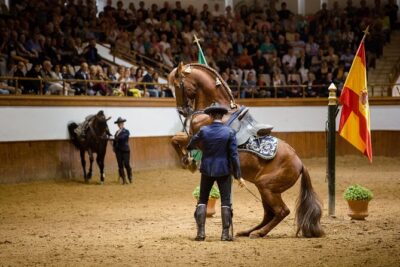
The horses do not simply trot around an arena. They pirouette, rear, leap, and move sideways with remarkable control, while riders guide them through a carefully arranged equestrian ballet. At Jerez’s Royal Andalusian School of Equestrian Art, traditional Spanish riding becomes theater without losing its sporting skill.
I like the variety most. One show can move from cattle-herding techniques and carriage work to a formal Pas de Deux, then finish with a full group carrousel. I also like the setting and presentation: Spanish music, polished 18th-century costumes, and a program built around the traditions of Andalusian horsemanship.
The main consideration is that the exact program is not fixed. The school selects 6 to 8 numbers from its repertoire, so you cannot count on seeing every named exercise. Seats are sold by price category rather than by a specific row or number, although the arena is arranged for good viewing.
Key points to know before you book
- The show lasts 90 minutes to two hours, depending on the performance and program.
- Six to eight choreographies appear in each show, selected from dressage, Doma Vaquera, carriage driving, work in hand, and the carrousel.
- The horses perform advanced movements, including pirouettes, piaffe, levades, courbettes, caprioles, and the Spanish walk.
- The presentation is proudly Spanish, with classical music, traditional riding, and costumes based on 18th-century styles.
- The $31 price is good value if you enjoy horses, dressage, or cultural performances, especially since the show can fill a substantial part of an afternoon.
- From Cádiz, the school is reachable by train and a short taxi ride, making it a practical outing if you are staying there for several days.
Entering Jerez’s Royal Equestrian School
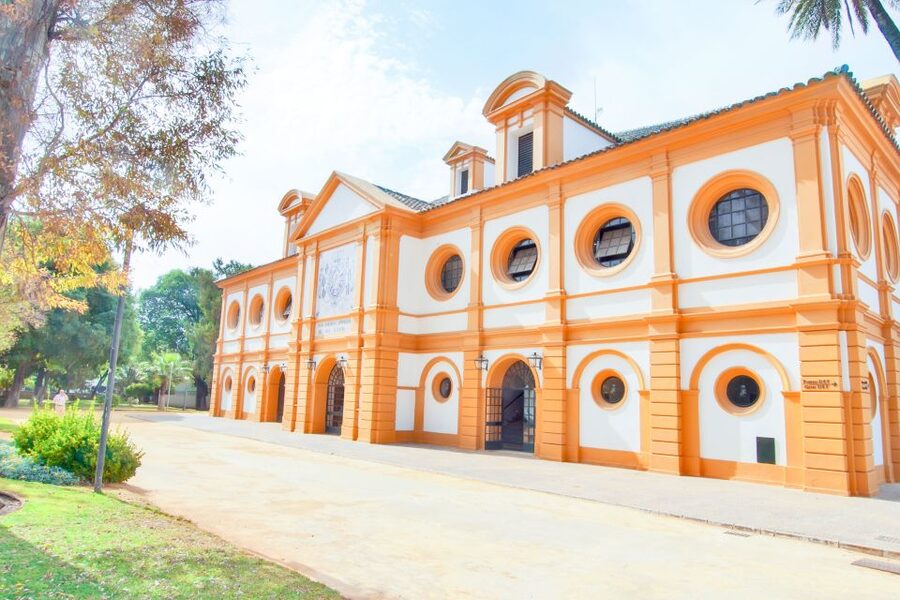
Your visit begins at the reservation box office at the Fundación Real Escuela Andaluza del Arte Ecuestre. This is not a casual street performance or a short tourist demonstration. You are entering the home of a formal Spanish equestrian institution, where riding skill, horse training, music, and ceremony are presented together.
Bring your printed voucher and your passport or identity card. The printed voucher is specifically required at the ticket office, so do not rely only on a phone confirmation. If you bought a discounted ticket, bring proof that you qualify for the discount. Without it, you may need to pay the difference to the full ticket price if seats are still available.
The ticket system is simple but a little less flexible than some modern performance venues. You purchase a category of seat, not a particular row or number. The school assigns seats according to the order of purchase or booking. That means booking earlier can matter if you care about your position in the arena.
The venue is wheelchair accessible. If you need a particular seating arrangement, it is sensible to confirm the details before you arrive.
A few more things to do in Spain worth a look
- El Salobre: Horse Riding Adventure with Transfer Options
★ 4.5 · 1,609 reviews - Jerez de la Frontera: Andalusian Horse Dance and Museums
★ 4.7 · 1,289 reviews - Andalusian Horses Dance Show
★ 4.5 · 483 reviews
Why the Andalusian horse matters here
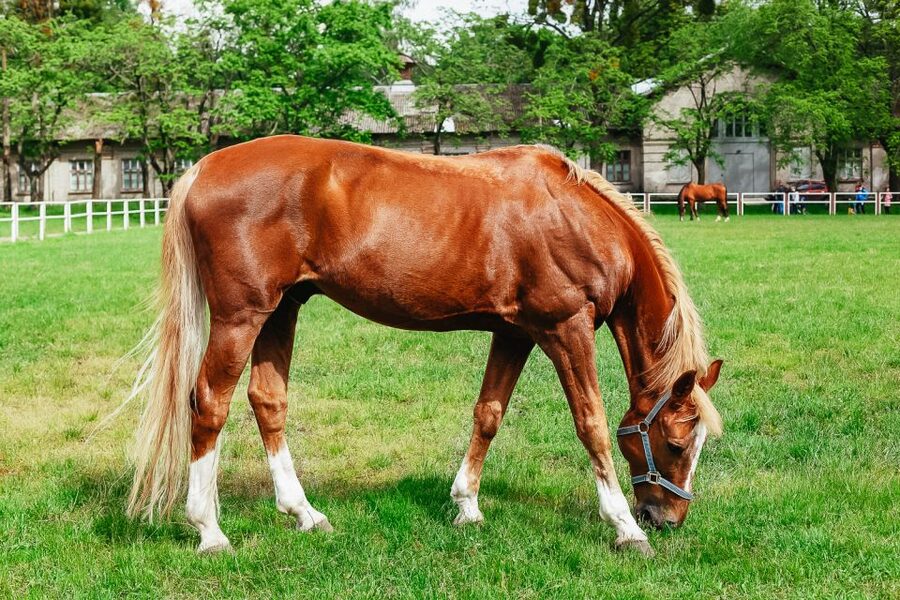
The performance focuses on the traditional Spanish horse and the riding systems developed around it. You do not need to know dressage terminology to enjoy the show, but a little context makes the movements easier to appreciate.
Classical dressage asks the horse to respond to tiny signals from the rider. The goal is not speed. It is balance, obedience, rhythm, and controlled movement. When a horse shifts from a collected trot into a piaffe, for example, the steps become higher and more contained, almost as if the animal is trotting in place.
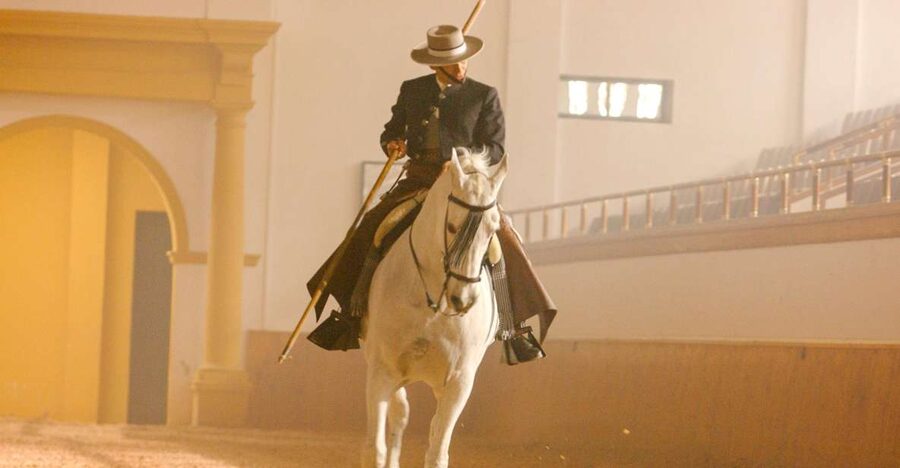
Doma Vaquera comes from working cattle in the Spanish countryside. The rider traditionally works with one hand while controlling the horse at different speeds. In the arena, you may see quick changes of rhythm, pirouettes, and arreones, in which the horse breaks sharply into a gallop.
This blend gives the show its Spanish character. It is not simply European dressage presented with Spanish decoration. The program connects formal riding with practical country work, old transport methods, and the pageantry of courtly performance.
Doma Vaquera, the fast-moving Spanish discipline
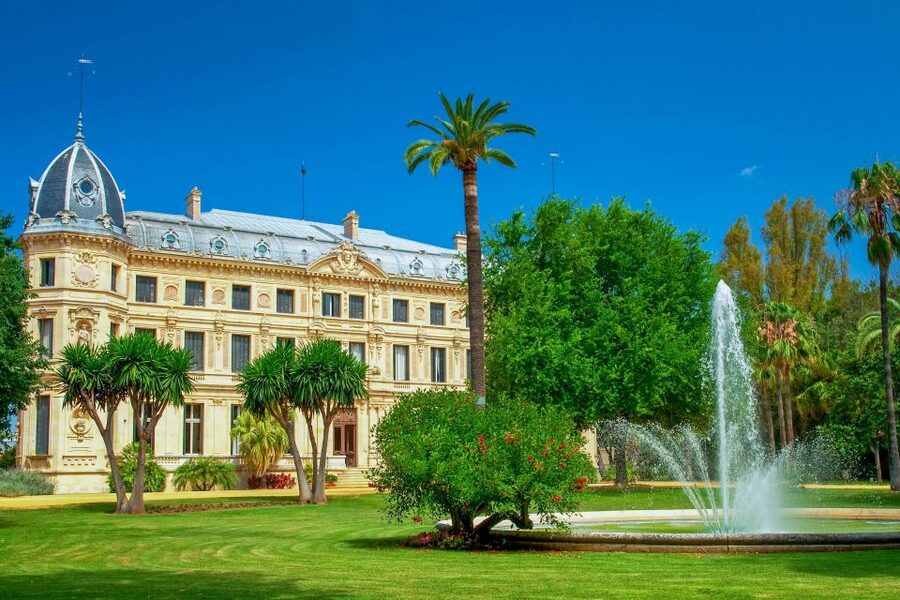
The Doma Vaquera section usually brings a change of pace. The rider guides the horse around the arena using one hand, moving from a trot into a gallop and then back into controlled figures.
The most striking moments are the sudden transitions. An arreón can look almost explosive, with the horse moving from restraint to speed in an instant. A pirouette demands the opposite quality: concentration and balance as the horse turns in a tight circle.
I find this part especially useful for understanding how Spanish riding developed outside the formal school. You are seeing a discipline tied to cattle work, not just a decorative performance invented for tourists. The show turns that working tradition into a precise public display.
If your main interest is quiet, classical dressage, this may be the liveliest part of the performance. If you enjoy speed and sharp changes, it gives the program needed energy.
Classical dressage with music and precision
The classical dressage numbers are the heart of the equestrian ballet. The school may include pieces such as The Colts, Airs on Horseback, Pas de Deux, Passage and Piaffer, Domino on Horseback, Airs Above the Ground, and Fantasy.
You may not see every one of these during your visit. The school chooses the day’s 6 to 8 choreographies, and management can change the program. Still, these titles give you a good idea of the range.
The Pas de Deux places two horses and riders together in a carefully matched routine. The appeal comes from timing. Each horse must perform its own movements while staying in step with the other.
Passage and piaffe show the horse’s ability to collect its movement. The passage is a highly controlled, elevated trot. The piaffe is even more contained, with the horse appearing to trot almost in place. From the audience, the movement can look effortless. It is not.
Airs Above the Ground are among the most dramatic exercises. Depending on the selected number, you may see a horse lift its front end or perform a powerful leap. These movements require strength, training, and absolute trust between horse and rider.
The music matters here. It gives the performance a formal rhythm and helps turn technical exercises into a staged ballet. You can enjoy the visual pattern even if you have never watched a dressage competition.
Same base, a different kind of day out:
- Barcelona: Sagrada Familia Entry Ticket with Audio Guide
★ 4.6 · 105,312 reviews - Barcelona: Park Güell Admission Ticket
★ 4.4 · 76,534 reviews - Seville: Royal Alcázar Entry Ticket
★ 4.6 · 28,378 reviews - Barcelona: Casa Batlló Entry with Self-Audioguide Tour
★ 4.7 · 25,359 reviews
Carriage driving brings old transport back to life
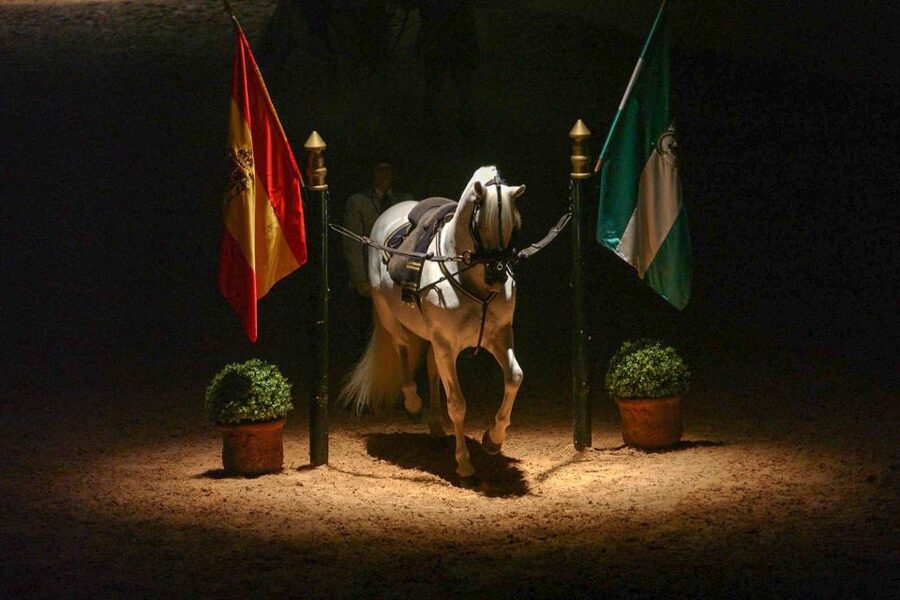
The carriage-driving section changes the shape of the show. Instead of watching a single horse and rider, you see horses working together to pull a traditional carriage while a coachman handles the reins.
These carriages were once used for transport. Here they appear as part of a sporting and exhibition tradition. The coachman’s skill is easy to underestimate because the movement can look smooth. Several horses, harnesses, wheels, and a heavy vehicle must work together in a confined arena.
This section also gives you a different view of the horse’s training. The animals must respond to the coachman while pulling weight, maintaining formation, and moving with the right rhythm. It is less intimate than watching a rider on horseback, but it adds useful variety to the program.
If you are taking children, carriage driving may help hold their attention between the slower dressage exercises. If you are interested in traditional transport, it is one of the more distinctive parts of the show.
Work in hand and the Spanish walk
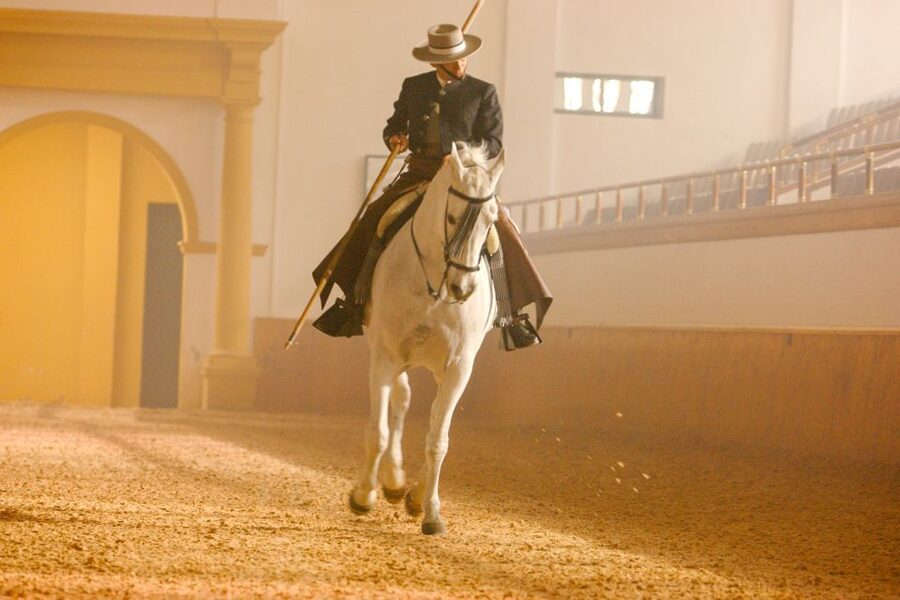
Work in hand shows what happens when the horse obeys the rider even though the rider is not in the saddle. The horse may perform advanced Haute École exercises, including levades, caprioles, courbettes, piaffe between pillars, and the Spanish walk.
The Spanish walk is the easiest movement for a first-time viewer to recognize. The horse lifts its front legs high in a controlled, deliberate rhythm. It looks theatrical, but the exercise still depends on precise training and balance.
The pillars used in some exercises help guide the horse’s position. They also make the horse’s obedience clear from a distance. There is no rider sitting above the animal to disguise or soften the commands. You watch the horse respond directly to signals from the ground.
This part can be quieter than Doma Vaquera or the airborne exercises. Give it your attention. It reveals the close communication at the center of the school’s work.
The final carrousel
The carrousel usually provides the show’s grand finish. Several horses and riders perform advanced movements together, creating lines, circles, and patterns across the arena.
A group routine is harder to coordinate than a solo number. Each horse must maintain its place while responding to its own rider. The visual pleasure comes from seeing individual skill become a shared pattern.
The final image is formal and ceremonial, with the horses, riders, music, and costumes working as one presentation. It is a fitting end to a program that moves between practical Spanish riding, formal dressage, and spectacle.
Costumes, music, and the feel of the performance
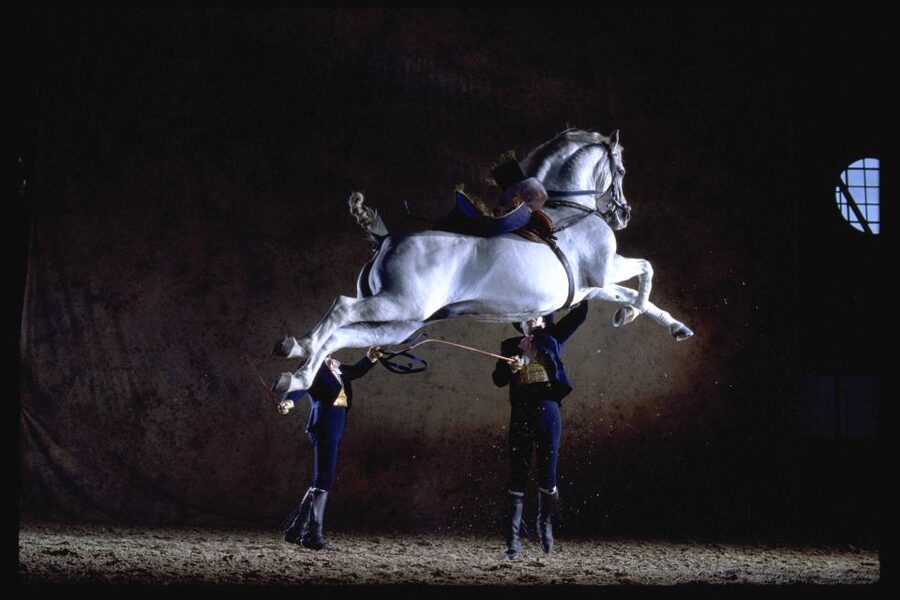
The show uses costumes inspired by the 18th century. Riders appear in traditional Spanish dress rather than modern competition clothing, which gives the performance a strong sense of occasion.
The costumes are not just decoration. They help connect the exercises to older Spanish riding traditions and make the difference between this presentation and a standard indoor horse show clear. The music does the same work. Classical pieces and quintessentially Spanish sounds provide the rhythm for the choreographies.
You should expect a polished performance rather than a rough demonstration. The school presents the horses and riders with ceremony, but the technical work remains the main attraction.
Some people will love the theatrical style. Others may prefer a competition, training session, or a more informal look at working horses. If you want something relaxed and spontaneous, this may feel too carefully arranged. If you enjoy pageantry with real riding skill behind it, the format works very well.
Timing, access, and planning your visit
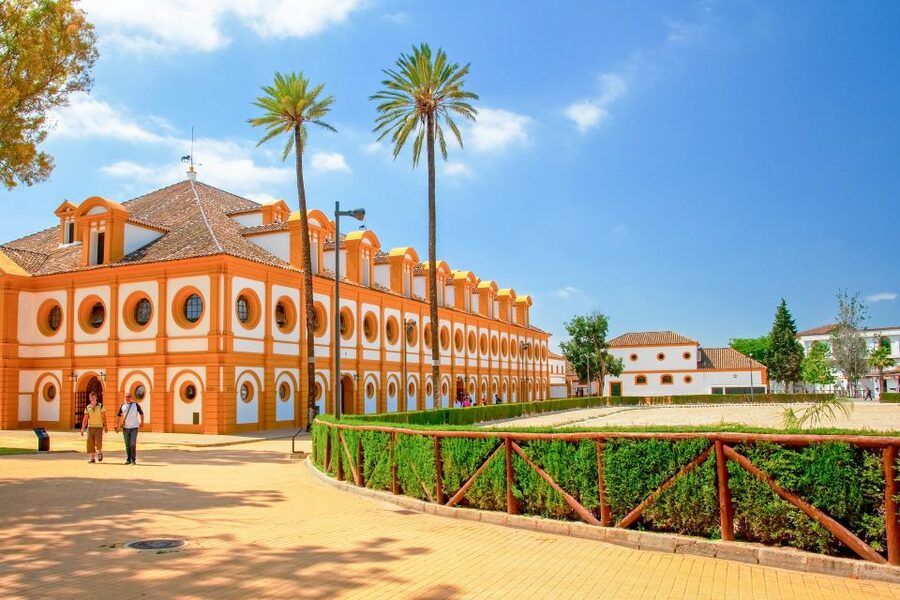
The performance lasts between 90 minutes and two hours. Check the available start time when booking because the school schedules performances rather than offering a constant flow of shows.
A practical advantage is that you can combine the event with time in Jerez. From Cádiz, the train makes the trip manageable, followed by a short taxi ride to the school. Allow enough time for the transfer, ticket collection, and finding your seat. The experience itself is not long, but rushing from the station could make the outing less pleasant.
The entrance is at the reservation box office at the Royal Andalusian School of Equestrian Art Foundation. Keep your printed voucher ready. The school also reserves the right to change the program, so arrive expecting the listed repertoire to be a guide, not a promise.
Photography is restricted. Flash photography is not allowed, and audio recording is prohibited. You also cannot bring pets, glass objects, bottles, cans, weapons, or sharp objects into the grounds. Pack lightly and follow the venue’s rules.
Is $31 a fair price?
At $31 per person, this is a reasonable cultural performance, particularly if you already plan to visit Jerez or are staying in Cádiz. You receive entrance to a substantial show, not a brief photo opportunity. The combination of dressage, Doma Vaquera, carriage driving, work in hand, music, and costumes gives the ticket several different experiences in one sitting.
The value is strongest for horse lovers and anyone curious about Spanish riding. You will see movements that are difficult to encounter in an ordinary city sightseeing program. The price also compares well with other formal performances, especially when the show lasts close to two hours.
The value is less clear if you have little interest in horses. The presentation is polished, but every section remains centered on equestrian technique. If your priority is flamenco, wine, food, or architecture, Jerez offers those experiences too, and you may prefer to spend your limited time elsewhere.
Discounted tickets may be available, but bring the required proof. If you cannot show eligibility, you may have to pay the difference at the ticket office.
Who will enjoy this most?
I would recommend this for:
- Horse lovers and dressage fans
- Families who want a structured cultural show
- Visitors staying in Jerez or Cádiz
- Anyone interested in Spanish rural and courtly traditions
- People who enjoy music, costumes, and formal performance
- First-time viewers who want to see several riding styles in one place
It is also a good choice if you have seen the show before but want to return. One visitor attended ten years apart and found the experience just as strong on the second visit. Since the school can change the program, returning does not guarantee exactly the same sequence.
You may want to skip it if you dislike staged performances, have no interest in horses, or want a short activity with complete control over timing. The 90-minute to two-hour length is manageable, but the fixed schedule requires you to plan around it.
Small practical details that matter
Bring identification and your printed voucher. Arrive with enough time to collect tickets, since discounted bookings require proof of eligibility.
Do not bring a pet, bottle, can, glass item, recording device, or sharp object. Flash photography is forbidden, and the management can refuse other items it considers unsuitable.
Seats are assigned within the category you purchase. You cannot choose a specific row or seat number, so book earlier if seating position matters to you.
If you are visiting during a special gala, check the date and ticket option carefully. The school sometimes presents larger events involving European equestrian schools and additional seating in an outdoor arena. Those performances are separate from the regular show and may follow different arrangements.
Should you book How the Andalusian Horses Dance?
Book it if you want a polished, distinctly Spanish performance that goes beyond a basic horse show. The strongest reasons are the variety of riding styles, the high level of horse-and-rider control, and the setting within Jerez’s Royal Andalusian School of Equestrian Art.
I would especially choose it during a Cádiz stay, when the train and taxi connection make the outing practical. At $31, it offers solid value for a 90-minute to two-hour cultural experience.
Just keep two things in mind: the program can change, and you cannot select an exact seat. If those limits are acceptable, this is one of the most memorable ways to spend an afternoon in Andalusia.
FAQ
How long does the Andalusian horse show last?
The performance lasts between 90 minutes and two hours. The exact duration may depend on the scheduled program.
Where do I collect my tickets?
Go to the reservation box office at the Royal Andalusian School of Equestrian Art Foundation.
Do I need to bring identification?
Yes. Bring your passport or identity card, along with your printed voucher.
Can I choose my exact seat?
No. Tickets are sold by seating category, without a choice of row or seat number. Seats are assigned according to the order of purchase or booking.
Is the experience wheelchair accessible?
Yes, the activity is wheelchair accessible.
Can I cancel my booking?
You can cancel up to 24 hours in advance for a full refund. The reserve-now, pay-later option also allows you to hold a place without paying immediately.
Just added in Spain
- Bizkaia Bridge, Gaztelugatxe, Bermeo and Gernika from Bilbao★ 4.5 · 299 reviews
- Benalmadena: City Sightseeing Hop-On Hop-Off Bus Tour★ 3.5 · 379 reviews
- Welcome to Barcelona: Private Tour with a Local★ 4.6 · 200 reviews
- Barcelona: White Rabbit Catalonia’s Top Immersive Experience★ 4.7 · 359 reviews
- Bean to Bar Chocolate Workshop in Barcelona★ 5.0 · 172 reviews
- Barcelona: Walking tour with Montjuic Castle & Cable Car★ 4.7 · 832 reviews
- Barcelona: Welcome to Barcelona Segway Tour★ 4.9 · 153 reviews
- Barcelona: Helicopter Flight with Optional Yacht Cruise★ 4.7 · 224 reviews
Horses, compared.
El Salobre: Horse Riding Adventure with Transfer Options
Read our review →
Jerez de la Frontera: Andalusian Horse Dance and Museums
Read our review →