
Reviewed · SPAIN
Guided tour of Baeza with entrance Baeza Cathedral
Baeza’s great pleasure is that its Renaissance center is compact enough to explore on foot, yet packed with grand squares, old university buildings, churches, fountains, and stone façades. This tour brings the main sights into one clear route, with entry to Baeza Cathedral and an olive-oil tasting at the end.
I like the way the tour links big monuments with small human details, from Antonio Machado’s preserved classroom to local anecdotes shared by guides such as Isabel, Adrian, Marta, Marisa, and Cesar. I also like the value: $18.14 includes the cathedral ticket, worth €7, plus roughly two hours and fifteen minutes of guided touring.
The one thing to consider is the pace. You cover a lot of ground and make several short stops, so this is best for seeing Baeza’s main sights in one sweep, not for lingering inside every building.
Key points at a glance
- A compact UNESCO-listed old town: The route covers Baeza’s major squares, churches, university buildings, palaces, and civic landmarks.
- Cathedral entry included: You go inside Baeza Cathedral and see the Corpus Christi Processional Custody.
- Antonio Machado connection: The tour visits the classroom where the poet taught from 1912 to 1917.
- Big views over olive country: Paseo de Antonio Machado looks across the Guadalquivir valley toward the Sierra de Cazorla and Sierra Mágina.
- A practical price: At $18.14, the cathedral admission alone accounts for a useful part of the cost.
- Olive oil to finish: A specialist explains and serves early-harvest extra virgin olive oil.
Why Baeza works so well on foot
Baeza is one of those Andalusian towns where the best sights are close together, but their stories are easier to understand with a guide. The town grew into an important center, then reached a high point during the Renaissance. Its old center still carries that period in stone: formal squares, elaborate façades, religious buildings, old government offices, and university rooms.
The tour begins at Plaza Pópulo, also called Plaza de los Leones. From there, you move through the historic center rather than spending time on transport between distant sights. That makes the 2-hour-15-minute format efficient, especially if you have only part of a day in Baeza.
I like the fact that the guide does not treat Baeza as a parade of façades. The stated focus includes anecdotes, curiosities, and local traditions. Adrian, in particular, is described as using historical and family stories to make the past easier to picture. Cesar is also noted for an energetic style, with anecdotes that can send you back to certain spots later in the day for a closer look and more photographs.
The group can include up to 25 people. That is not a private walk, but it is still small enough to keep the route manageable. If the full group is present, expect a normal public walking-tour feel, with some need to stay near the guide in busy areas or while entering buildings.
A few more things to do in Spain worth a look
- Barcelona: Sagrada Familia Entry Ticket with Audio Guide
★ 4.6 · 105,312 reviews - Barcelona: Park Guell Guided Tour with Skip The Line Entry
★ 4.7 · 17,563 reviews - Málaga: Caminito del Rey Guided Tour with Transportation
★ 4.8 · 12,183 reviews
Plaza del Pópulo and the old city gateway
Your first substantial stop is Plaza del Pópulo, one of Baeza’s principal squares. It gathers several reminders of the city’s civic and commercial past: the Old Butchers, the Public Notaries, the Fountain of the Lions, the Arco de Villalar, and Jaén’s Gate.
The value here is the concentration. Instead of seeing one isolated monument, you get a quick lesson in how a historic Spanish town organized trade, administration, ceremony, and entry through its walls. The twenty-minute stop should give you enough time to look around and hear the guide’s explanation, though not enough for a slow architectural study of each building.
This is also a useful starting point because it gives you an immediate sense of Baeza’s scale. The square is not just a photo stop. It sets up the rest of the walk, showing how the town’s public buildings fit together.
Santa María Square and the cathedral
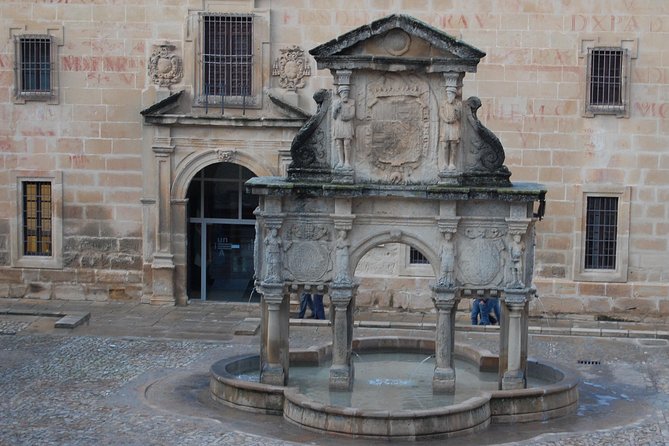
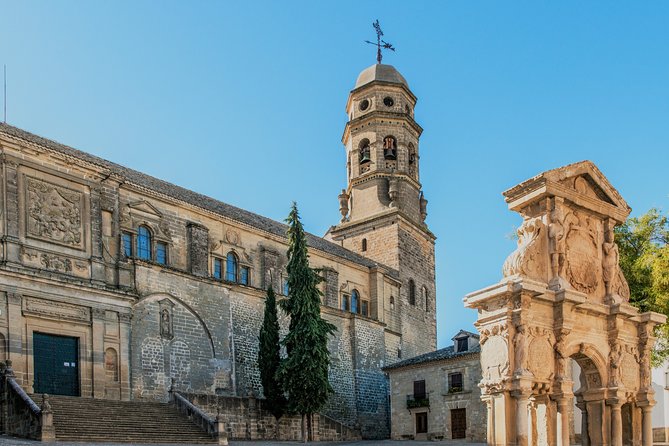
Plaza de Santa María is presented as Baeza’s most important square, and it brings together several major symbols of local power. The Santa María Fountain gives the space its name, while the old town halls represent civic authority. The cathedral represents the church, and the Seminary of San Felipe Neri adds another layer of religious and educational history.
This is the point where Baeza’s architecture begins to feel grander. You can look from one important building to another without leaving the square, which makes the guide’s explanation especially useful. The square is also a good place to notice how the city’s religious and civic institutions once operated side by side.
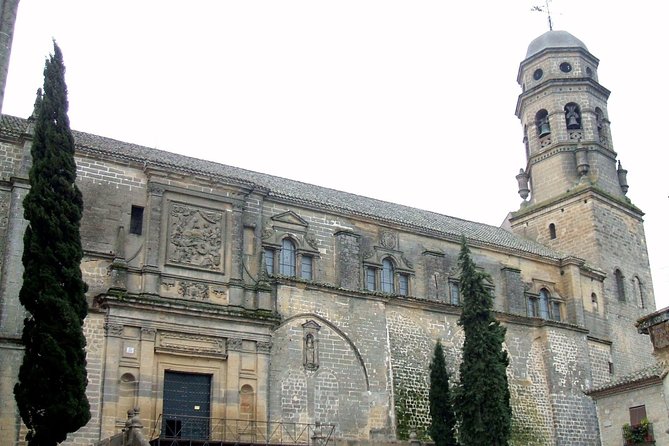
The cathedral visit is included rather than treated as an outside viewing only. Inside, the main object highlighted on the tour is the Corpus Christi Processional Custody, described as one of Spain’s great examples of goldsmithing. That gives the interior a specific focus. You are not simply walking through a church and trying to decide what matters. The guide points you toward an important piece of religious art and explains why the building matters to Baeza.
The cathedral visit lasts about thirty minutes. For many people, this will be the most substantial indoor section of the walk. If you prefer quiet, unhurried visits to churches, keep your expectations measured. The tour has a fixed route and several more stops ahead.
A view across Jaén’s sea of olive trees
At Paseo de Antonio Machado, the tour shifts from buildings to views. From here, you can look across the Guadalquivir River valley and toward the mountains of the province, including the Sierra de Cazorla and Sierra Mágina.
The olive groves are the main visual theme. Jaén is famous for its enormous olive-growing region, and the view helps explain why olive oil is so central to local life. The phrase sea of olive trees is not hard to understand when the groves stretch across the countryside below.
This is a short ten-minute stop, so it is worth having your camera ready before the explanation begins. The viewpoint also gives the tour some breathing room after the denser sequence of squares and monuments. You see Baeza not only as a historic town, but as part of the agricultural province around it.
Same base, a different kind of day out:
- Barcelona: Park Güell Admission Ticket
★ 4.4 · 76,534 reviews - Seville: Royal Alcázar Entry Ticket
★ 4.6 · 28,378 reviews - Barcelona: Casa Batlló Entry with Self-Audioguide Tour
★ 4.7 · 25,359 reviews - Seville: Cathedral and La Giralda Entry Ticket
★ 4.5 · 24,592 reviews
Jabalquinto Palace and Santa Cruz Church
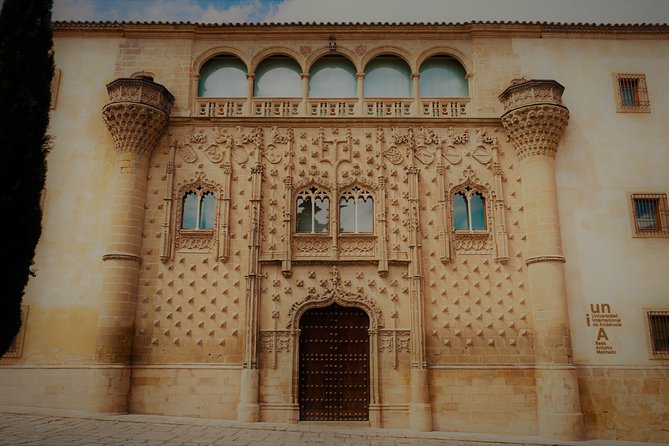
Palacio de Jabalquinto is one of Baeza’s finest civil buildings. It now houses the International University of Andalusia, which gives the palace a continuing academic role rather than leaving it as a purely historic shell.
The tour allows about ten minutes here. That is enough to hear why the building matters and view its exterior, but you should not expect a long palace visit based on the information provided. Its inclusion helps show that Baeza’s Renaissance importance was not limited to churches. Wealthy and powerful civic figures also shaped the town’s appearance.
Next comes the Church of Santa Cruz, identified as the only late Romanesque building in Andalusia. It dates from the thirteenth century, giving you a contrast with the later Renaissance architecture that dominates much of Baeza.
That contrast is one of the strongest reasons to take a guided route. On your own, it would be easy to group all the old stone buildings together. Here, you can begin to separate periods and styles: late Romanesque at Santa Cruz, Renaissance civic buildings elsewhere, and later changes layered onto the town.
The old university and Antonio Machado’s classroom
The Antigua Universidad de Baeza is the original sixteenth-century building that housed the University of Baeza. The stop lasts about fifteen minutes, enough to place the institution within the town’s cultural story.
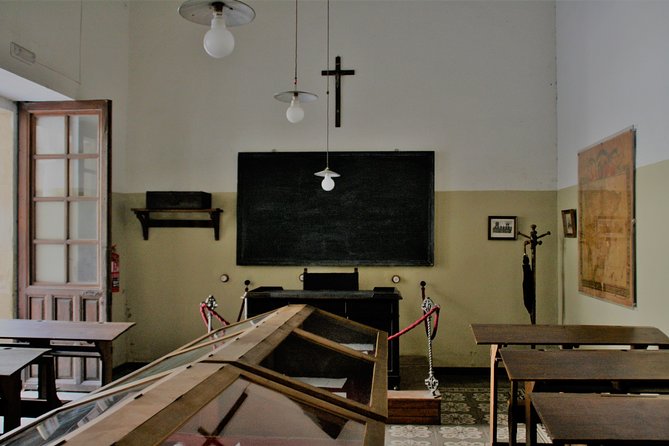
The most personal moment comes at the Aula de Antonio Machado. The room where the poet taught between 1912 and 1917 is preserved in its original form. That makes the visit more than a general literary reference. You see the actual classroom connected with a known period of Machado’s life and work.
For anyone interested in Spanish literature, this may be the most memorable part of the tour. For everyone else, it provides a welcome change of scale. After large squares and formal civic buildings, a preserved classroom gives the town a human face.
The guide’s storytelling matters here. Adrian’s approach, with anecdotes tied to local families and events, can make places like this easier to remember. Cesar is also noted for keeping the explanations lively and encouraging curiosity beyond the formal route. Guide assignments can vary, so you should not assume you will have one particular person, but the named guides associated with this experience include Isabel, Adrian, Marta, Marisa, and Cesar.
Baeza’s central square and town hall
Plaza de la Constitución is Baeza’s central square and a practical part of modern town life. It retains older buildings while also serving as a place for pubs, restaurants, and shops.
This stop helps connect the historic center with the town you see today. Not every part of a preserved old town feels like a museum, and this square is a reminder that Baeza remains a living community. The fifteen-minute visit gives you a useful orientation if you plan to return later for food or a relaxed walk.
Baeza Town Hall follows, with about ten minutes allotted. The building is considered one of the notable examples of Spain’s early Renaissance. Together, the square and town hall give the tour a strong civic finish before the food element begins.
If architecture is your main interest, pay close attention to the guide’s explanation here. If you are ready for a break after walking, the central location makes this a convenient point to note places you may want to revisit after the tour.
Finishing with early-harvest EVOO
The last stop is an olive-oil boutique, where a specialist leads a tasting of extra virgin olive oils. The tasting is included, and the focus is on early-harvest EVOO, a product closely tied to the surrounding province.
This ending works because it connects the panoramic olive-grove view with something you can taste. You have just seen the agricultural setting, and now you get an explanation of the oil itself from someone focused on the product.
The tasting lasts about fifteen minutes. It is not a meal, and lunch is not included, so plan to eat separately. Still, the tasting adds real local context and gives the tour a more distinctive finish than simply returning to the starting square.
At $18.14, the food element is a useful bonus rather than the main reason to book. The core value comes from the guided walk, monument access, cathedral entry, and the time saved working out how the old center fits together.
Timing, walking, and practical value
The advertised duration is approximately 2 hours and 15 minutes, with several short stops. The route includes around thirty minutes in the cathedral, twenty minutes in Plaza del Pópulo, twenty minutes in Plaza de Santa María, and shorter visits to the remaining sites.
Because most of the experience takes place outdoors, comfortable shoes and weather-appropriate clothing make sense. The tour begins and ends at Plaza Pópulo, Pl. de los Leones, 1, in Baeza. It does not include lunch, and the activity ends back at the meeting point.
The mobile ticket is convenient, and confirmation is provided when you book. Service animals are allowed, public transportation is nearby, and most people can participate. The group limit is 25, which keeps the experience from becoming a very large procession.
The booking pattern suggests that people often reserve about sixteen days ahead. You do not need to treat that as a strict rule, but advance booking is sensible if your schedule in Baeza is fixed.
Free cancellation is available up to 24 hours before the start time for a full refund. Changes or cancellations inside that window are not accepted for a refund. The activity also requires a minimum number of participants, and if it is canceled for that reason, you are offered another date or experience, or a full refund.
Who should book this Baeza walk
I would choose this tour if you want a strong first look at Baeza without spending hours planning a route. It suits people who enjoy architecture, Spanish history, religious art, literature, and food traditions in one compact outing.
It is also a good fit if you want context rather than just photographs. The classroom of Antonio Machado, the late Romanesque Santa Cruz Church, and the cathedral’s processional custody each give the town a different angle.
You may want something else if you prefer to explore at a very slow pace, stop for long photographs, or study each interior on your own. The route covers many places in a limited time, and the short stop lengths mean the guide has to keep things moving.
The English option is especially useful for visitors who want the stories explained clearly. The named guides are praised for being easy to understand, enthusiastic, humorous, and good at bringing local stories into the walk. That personal delivery is a major part of the experience, though the exact guide is not guaranteed.
Should you book it?
Yes, if you want an efficient introduction to Baeza with cathedral admission, major monuments, a literary connection, wide valley views, and olive-oil tasting in one outing. The $18.14 price is fair, especially with the €7 cathedral ticket included.
I would book it early if Baeza is an important stop on your trip, then return later to the places that catch your eye. The tour gives you the framework. Your second walk can provide the slower look.
FAQ
How long does the guided tour of Baeza last?
The tour lasts approximately 2 hours and 15 minutes.
Where does the tour begin?
It begins at Plaza Pópulo, Pl. de los Leones, 1, 23440 Baeza, Jaén, Spain.
Where does the tour end?
The activity ends back at the meeting point in Plaza Pópulo.
Is entry to Baeza Cathedral included?
Yes. Cathedral admission is included and is valued at €7.
Is lunch included?
No. Lunch is not included in the tour price.
Is the olive-oil tasting included?
Yes. The tour ends with a specialist-led tasting of early-harvest extra virgin olive oil, and admission to the tasting is included.
What is the maximum group size?
The tour has a maximum of 25 participants.
Just added in Spain
- Full Day Rainforest Tour with Tasting and Swimming Time ツ★ 5.0 · 607 reviews
- The Red Canyon Tour – Small Group Trip with Local Food Tasting ツ★ 5.0 · 798 reviews
- Full Day Ticket at Perchel Beach Club with Lunch★ 5.0 · 316 reviews
- 3 Wheel Motorcycle like Quad/Buggy Tour Gran Canaria (Maspalomas)★ 5.0 · 237 reviews
- Arucas, Teror, Viewpoint Roque Nublo – Highlights Gran Canaria★ 4.5 · 170 reviews
- Gran Canaria Highlights Private Tour VIP★ 5.0 · 106 reviews
- Full day Hiking Gran Canaria Peaks of Gran Canaria★ 5.0 · 130 reviews
- Coastering in Gran Canaria (Aquatic Route in the ocean cliffs)★ 5.0 · 135 reviews