
Reviewed · HISTORICAL TOURS
Granada: Historic Center and Lower Albaicin Walking Tour
Granada’s story comes into focus as you walk from the monument to Isabel la Católica and Cristóbal Colón into the old center, then climb toward the lower Albaicin. In 2.5 hours, you see Islamic-era traces, Christian monuments, grand squares, and a fine view of the Alhambra without paying for an attraction ticket.
I like the strong sense of place and the way the route links Granada’s Moorish past with the Reconquista of 1492. I also like the small-tour feel reported by many visitors, with guides such as Pablo, Jaime, Irene, and Anna answering questions and offering ideas for the rest of your stay. The main drawback is the uphill walk into the Albaicin, which can be hard if you have knee, heart, or other mobility problems.
Key points to know before booking
- A useful first-day orientation: The route covers a lot of central Granada in a short time, helping you get your bearings before exploring alone.
- A clear look at two eras: You connect Granada’s Islamic heritage with the Christian buildings that followed the 1492 conquest.
- Several important sights from the outside: The route includes the Alcaiceria, Madraza, Cathedral, Corral del Carbón, Royal Chancillería, and other central landmarks.
- The lower Albaicin has the best walking character: Narrow streets and Moorish details lead to a strong Alhambra viewpoint.
- Guides shape the experience: Pablo, Jaime, Irene, Rocio, Emilio, and others have been praised for history, humor, patience, and practical advice.
- Good value at $16: You get a 2.5-hour guided walk, but this is not an Alhambra interior visit and does not replace a dedicated monument tour.
Why this $16 Granada walk is useful
Granada can feel confusing at first. Its old center has layers of Roman, Islamic, Jewish, and Christian history, while the Albaicin rises in a maze of lanes toward the hill opposite the Alhambra. A map can show you the streets, but it does not explain why a former silk market sits near a Renaissance cathedral, or how a Muslim city became the final stronghold of Islamic rule in Iberia.
That is where this tour earns its modest price. For $16, you spend two and a half hours with a guide who gives the city a readable shape. I would use it early in a Granada visit, especially if you want to know which buildings deserve a second look and which neighborhoods are easiest to explore on your own.
The route is not built around long interior visits. Instead, it is a walking introduction to the center and lower Albaicin, with historical explanation at the major stops. That makes it a good match for someone who wants context, photographs, and local orientation without committing half a day to a museum.
The experience has a 4.7 rating from 136 bookings, and the most consistent praise goes to the guides. Pablo is described as friendly, entertaining, and generous with suggestions for places to visit later. Jaime is praised for patient explanations and a clear love of Granada. Irene is repeatedly noted for involving the group and answering questions in detail. Those personal touches matter on a walking tour. A dull guide can turn a handsome square into a roll call of dates. A good one helps you notice how the city works.
A few more things to do in Granada worth a look
- Madrid Essential: Historic Center, Plaza Mayor & Royal Palace
★ 5.0 · 6,416 reviews - Barcelona: Tapas Walking Tour with Food, Wine, and History
★ 4.8 · 4,261 reviews - Sevilla Food Tour: Tapas, Wine, History & Traditions
★ 5.0 · 3,468 reviews
Meeting Isabel and Columbus in the city center
The meeting point is in front of the monument to Isabel la Católica and Cristóbal Colón. This is a practical starting place in the heart of Granada, near the city’s major central sights.
Your guide uses the monument as a doorway into the city’s final medieval chapter. Ferdinand and Isabella’s connection with Christopher Columbus points to the year 1492, the year Granada surrendered and the Christian Reconquista reached its conclusion. The tour treats that event as more than a date. It explains why Granada’s streets, buildings, and public spaces carry both Islamic and Christian marks.
This opening also gives you a useful framework for the rest of the walk. You are not simply moving from one photo stop to another. You are watching a city change hands, with old structures reused, new religious buildings added, and earlier traditions remaining visible in the street plan.
The old center, from Corral del Carbón to the Alcaiceria
The first part of the walk takes you through Granada’s historic center. The Corral del Carbón is one of the most memorable stops because it points to the commercial life of Islamic Granada. Its name is connected with a former inn and trading space, and the building helps you picture merchants, goods, and travelers moving through the city.
From there, the route reaches the Alcaiceria. Today, the area is known for its small shops and narrow lanes, but its importance comes from its earlier role as a silk market. This is one of the places where the tour’s focus on Islamic heritage becomes especially clear. You can see how the compact streets differ from the broad open spaces created around later Christian institutions.
I like this section because the guide can connect architecture with daily life. Instead of treating the Alcaiceria as a shopping stop, the walk places it within Granada’s trading history. You may also hear practical suggestions for places to visit later, something several guides are praised for doing well.
Do not expect a full shopping excursion here. The point is the setting and its history, not a long pause in every shop. If you want time to browse, return after the tour.
Plaza Bib Rambla and the city’s public life
Plaza Bib Rambla gives the route a change of pace. This large central square has long been tied to public activity, and the Giants Fountain provides a clear visual landmark. It is an easy place to pause, listen, and look around while the guide explains how Granada’s central spaces have changed over time.
The square also helps you understand the contrast between the older, more enclosed lanes and the open civic spaces of the Christian center. A guide may point out how public life, religious power, trade, and ceremony came together here.
The stop is especially useful for first-time visitors because it puts you close to several other major sights. After the tour, you can return to Plaza Bib Rambla for a slower look or use it as a reference point while walking around on your own.
Same base, a different kind of day out:
- Granada: Alhambra & Nasrid Palaces Tour with Tickets
★ 4.7 · 19,801 reviews - Granada: Alhambra and Nasrid Palaces Entry Ticket
★ 4.6 · 15,130 reviews - Granada: Alhambra & Generalife Fast-Track Guided Tour
★ 4.7 · 8,313 reviews - Granada: Alhambra & Gardens Tour w/Nasrid Palaces Option
★ 4.5 · 6,437 reviews
The Madraza, Cathedral, and Christian Granada
The Madraza is one of the most important reminders that Granada was once a major Islamic center. Its name refers to a school, and the building represents the intellectual and religious life of the city before the Christian conquest.
The nearby Cathedral makes the political and religious shift plain. Its scale and style belong to a later Christian Granada, and its position in the center shows how new institutions reshaped the old city. The tour also includes the Church of Saint Ana, the Royal High Court, and the Royal Chancillería, giving you more than one example of how power was organized after 1492.
These stops can blur together if you only collect names. The guide’s role is to separate them: one building tied to education, another to worship, others to courts and government. Guides such as Irene and Jaime have been praised for explaining architecture as well as history, which is helpful when several grand façades appear within a short walk.
The route also passes the Royal Jail. That detail adds a less polished side to the city center. Granada was not only a place of palaces and churches. It was also a working administrative city with courts, punishment, trade, and ordinary public life.
The tour generally focuses on viewing and explaining these places rather than providing extended interior access. If you want to study the Cathedral or Madraza inside, plan separate time and check opening arrangements independently.
Entering the lower Albaicin
The transition into the lower Albaicin is the physical heart of the experience. The neighborhood’s narrow streets evoke its Moorish past, and the route gives you a taste of the district without taking you through every upper lane.
This is also where you need to pay attention to the practical warning. The walk includes an uphill section, uneven streets, and cobblestones. One family found that members with angina and knee problems needed frequent rests, and their guide adjusted the pace because the group was small. That is encouraging, but it does not make the route suitable for everyone. The activity specifically is not recommended for people with mobility impairments.
Wear comfortable shoes. This is not a suggestion to ignore. The center may feel easy at first, but the Albaicin changes the effort level. You should also be ready for pauses while the guide explains the district, since the best experience comes from looking around rather than racing uphill.
The lower Albaicin is a good compromise if you want the neighborhood’s atmosphere but do not have time or energy for a longer hill walk. You see the whitewashed streets, tight corners, and Moorish character, then reach a viewpoint without spending the entire day climbing.
The Alhambra viewpoint and the best photo stop
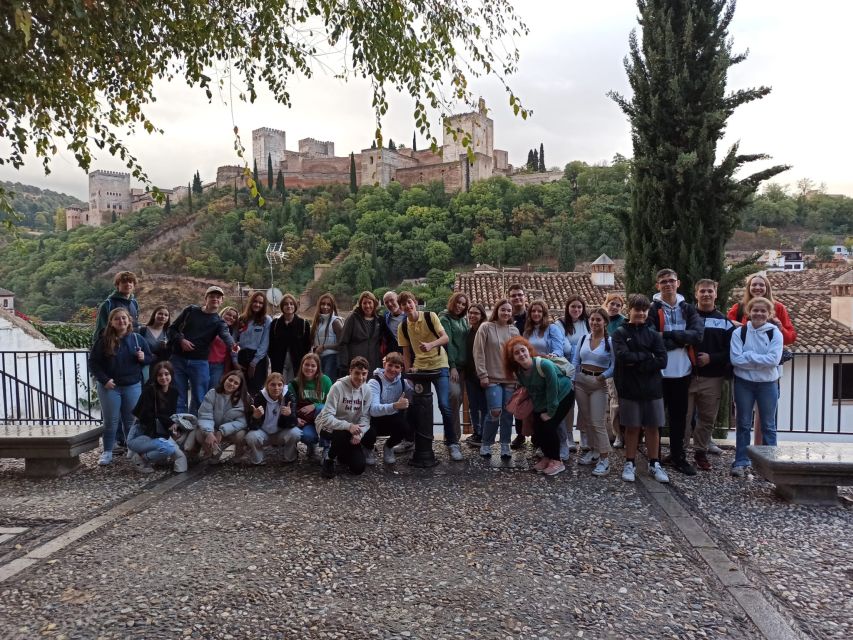
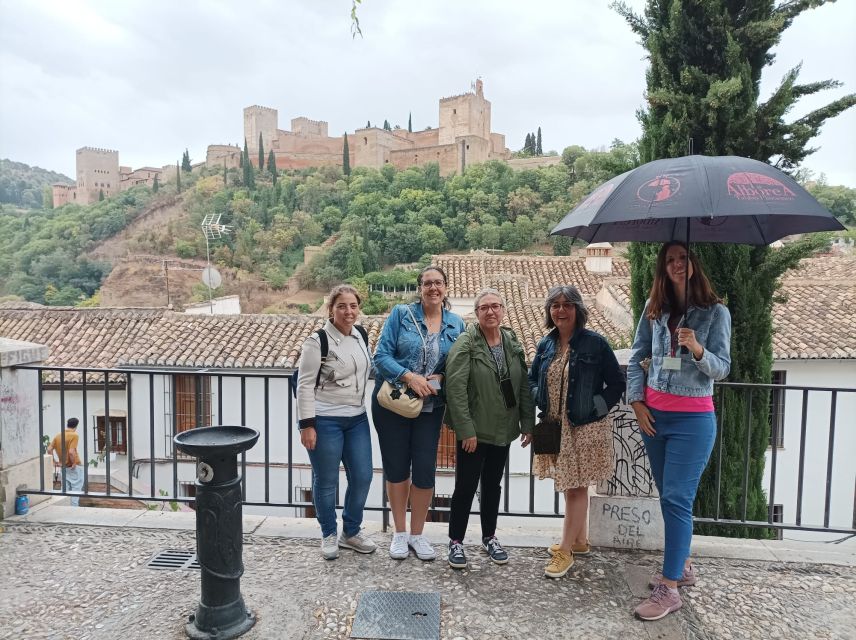
The Alhambra view is the route’s visual payoff. From the lower Albaicin, you get a different perspective on Granada’s most famous landmark. Rather than walking through the Alhambra itself, you look across toward it and see how the palace complex relates to the city and surrounding hills.
This distinction matters when you book. The tour does not include Alhambra admission, palace interiors, or a detailed visit to the fortress. It gives you a strong outside view and the historical setting needed to appreciate a separate Alhambra visit.
Bring a camera, but also give yourself time to listen. The guide can explain the relationship between the old Muslim city, the Albaicin hillside, and the Alhambra. The view becomes more meaningful when you understand why the palace was placed there and how the city grew around it.
The viewpoint is also a good place to ask questions. Several guides have been praised for welcoming questions rather than rushing through a script. That makes a difference if you want to ask about architecture, the Reconquista, flamenco, or what to see next.
The guides make the difference
The experience is offered in English or Spanish. Guide quality naturally varies from day to day, but the named guides associated with this walk have earned especially warm praise for their teaching style.
Pablo is described as both informative and entertaining, with plenty of suggestions for independent sightseeing. Jaime is noted for patient answers and detailed explanations of everything from architecture to old cobblestones. Irene is praised for involving the group, asking questions, and making the history feel like a conversation. Other guides, including Rocio, Emilio, Anna, and Elene, are described as friendly, organized, attentive, and good at keeping people engaged.
There is one fair caution. Two English-speaking visitors found a guide’s accent difficult to follow at times. They still considered the tour worthwhile, but if you need very clear, slow English, it is sensible to remember that the experience depends on the individual guide’s speech.
The small-group atmosphere can also vary. Some departures have felt almost private, including one group of seven and another with only two people. That can make it easier to ask questions and adjust the pace, but you should not assume every departure will be that intimate.
How the timing and price work for you
The tour lasts 2.5 hours. That is long enough to cover the main center and the lower Albaicin, yet short enough to fit around lunch, an afternoon museum, or a separate Alhambra visit.
At $16 per person, I consider it strong value if you want explanation rather than a simple list of sights. A private guide would cost much more, while exploring alone would give you no help connecting the buildings. The price is less compelling if you already know Granada well or prefer to read at your own pace.
I would book this for the beginning of a stay. You can use the guide’s suggestions to decide where to eat, which monuments deserve more time, and how to return to the Albaicin later. The route also helps you avoid wasting your first afternoon wandering without a sense of direction.
You can reserve now and pay later, and cancellation is free up to 24 hours before the activity for a full refund. Those terms are useful if your Granada schedule is still shifting.
Who should book this walking tour?
I would recommend it to first-time visitors, history-minded walkers, couples, families with older children, and anyone who wants a quick but meaningful introduction to Granada. It is particularly useful if you want to see the center and Albaicin in one outing rather than arranging separate walks.
It suits you best if you can manage 2.5 hours on foot and an uphill stretch. Comfortable shoes are essential, and the route is not suitable for people with mobility impairments.
I would choose a different plan if your main goal is to enter the Alhambra, spend hours inside the Cathedral, or avoid hills altogether. This is a city orientation and history walk, not a full monument admission tour.
Should you book it?
Book it if you want a well-priced introduction to Granada’s Islamic and Christian past, a guided look at the central monuments, and a memorable Alhambra viewpoint. The strongest reason to choose it is the guide-led storytelling, with Pablo, Jaime, Irene, and others praised for making history clear, personal, and useful for the rest of your visit.
Skip it if you have limited mobility or want a slow, interior-focused sightseeing day. For most first visits, though, this 2.5-hour route gives you a lot for $16 and helps Granada make sense before you explore it on your own.
FAQ
How long does the Granada walking tour last?
The tour lasts 2.5 hours.
What language is the tour offered in?
The live tour guide is available in English or Spanish.
Where do I meet the guide?
Meet the guide in front of the monument to Isabel la Católica and Cristóbal Colón.
Does the tour include entry to the Alhambra?
No. The tour provides a viewpoint of the Alhambra but does not include entry to the palace complex.
What should I bring?
Bring comfortable shoes because the tour includes walking through the historic center and an uphill section in the lower Albaicin.
Is the tour suitable for people with mobility impairments?
No. The activity is not suitable for people with mobility impairments because of the walking route and uphill section.
Just added in Granada
- Granada: Alhambra and Nasrid Palaces Private Tour★ 4.9 · 242 reviews
- Granada: Sacromonte Caves Flamenco Show with Dinner★ 4.4 · 156 reviews
- From Granada: Alpujarra Villages Guided Day Tour★ 4.8 · 217 reviews
- From Granada: Alpujarra Mountain Villages Tour★ 4.7 · 298 reviews
- Granada: Traditional Flamenco Show at Tablao Casa Ana★ 4.8 · 390 reviews
- Granada: Alhambra Palace Guided Tour★ 4.3 · 224 reviews
- Granada: 1-Hour Traditional Flamenco Show at Palacio★ 4.7 · 256 reviews
- Granada: Alhambra and Albaicín Small Group Tour★ 4.8 · 373 reviews
Historical Tours, compared.

Madrid Essential: Historic Center, Plaza Mayor & Royal Palace
Read our review →
Tapas Walking Tour with Food, Wine, and History
Read our review →
Sevilla Food Tour: Tapas, Wine, History & Traditions
Read our review →
Valencia Old Town Tour with Wine & Tapas in 11th Century Historic Monument
Read our review →
Ultimate Seville Tapas, Wine & History Small Group Tour
Read our review →
Skip-the-Line Great Mosque-Cathedral History Tour
Read our review →

Taste of Malaga Tour : Tapas, History and Local Customs
Read our review →Browse the lists this tour appears in