
Reviewed · SPAIN
From Almeria: Tabernas Desert 4WD Joyriding Tour
Europe’s only natural desert is not a theme-park prop. It is a harsh, sculpted place of dry ravines, bare rock, dusty channels, and surprisingly persistent life. This two-hour 4×4 tour takes you beyond the easy roadside views, with regular stops to explain the geology, wildlife, settlements, and movie scenes that made Tabernas famous.
I like the small groups, limited to six people, and the guides’ clear enthusiasm for both natural science and cinema. I also like that the outing uses real 4×4 vehicles to reach parts of the desert you could not comfortably access by ordinary car. The main drawback is space: three people across the back seat can feel cramped, and the ride is not a good match for back problems, motion sickness, or recent surgery.
Key points to know before you book
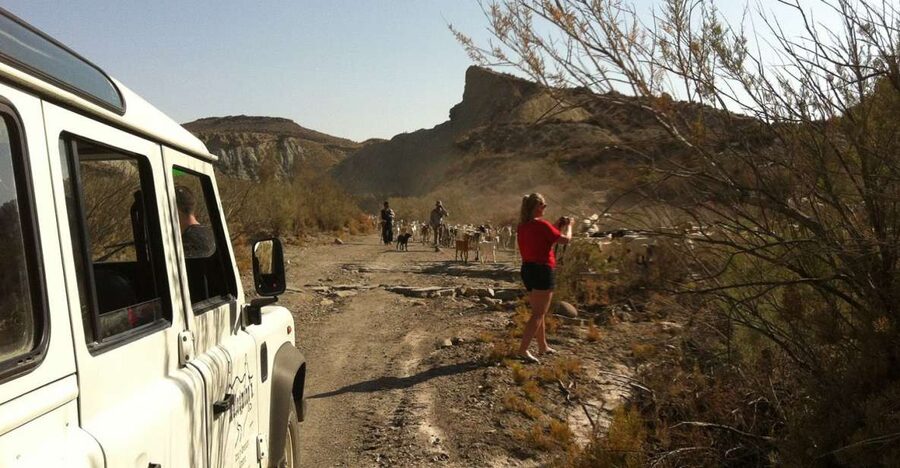
- Real off-road access: Nissan, Land Rover, and Toyota 4×4 vehicles take you through canyons, ramblas, badlands, and other rough terrain.
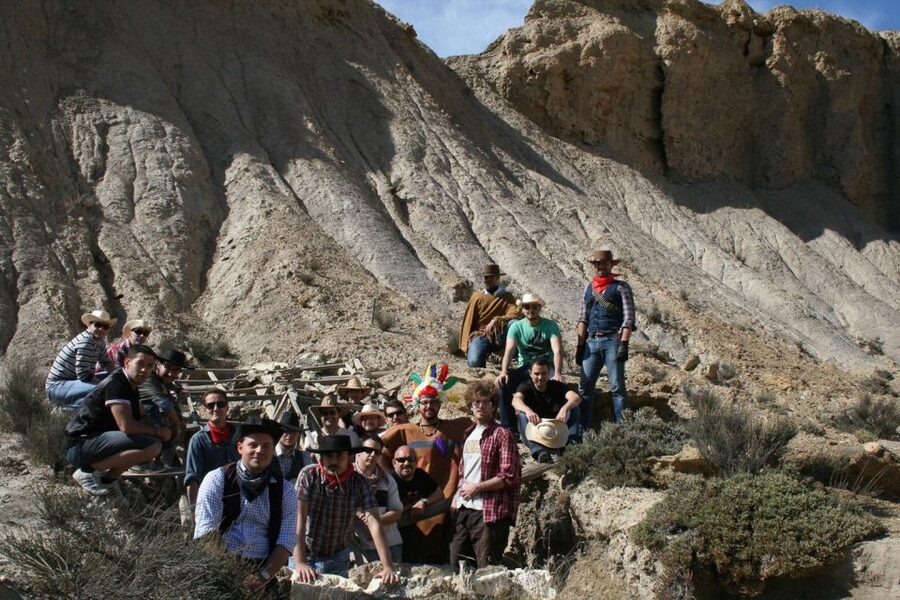
- Two subjects in one tour: You learn how tectonic movement and drying climate shaped the desert, then connect those settings to famous films.
- Small groups matter: The maximum is six people, with a maximum of two languages per vehicle.
- The guides make the difference: Andrés, Dalila, Cristina, and Dalia are noted for clear explanations, friendly manners, and strong English, Spanish, or French.
- This is not a Western-set visit: The tour explains the film industry but does not enter the Western villages or theme-park sites.
- Plan for sun and heat: Bring water, sunscreen, a camera, and clothing suited to the season. Tabernas can range from about -5°C to 48°C.
Why Tabernas feels unlike the rest of Andalusia
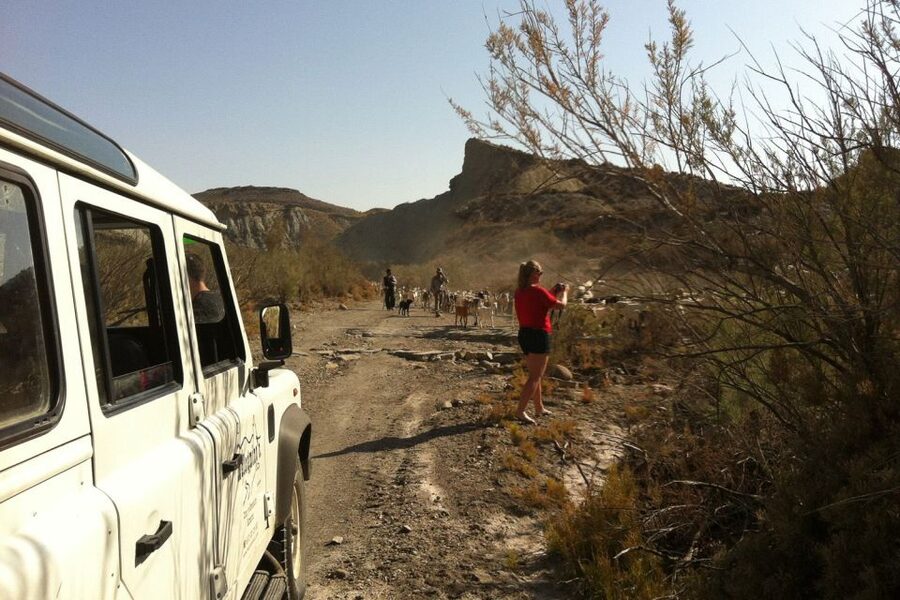
The Tabernas Desert covers about 12,000 hectares, with gray, beige, and brown formations shaped by tectonic movement and a long shift toward a drier climate. Annual rainfall is listed at roughly 250 millimeters, while the area gets more than 3,000 hours of sunshine.
That combination helps explain the scenery. Water has cut narrow channels and broad dry riverbeds called ramblas into soft sediment. Bare slopes, gullies, cliffs, and folded rock create a stark setting that can look like North Africa, the Middle East, or the American Southwest, often within a short distance of one another.
I like the way this tour puts the desert into context instead of treating it as a backdrop for quick photographs. The guide explains why the ground looks the way it does, how plants and animals cope with the dry conditions, and why human settlement has always been difficult here.
The word desert can suggest endless dunes. Tabernas is different. Expect eroded hills, dry channels, ravines, and badlands rather than a sea of sand. That variety is one reason the area has worked so well for film crews.
Other trips people book in Spain:
- Barcelona: Sagrada Familia Entry Ticket with Audio Guide
★ 4.6 · 105,312 reviews - Barcelona: Park Güell Admission Ticket
★ 4.4 · 76,534 reviews - Seville: Royal Alcázar Entry Ticket
★ 4.6 · 28,378 reviews
Meeting the 4×4 in Tabernas village
The meeting point is in front of the information office on Calle de Las Angustias, at the entrance to Tabernas when arriving from Almería. Look for the bar called El Portichuelo opposite the meeting area.
The tour begins and ends in the village, which makes it easy to add to a day of sightseeing in the area. It also means you need to arrange your own way to Tabernas. One useful planning detail: an early start may require a taxi if local buses have not begun running yet.
The vehicles are genuine 4×4 models, including Nissan, Land Rover, and Toyota. They are assigned according to group size and language needs. The maximum is six people, and each car carries no more than two tour languages.
That language limit is worth noticing. A bilingual tour can take longer than a single-language tour, but the small group and regular stops help keep the commentary manageable. Spanish and English tours operate year-round, and French can be arranged.
What the two-hour route is really like
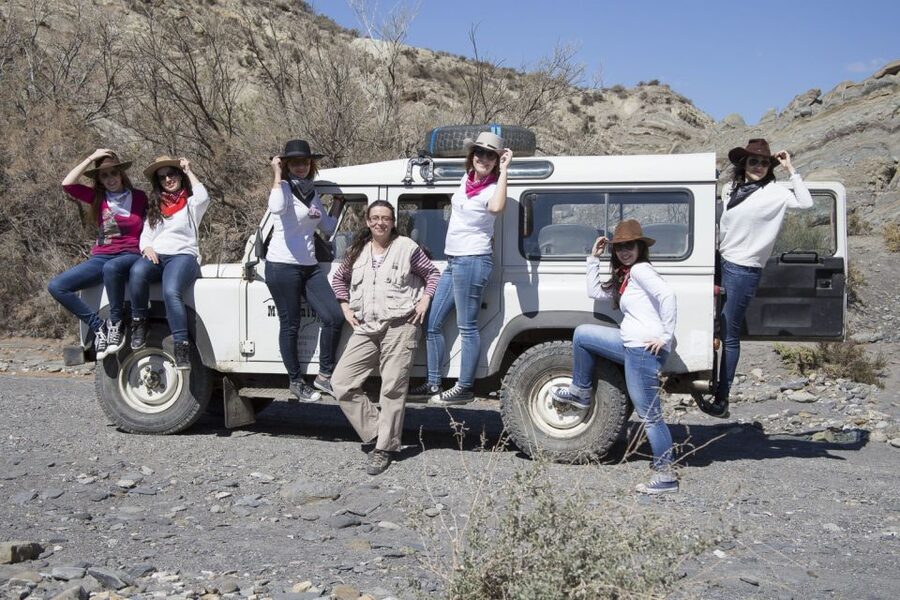
The tour is best understood as a guided nature and film outing with an off-road ride, not as a high-speed driving thrill. The 4×4 is used because the terrain requires it, but the main purpose is to see and understand the desert.
You will make numerous stops. At each one, the group gets out for explanations and photographs, so nobody has to admire the scenery only through a window. The guide uses photographs and other interpretation material to connect the present-day view with geological features and scenes from the area’s film past.
You can also swap seats in your assigned vehicle during the route. That is useful in a small car, especially if you want a different view or prefer not to spend the full two hours in one position.
Expect the route to include several types of terrain:
- Canyons: Narrower passages show how erosion has cut through the soft rock.
- Ramblas: These dry channels reveal how occasional water flow can shape a very dry region.
- Badlands: Bare, heavily eroded slopes create some of the area’s strongest visual contrasts.
- Rock formations: The guide explains how movement beneath the ground and later erosion produced the forms around you.
- Film locations: The same formations are identified as settings used by major film productions.
The frequency of the stops makes the tour approachable for people who do not want a strenuous desert walk. You get out, listen, look around, and take photographs before continuing by vehicle. Still, you must be able to climb into and out of the 4×4 repeatedly.
The geology and wildlife are more than background scenery
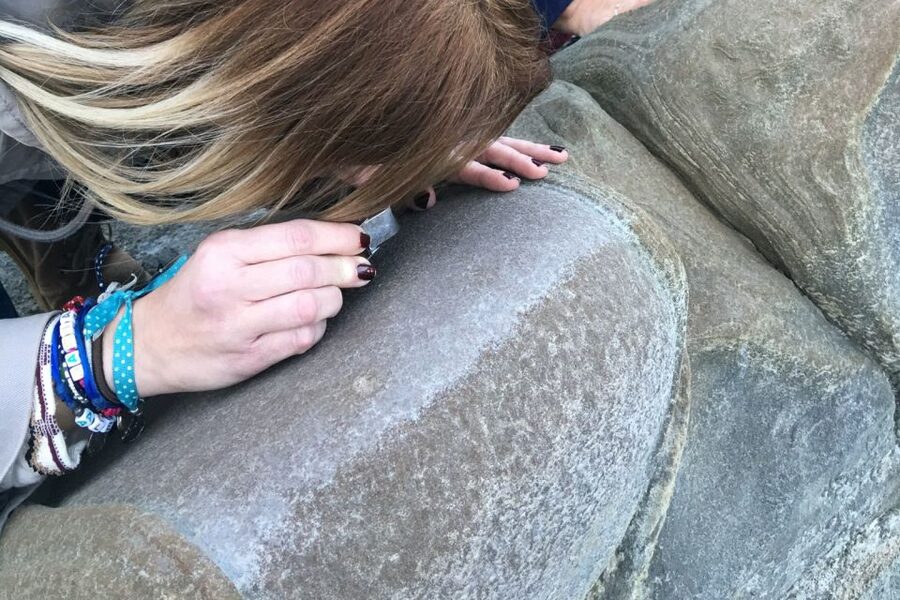
The strongest part of the outing is the interpretation. The colors and shapes are striking on their own, but the desert becomes far more interesting when you understand the forces behind them.
The guide discusses the area’s tectonic movements, its increasingly arid climate, and the way water has carved the ground. You also hear about how life continues in a place that can be extremely hot, dry, and difficult for people.
The activity describes the desert as a hostile zone for human life, but that does not mean it is empty. Plants and animals have adapted over centuries, and the guide points out the relationship between natural life and the human communities that have tried to use this region.
You should not expect a wildlife safari or a long nature walk. The value is in learning how to read the terrain. A dry channel is not just a dusty road, and a bare hillside is not simply a pile of rocks. The guide helps you see the signs of climate and erosion in front of you.
This is also where the guide’s skill matters. Andrés is praised for patience and clear explanations. Dalila and Dalia are known for their enthusiasm about the geology and the area’s forms. Cristina is noted for speaking Spanish, English, and French with ease. Guides may vary, but the pattern is clear: this experience depends heavily on having someone who can turn observation into a story.
Same base, a different kind of day out:
- Barcelona: Casa Batlló Entry with Self-Audioguide Tour
★ 4.7 · 25,359 reviews - Seville: Cathedral and La Giralda Entry Ticket
★ 4.5 · 24,592 reviews - Madrid: Tour Bernabéu Entry Ticket
★ 4.5 · 21,573 reviews - Barcelona: 24 or 48-Hour Hop-On Hop-Off Bus Tour
★ 4.4 · 20,872 reviews
Following Lawrence of Arabia and the Dollar Trilogy
Tabernas became a major film setting because production crews could reach it easily, count on reliable sunshine, and find scenery that could represent several parts of the world. The desert has played the role of the Middle East, Africa, and the American Southwest.
The film references range from Lawrence of Arabia and Cleopatra to Sergio Leone’s Dollar Trilogy. The success of those productions helped bring the first Western town set to Almería, later followed by other Western-themed sites and dozens of spaghetti Westerns.
The movie connections continue well beyond the classic era. The area has also appeared in projects including Patton, Indiana Jones, Exodus, Game of Thrones, Risen, El Zorro, 800 Bullets, Mar de Plástico, and Millennium.
The best part is that the film talk is tied to the actual ground beneath you. You are not simply given a list of titles. At different stops, the guide identifies why a particular setting worked on screen and how the same formation could suggest another country or period.
Keep your expectations straight, though. This is not a visit inside the Western villages, and it does not include a theme-park show. The activity explains their place in local film history but does not take you through the sets. If you want staged gunfights, buildings, or cowboy entertainment, you need a separate ticket and visit.
If you prefer the natural setting behind the movie image, this arrangement is a plus. The route avoids turning the entire experience into a film museum and gives equal weight to geology, ecology, and local human history.
What the small group improves, and where it falls short
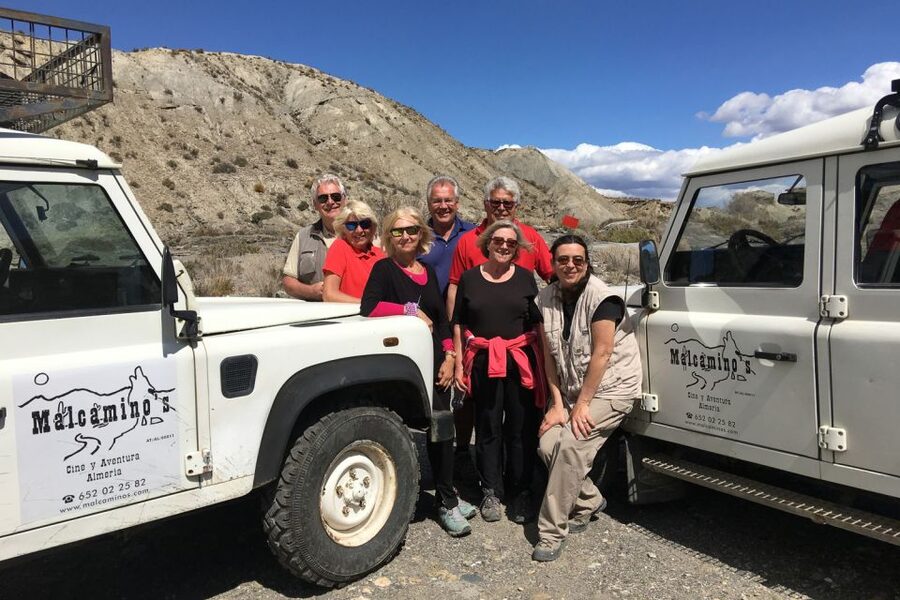
A six-person limit is a real advantage in a terrain where stopping and looking matter. You can ask questions, hear the guide without much trouble, and get out of the vehicle at the same points as everyone else.
Small groups also make it easier to handle language needs. The operator limits each car to two languages, which should keep the explanations from becoming too fragmented. Spanish, English, and French are available, depending on the booking.
The tradeoff is vehicle space. One passenger specifically found three people in the back seat uncomfortable, and another described the car as cramped. Seat swapping helps, but it does not turn a compact 4×4 into a roomy minibus.
If you are tall, broad-shouldered, or prone to motion sickness, keep this in mind. The ride crosses rough ground, and getting in and out adds physical effort. People with back problems, recent surgery, or limited mobility should think carefully before booking. One person with hip problems managed the tour because the stops allowed walking, but the key requirement was being able to enter and leave the vehicle.
Children under six need a child seat. Babies under one year are not considered suitable for this activity. Strollers are not allowed.
The best time to go and what to pack
Tabernas can be punishingly hot, especially in July and August. A past visitor specifically recommended an evening departure for cooler conditions, but the most important rule is to match your clothes to the season and start time.
Bring:
- Water, since food and drinks are not included
- Sunscreen
- Comfortable clothes
- A camera
- Shoes and clothing suitable for getting out of the vehicle and walking around the stops
Do not count on shade. The desert has more than 3,000 hours of sunshine each year, and its temperatures can range from about -5°C to 48°C. Even cooler months can bring strong sun, while winter mornings may feel genuinely cold.
Smoking is not allowed. You must not feed or touch animals, and you must not touch plants. Those rules are not decorative. This is a protected area with restrictions on private motorized vehicles, and the activity is supervised by the Andalusian environmental department and Seprona, Spain’s official nature police.
Is $45 good value for two hours?
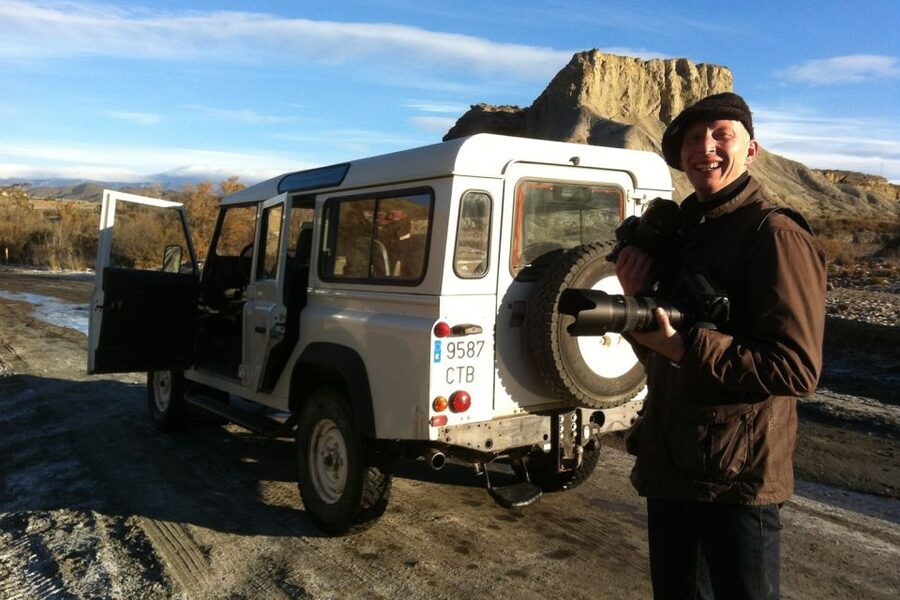
At $45 per person, I consider this a fair price if you want access to the desert without arranging a demanding walk or bicycle route. The fee includes the 4×4 ride, insurance required in Spain, interpretation materials, and a specialized guide.
The real value is access. Private motorized vehicles are restricted in the protected area, so hiring a permitted tour is one of the practical ways to reach the interior by vehicle. You could explore on foot or by bicycle using routes such as PR 269 and GR 140, but those are different experiences and demand more effort, planning, and tolerance for heat.
Two hours is enough for a useful introduction, not a full-day expedition. You see several types of terrain, stop for explanations, and get a solid overview of the geology and movie connections. If you want long walks, extended photography time, or a slow study of one canyon, the schedule may feel short.
The price also compares well for families and couples who want one focused activity near Almería. Food and water are not included, and the Western sets cost extra, so budget for those separately if they interest you.
Who should book this Tabernas experience?
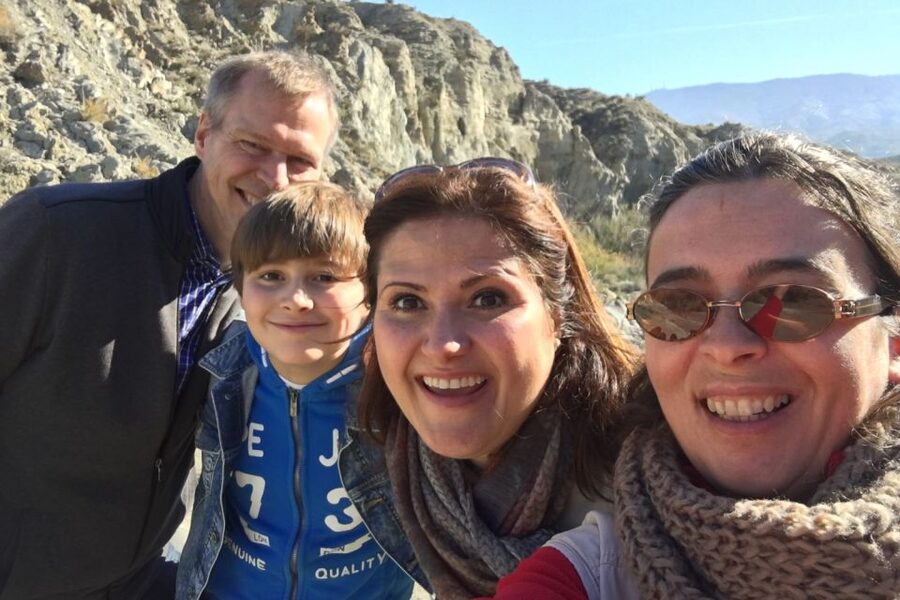
I would choose this tour if you enjoy natural science, film locations, unusual scenery, or all three. It works particularly well for families with older children and teenagers because the movie connections give the geology an easy entry point.
It also suits anyone without the time or inclination for the PR 269 or GR 140 walking routes. You stay in the vehicle for much of the outing, but the regular stops provide a chance to stretch your legs and explore short sections on foot.
I would be cautious if you have a bad back, motion sickness, recent surgery, or difficulty climbing into a vehicle. The tour is not a hard hike, but rough terrain and repeated vehicle access still require some physical ability.
The tour can be canceled up to 24 hours before departure for a full refund, and reserve-now, pay-later booking is available. The operator can exclude people who ignore safety or nature rules, arrive visibly under the influence, or wear unsuitable clothing such as a bikini or bare chest, without a refund.
Should you book it?
Book it if you want the real Tabernas Desert rather than only a Western-set attraction. The combination of small-group 4×4 access, strong guide commentary, geology, wildlife, and cinema gives you a fuller picture of the area than a quick photo stop.
Skip it if your main goal is a long off-road thrill, spacious vehicle seating, or entry to the Western villages. For most people visiting Almería, though, $45 is a sensible way to reach protected desert terrain and understand why this dry corner of Andalusia has drawn scientists, local communities, and film crews for generations.
FAQ
Where does the Tabernas Desert 4×4 tour begin?
It begins in front of the information office in Tabernas village, at Calle de Las Angustias s/n, 04200 Tabernas. The bar called El Portichuelo is opposite the meeting point.
Where does the tour finish?
The activity finishes at the same meeting point in Tabernas village.
How long does the tour last?
The tour lasts two hours.
How much does the tour cost?
The listed price is $45 per person.
What languages are available?
Spanish and English tours are available year-round. French can also be booked. Each vehicle has a maximum of two languages.
How many people can join each vehicle?
The small-group tour is limited to six participants.
Are the Western villages included?
No. The tour explains the importance of the Western sets in the region’s film history, but entry to the villages is not included.
What should I bring?
Bring sunscreen, water, comfortable clothing suited to the season, and a camera.
Can children join the tour?
Children can join with a child seat if they are under six. Babies under one year are not considered suitable for the activity.
Is the tour suitable for people with mobility or health concerns?
The tour is not suitable for wheelchair users, people with back problems, recent surgery, motion sickness, or babies under one year. You must also be able to get in and out of the 4×4 vehicle.
Just added in Spain
- Bizkaia Bridge, Gaztelugatxe, Bermeo and Gernika from Bilbao★ 4.5 · 299 reviews
- Benalmadena: City Sightseeing Hop-On Hop-Off Bus Tour★ 3.5 · 379 reviews
- Welcome to Barcelona: Private Tour with a Local★ 4.6 · 200 reviews
- Barcelona: White Rabbit Catalonia’s Top Immersive Experience★ 4.7 · 359 reviews
- Bean to Bar Chocolate Workshop in Barcelona★ 5.0 · 172 reviews
- Barcelona: Walking tour with Montjuic Castle & Cable Car★ 4.7 · 832 reviews
- Barcelona: Welcome to Barcelona Segway Tour★ 4.9 · 153 reviews
- Barcelona: Helicopter Flight with Optional Yacht Cruise★ 4.7 · 224 reviews