

Reviewed · SPAIN
Gibraltar Inside Out Intermediate Tour 3.30hrs
The most memorable part of this Gibraltar tour may be the Barbary macaques, but the real strength is the way the monkeys fit into a much bigger story. In about three and a half hours, you travel from ancient fortifications and sea views to St. Michael’s Cave, the Great Siege Tunnels, and the famous airport runway.
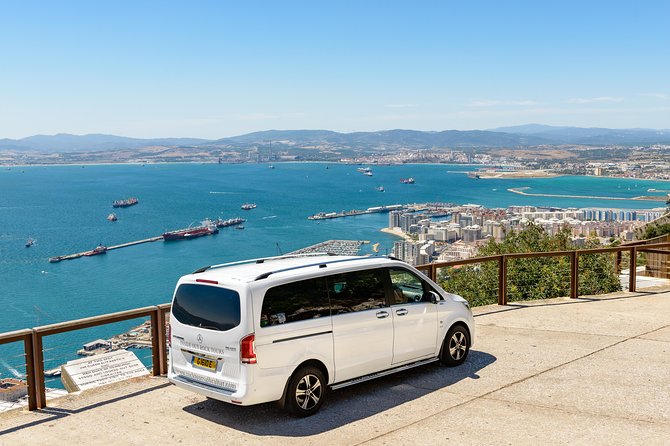
I like the private format for groups of eight or fewer, since your guide can adjust the pace and get close to the main sights. I also like the clean, modern vehicle, child seats, flexible pickup, and local guides such as Carl, a fourth-generation Gibraltarian. The main drawback is price: at $581.64 per person, this is a costly choice unless your group values private transport and close guidance.
Key points at a glance
- Up-close macaque encounters: The Upper Apes Den is a major highlight, with guides who know how to approach the animals safely.
- A private group of eight or fewer: You avoid the feel of a large coach party and can ask questions throughout the drive.
- A broad Gibraltar overview: The route covers the Rock, military sites, caves, beaches, Europa Point, and the airport runway.
- Local pickup: You can arrange pickup at a Gibraltar hotel, the cruise terminal, the Spanish border, or another location in Gibraltar.
- Modern transport: The vehicle has screens, and child safety seats are available.
- Tickets require attention: Tours booked before October 15, 2025 do not include the £25-per-person admission charge.
Why the private format matters on Gibraltar
Gibraltar is compact, but its sights are spread across steep roads, the city, the Rock, and the southern tip. A private vehicle saves time and spares you from trying to connect the attractions on your own.
The tour is designed for a maximum of eight people. That matters at stops such as the Skywalk and the macaque area, where a small group is easier to manage than a large busload. It also lets you ask for clarification when the story gets complicated. Gibraltar has Moorish, Spanish, British, and military chapters, and a good guide helps connect them.
The guides named in the experience include Carl, Adrian, John, Paul, Chris, Douglas, Neil, and Sergio. Carl is a fourth-generation local, and several guides are described as Gibraltar natives or long-time residents. Their local background is especially useful for details about daily life, restaurants, the airport, and the Rock’s animals.
You should expect an active sightseeing drive rather than a long walking tour. The vehicle brings you close to many entrances, which helps if someone in your group has limited mobility. One family specifically valued the effort to keep an older relative comfortable and near the access points.
Pickup is available anywhere in Gibraltar. You can also arrange to meet at the Spanish border or the cruise terminal, which makes this a practical option for a port stop. If you are coming from a ship, an early start is wise because it helps you reach the upper attractions before queues and crowds build.
Other trips people book in Spain:
- Barcelona: Sagrada Familia Entry Ticket with Audio Guide
★ 4.6 · 105,312 reviews - Barcelona: Park Güell Admission Ticket
★ 4.4 · 76,534 reviews - Seville: Royal Alcázar Entry Ticket
★ 4.6 · 28,378 reviews
The Rock, Charles V Wall, and Trafalgar Cemetery
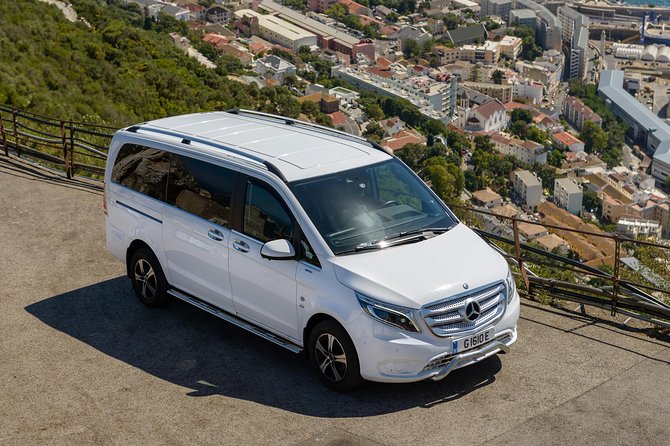
The tour begins with Gibraltar itself, a British Overseas Territory on Spain’s southern coast. The Rock rises 426 meters above the surrounding area, and its position at the entrance to the Mediterranean explains why so many powers fought to control it.
Your guide can point out the Charles V Wall, a sixteenth-century defensive barrier that forms part of Gibraltar’s fortifications. It is a good reminder that the Rock was not simply a lookout point. It was a working fortress, with walls and gates designed to control movement from the shore toward the heights.
Trafalgar Cemetery occupies what was once a defensive ditch south of the city walls. Despite its name, it was not the main burial ground for the Battle of Trafalgar. Its small size and position beside the old defenses make it a useful stop for understanding how tightly Gibraltar’s town and military works were packed together.
The Gibraltar Botanic Gardens, also called La Alameda Gardens, offer a change of pace. Established in 1816 for soldiers and local residents, the six-hectare gardens provide shade and greenery below the Rock. The stop is not the main reason to book this tour, but it adds a calmer side of Gibraltar before the route moves higher.
Upper Rock Nature Reserve and the Pillars of Hercules
The Upper Rock Nature Reserve covers more than 40 percent of Gibraltar. It protects the high section of the Rock and provides the setting for the cave, macaque area, Skywalk, and several military sites.
The reserve is also where the views become the main event. From the upper roads and viewpoints, you can look across the Mediterranean, the Bay of Gibraltar, and the Strait toward North Africa. Clear conditions matter, so do not be disappointed if haze softens the distant view.
At the Pillars of Hercules, the guide explains the old Greek myth of Hercules smashing through the Atlas Mountains to connect the Mediterranean and Atlantic. In the physical geography of the Strait, Gibraltar forms the northern pillar and Jebel Musa in Ceuta forms the southern one.
This stop takes only about 10 minutes, but it gives the route a sense of place. You are not simply looking at a large rock. You are looking at one side of the narrow water passage between Europe and Africa.
St. Michael’s Cave and the Skywalk
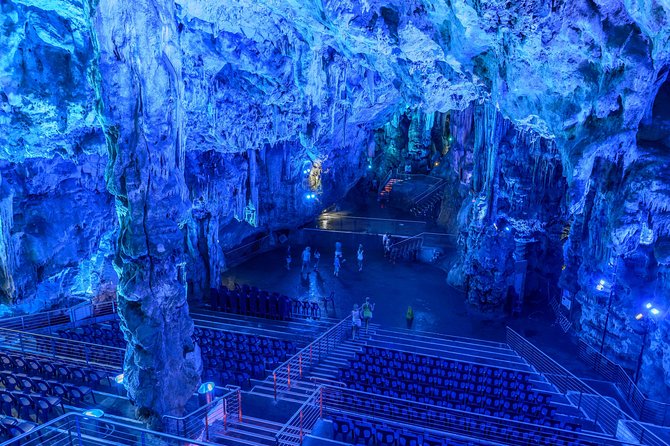
St. Michael’s Cave sits more than 300 meters above sea level and is the most visited of the more than 150 known caves inside the Rock. Its chambers are the result of water working through the limestone over a very long period.
The cave also has a military connection. During the Second World War, workers blasted inside it to improve ventilation because it was considered for use as an emergency hospital. That work revealed a deeper cave system known as Lower St. Michael’s Cave.
You spend about 20 minutes at the cave, so this is a focused visit rather than a slow geological tour. The short stop works well in a packed route, but anyone hoping to explore every corner of the cave should book a longer cave visit separately.
The Skywalk offers a different kind of drama. A former military lookout was converted into a glass platform and walkway with a 360-degree view. The transparent floor is not ideal for anyone uneasy with heights, but it gives you a strong sense of the Rock’s steep drop and exposed position.
You have about 15 minutes here. That is enough for photographs and a quick look around, though the stop may feel brief if the viewpoint is busy or your group wants several photos.
Same base, a different kind of day out:
- Barcelona: Casa Batlló Entry with Self-Audioguide Tour
★ 4.7 · 25,359 reviews - Seville: Cathedral and La Giralda Entry Ticket
★ 4.5 · 24,592 reviews - Madrid: Tour Bernabéu Entry Ticket
★ 4.5 · 21,573 reviews - Barcelona: 24 or 48-Hour Hop-On Hop-Off Bus Tour
★ 4.4 · 20,872 reviews
Meeting the macaques at the Upper Apes Den
The macaques are the tour’s most distinctive attraction. They are the only wild monkeys found in Europe, and more than 200 animals live in nine groups across the upper Rock.
You visit the Upper Apes Den, at roughly the same height as the cable car station. The area gives you a chance to see the animals at close range, but you should remember that these are wild macaques. Keep food and loose belongings secure, and follow your guide’s instructions.
This is where guide quality matters most. Carl is described as having a close understanding of the animals, and Adrian is also noted for handling the macaque encounter well. Some guides have built trust with particular animals, including younger monkeys, which can make the stop feel more personal. Still, no guide can guarantee that a particular macaque will appear or behave in a certain way.
The old story says that Winston Churchill ordered more macaques brought to Gibraltar in 1942 after their numbers fell to seven. The tale connects the animals to British rule, though the larger point is clear: macaques have become part of Gibraltar’s identity and tourism.
Allow about 20 minutes at the feeding station. This is enough for photographs and observation, but not enough to linger indefinitely. The animals are a highlight, not a staged animal show, and the experience is best when you watch their behavior rather than try to force an interaction.
Great Siege Tunnels and Gibraltar’s military story
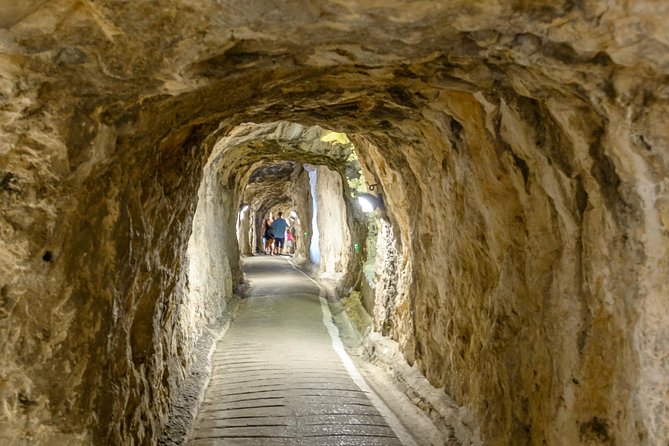
The Great Siege Tunnels explain why Gibraltar mattered so much to Britain and why Spain and France tried to recapture it. The tunnels were cut by hand during the Great Siege of 1779 to 1783, when the defenders fought to hold the fortress.
The galleries were carved directly into the Rock and used to position guns and protect the defenders. The 25-minute stop gives you time to see the passages and understand how engineers turned solid limestone into a defensive network.
This is one of the most worthwhile historical stops because it makes the Rock’s military role physical. You are not just looking at a wall or reading a date. You are inside the fortress, seeing the labor required to defend it.
The route includes many attractions, so your time in the tunnels is limited. If military history is your main interest, ask your guide to explain how the tunnels fit with the walls, batteries, and other defenses.
Moorish Castle and the 100 Ton Gun
The Moorish Castle Complex sits at the northern end of the Upper Rock Nature Reserve. Its construction began in the eighth century, and it was rebuilt in the fourteenth century after heavy damage during a Moorish reconquest.
The Tower of Homage and Gate House are the most prominent remains. The 15-minute stop is short, but the castle provides a useful link to Gibraltar’s medieval past. It also shows how the defenses changed as control of the Rock shifted between Muslim, Spanish, and British rulers.
The 100 Ton Gun at Napier of Magdala Battery brings the story into the nineteenth century. The gun weighs slightly more than 100 tons, has a 32-foot barrel, and could fire a 2,000-pound shell about eight miles. Only two of the four guns built in 1870 remain, with the others made for Malta.
You spend about 15 minutes at the battery. The gun is large enough to make the numbers easy to grasp, and the stop is appealing even if you are not a military specialist.
Europa Point, Catalan Bay, and the airport runway
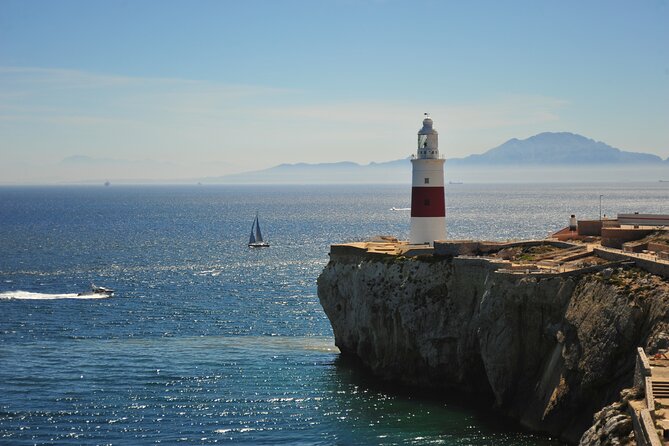
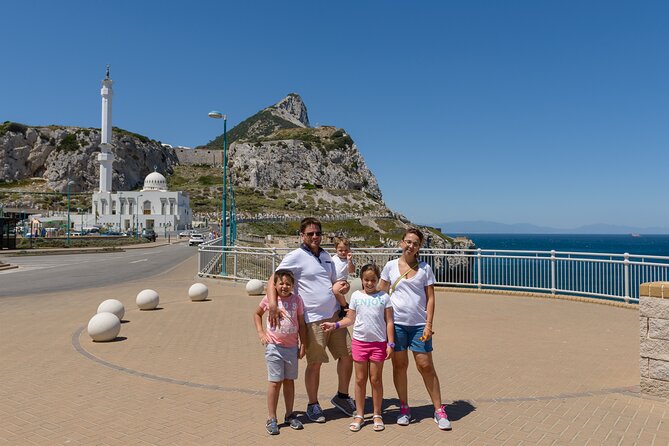
Europa Point is Gibraltar’s southern tip and one of the best places to look across the Strait toward Morocco and Spanish Ceuta. The Europa Point Lighthouse was built between 1838 and 1841 and became fully automated in 1994.
The lighthouse’s beam can be seen from more than 27 kilometers away. Nearby, you will find the Shrine of Our Lady of Europa and Nuns Well, an ancient underground reservoir. The stop is free and takes about 15 minutes.
Catalan Bay adds a seaside village to the route. Its beach is Gibraltar’s second-largest sandy beach and can become crowded in summer. You have only about 10 minutes here, so think of it as a scenic look rather than beach time.
The final novelty is the drive across Gibraltar Airport’s runway. Public roads cross the runway, which is unusual enough to make this a fun closing detail. The crossing takes about 10 minutes and gives you one last reminder of how tightly Gibraltar’s civilian, military, and transport spaces are packed together.
Price, timing, and what is included
The listed price is $581.64 per person. That is a high cost, especially for a three-and-a-half-hour experience, but the real comparison is with the price of arranging a private vehicle, several admissions, local guiding, and port or border pickup separately.
The value improves for a full group of eight, because the private vehicle and guide cost can be shared. For one or two people, the price is harder to justify unless convenience, cruise timing, and personal attention matter more than budget.
The itinerary includes many stops, and the stated visit times add up to more than the headline duration if treated as separate full visits. In practice, the guide combines drive-by commentary with short stops and a longer period in the Upper Rock area. You should treat the schedule as an overview of what the tour covers, not a promise of extended time at every attraction.
Professional local guiding is included. Admission charges are a point to check carefully: tours booked before October 15, 2025 do not include the £25-per-person ticket cost. The supplied information does not clearly assign every individual admission at every stop, so confirm the current ticket arrangement before paying.
The tour operates daily from 7:00 a.m. to 4:00 p.m. and is offered in English, with up to nine languages catered for. Confirmation is provided at booking, and free cancellation is available up to 24 hours before the start time.
Who should book this Gibraltar tour?
I would choose this tour for a family, cruise group, or small party that wants to see the major Gibraltar sights without arranging transport. The child seats, flexible pickup, clean vehicle, and ability to keep the group together are practical advantages.
It also suits you if the monkeys, military history, and panoramic views all matter. You get a far broader picture than a simple cable-car ride to the top, including the Great Siege Tunnels, Moorish Castle, Europa Point, Catalan Bay, and the runway crossing.
I would think twice if you are on a tight budget, want long visits at each attraction, or prefer to explore at your own speed. The route is packed, and the price is substantial. A private format gives you flexibility, but it does not turn three and a half hours into a full day.
Should you book it?
Book this tour if you want a fast, well-organized introduction to Gibraltar and value a local guide who can adjust the day to your group. The strongest reasons are the private vehicle, pickup at the cruise terminal or border, close macaque experience, and unusually broad mix of history and scenery.
Skip it if you mainly want a relaxed beach visit or a long walk through the Rock. For everyone else, especially cruise passengers with limited time, this is a strong way to cover Gibraltar’s essential sights in one outing. Just confirm the admission fee, start early when possible, and judge the price against your group size.
FAQ
How long does the Gibraltar Inside Out Intermediate Tour last?
The tour lasts approximately 3 hours and 30 minutes.
How many people can join the private tour?
Private tours are available for groups of eight people or fewer. Only your group participates.
Where can pickup take place?
Pickup can be arranged anywhere in Gibraltar, including a Gibraltar hotel, the cruise liner terminal, or the border with Spain. The meeting point can also be another agreed location in Gibraltar.
Are admission tickets included?
Tours booked before October 15, 2025 do not include the £25-per-person ticket charge. Check the current booking details for the admission arrangement that applies to your date.
Is the tour available in languages other than English?
The experience is offered in English, and the tour information states that up to nine languages can be catered for. Confirm the language you need when booking.
What is the cancellation policy?
You can cancel at least 24 hours before the local start time for a full refund. Cancellations or changes made less than 24 hours before the start time are not accepted for a refund.
Just added in Spain
- The Red Canyon Tour – Small Group Trip with Local Food Tasting ツ★ 5.0 · 798 reviews
- Full Day Rainforest Tour with Tasting and Swimming Time ツ★ 5.0 · 607 reviews
- Full Day Ticket at Perchel Beach Club with Lunch★ 5.0 · 316 reviews
- 3 Wheel Motorcycle like Quad/Buggy Tour Gran Canaria (Maspalomas)★ 5.0 · 237 reviews
- Arucas, Teror, Viewpoint Roque Nublo – Highlights Gran Canaria★ 4.5 · 170 reviews
- Gran Canaria Highlights Private Tour VIP★ 5.0 · 106 reviews
- Full day Hiking Gran Canaria Peaks of Gran Canaria★ 5.0 · 130 reviews
- Coastering in Gran Canaria (Aquatic Route in the ocean cliffs)★ 5.0 · 135 reviews