
Reviewed · WALKING TOURS
Barcelona Architecture Walking Tour With Casa Batlló Upgrade
Barcelona’s great architectural story unfolds along a walk from the former Sant Pau hospital to Passeig de Gracia. You’ll see the work of Gaudí, Domènech i Montaner, Puig i Cadafalch, and other Catalan modernist architects, with an expert explaining the symbols, politics, and design choices behind the façades.
I like the route’s strong architectural focus and the chance to compare several important designers in one outing. I also like the flexible price: you can keep costs down with the walking tour or add entry to Casa Batlló for a closer look inside. The main drawback is practical: the group may move quickly, and without listening devices, hearing the guide beside noisy streets can be difficult.
Key points to know before booking
- Sant Pau begins the story: Start at one of the world’s largest Art Nouveau complexes, once a working Barcelona hospital.
- Sagrada Familia is viewed from outside: The guide explains its façades and symbols, but church admission is not included.
- The route links several architects: Compare Gaudí with Domènech i Montaner, Puig i Cadafalch, and others.
- Casa Batlló is an optional upgrade: Add admission if you want to explore one of Gaudí’s most elaborate interiors.
- Chocolate is part of the walk: The tour includes a sample at Casa Amatller.
- Expect a brisk city walk: The tour lasts about two to two and a half hours and allows up to 20 people.
Why this Barcelona architecture route works
This is not a general sightseeing walk with a few decorative buildings tacked on. It is built around Barcelona’s modernist movement, a period when architects turned apartment blocks, hospitals, and houses into works of art.
That focus gives the route a useful shape. You begin with Domènech i Montaner at Sant Pau, move toward Gaudí’s Sagrada Familia, then finish on Passeig de Gracia, where several famous façades face one another along the same grand avenue.
I like that progression because it lets you compare architects instead of seeing Gaudí in isolation. You’ll notice different uses of stone, tile, ironwork, balconies, towers, and symbolism. The walk also gives you a better sense of Barcelona’s Eixample district, where broad streets and large blocks made room for ambitious private homes.
The tour is conducted in English and is led by a local guide, with an expert architect guide available as an optional upgrade. Guides such as Perrine and Patricio have been praised for bringing cultural, political, and economic context to the buildings, not simply pointing out their unusual shapes.
Still, this is a street-based tour. You’ll spend much of the time looking upward, listening outdoors, and moving between stops. The advertised maximum is 20 people, though the pace and sound level can vary. If your guide walks quickly or the group spreads out, you may need to stay close and ask for information to be repeated.
A few more things to do in Barcelona worth a look
- Barcelona Tapas and Wine Experience Small-Group Walking Tour
★ 5.0 · 5,804 reviews - Barcelona: Tapas Walking Tour with Food, Wine, and History
★ 4.8 · 4,261 reviews - Barcelona Tapas Walking Tour: Food, Wine & History
★ 4.5 · 1,928 reviews
Starting at Sant Pau’s modernist hospital
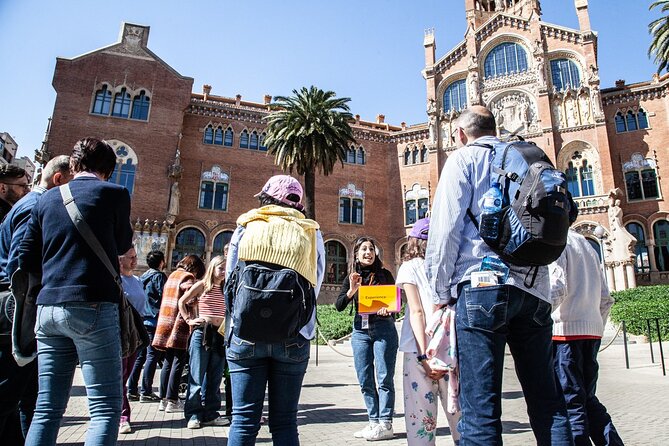
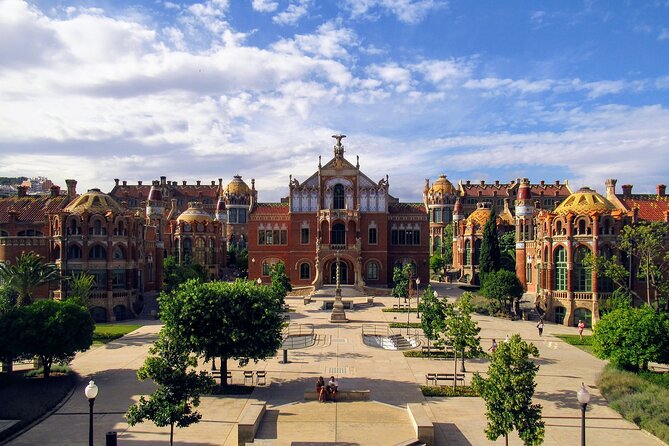
The tour begins at Recinte Modernista de Sant Pau, at Carrer de Sant Antoni Maria Claret, 167. The site was designed by Lluís Domènech i Montaner, one of the major figures of Catalan modernism.
This is an excellent starting point because Sant Pau is more than a pretty façade. It was once one of Barcelona’s most important hospitals and remained in use until the late 1990s. The complex is recognized as the largest Art Nouveau site in the world, giving the tour an impressive first example before you reach Gaudí.
You’ll spend about 15 minutes here. The visit is focused on the exterior, and admission is not included. That distinction matters. You’ll learn why the buildings look the way they do, but you should not expect time inside the former hospital unless you arrange a separate visit.
The stop also sets up a useful comparison. Domènech i Montaner’s work often combines decoration, symbolism, and practical purpose. The hospital was designed as a functioning institution, yet its gardens, ornament, and buildings were given unusual care. Listen for how your guide explains the relationship between health, light, space, and design.
Walking along Avinguda Gaudí to Sagrada Familia
From Sant Pau, the group walks along Avinguda Gaudí toward the Basilica de la Sagrada Familia. This connection is one of the pleasant parts of the route because the city itself becomes the link between the sights.
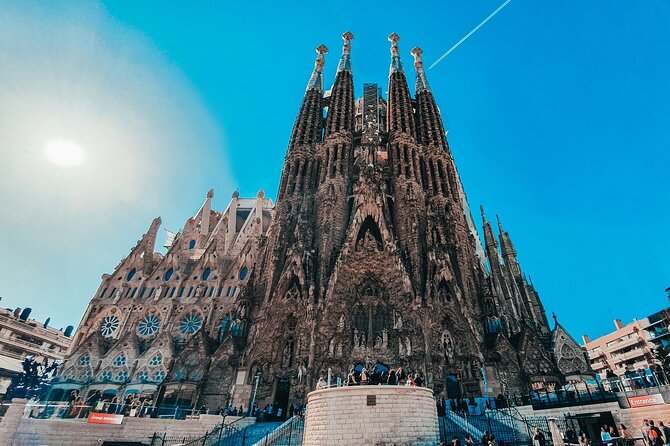
At Sagrada Familia, you’ll spend about 30 minutes viewing the church from different angles. The guide focuses on the symbols embedded in the façades and explains details that are easy to miss when you simply stop for photographs.
This is an exterior visit. Admission to the basilica is not included, so you will not go inside as part of this tour. That is not necessarily a weakness. The exterior is complex enough to reward a focused explanation, and you can arrange a separate interior visit if you want more time with Gaudí’s design.
The route is especially useful if you are trying to understand the church rather than merely collect a picture. Your guide can point out how the façades differ and how Gaudí used religious imagery, sculptural detail, and unusual forms to create a building unlike anything else in Barcelona.
Set aside time and energy for the walk. The total experience lasts two to two and a half hours, and this is only the first major portion of the route. Comfortable shoes and attention to the guide will matter more than trying to take photographs at every stop.
CaixaForum Macaya and Casa de les Punxes
The next stops are shorter, but they broaden the story beyond Gaudí.
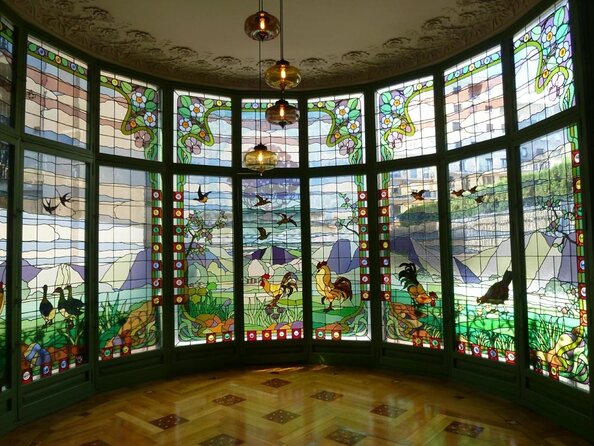
At CaixaForum Macaya, you’ll spend about 10 minutes hearing the background of what is described as a hidden architectural jewel. It is another chance to see Domènech i Montaner’s approach, this time in a more intimate urban setting.
The stop at Casa de les Punxes lasts about 15 minutes. Its name refers to the pointed towers that give the building a fairy-tale appearance, and your guide explains the story behind this distinctive house.
These visits are exterior-focused, with admission not included. Their value comes from comparison. If you only visit Gaudí’s famous buildings, it is easy to assume Barcelona’s modernist architecture begins and ends with one man. Casa de les Punxes and CaixaForum Macaya help correct that impression.
The shorter timing also means you should not expect a full architectural lecture at every address. The guide has to keep the group moving toward Passeig de Gracia, where the route reaches its densest concentration of important buildings.
Same base, a different kind of day out:
- Barcelona: Sagrada Familia Entry Ticket with Audio Guide
★ 4.6 · 105,312 reviews - Barcelona: Park Güell Admission Ticket
★ 4.4 · 76,534 reviews - Barcelona: Casa Batlló Entry with Self-Audioguide Tour
★ 4.7 · 25,359 reviews - Barcelona: 24 or 48-Hour Hop-On Hop-Off Bus Tour
★ 4.4 · 20,872 reviews
Passeig de Gracia and the Manzana de la Discordia
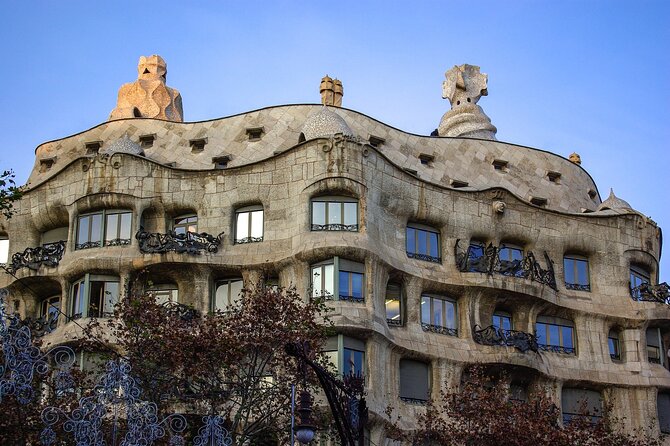
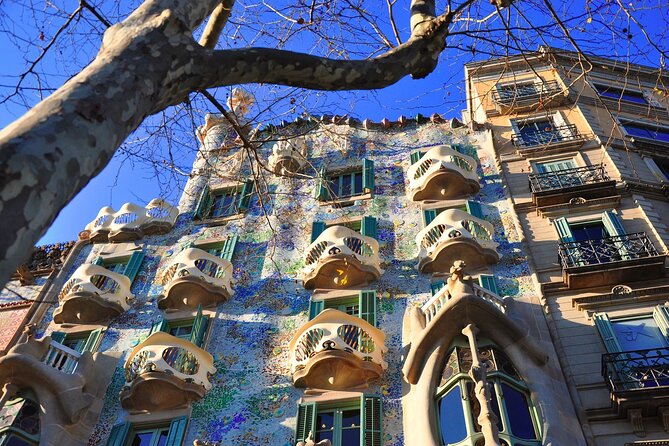
The tour’s longest architectural stretch takes place on Passeig de Gracia, Barcelona’s grand showcase of modernist façades. You’ll learn about Casa Milà, Casa Batlló, Casa Amatller, and Casa Lleó Morera, among others.
The area is often called the Manzana de la Discordia, or Block of Discord, because several competing architectural visions appear close together. The name suits the scene. These buildings do not form a quiet, matching row. Each architect worked to create something distinctive, using balconies, stonework, ceramic details, and sculptural decoration to claim attention.
This is where the tour’s comparative approach pays off. You can look at Gaudí’s Casa Batlló beside Casa Amatller by Puig i Cadafalch and Casa Lleó Morera by Domènech i Montaner. The façades are close enough together that you can compare them almost immediately.
The official route description includes two 30-minute sections connected with Passeig de Gracia and the Manzana de la Discordia. In practical terms, this is the central portion of the experience, and it gives the guide time to discuss several buildings rather than rushing past each one.
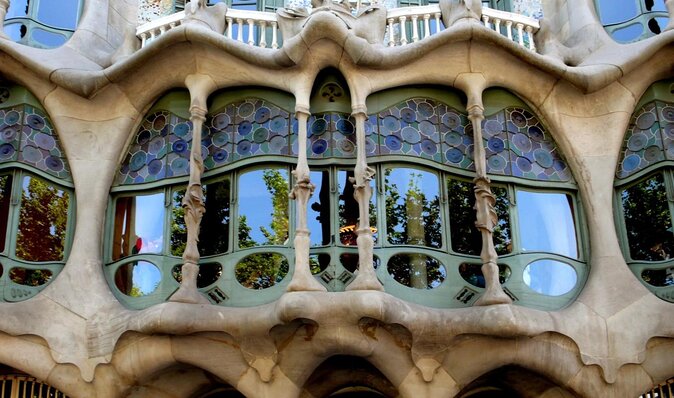
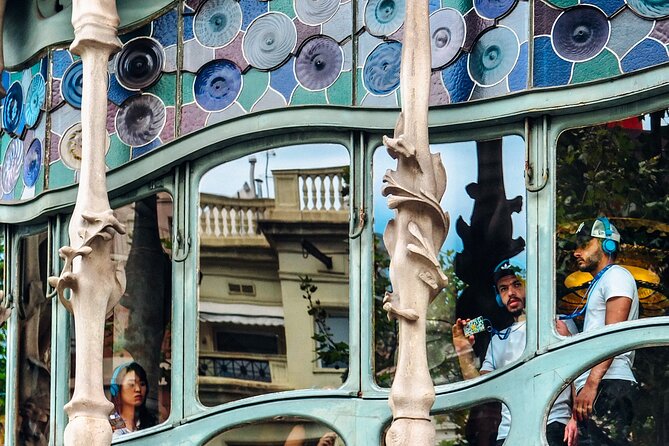
You will see Casa Batlló from the outside even on the basic option. Look for its colors and elaborate window decorations. The building is one of Gaudí’s most elaborate creations, but the tour does not automatically include interior admission.
That is the point at which the optional upgrade becomes important. If you add Casa Batlló admission, you can go beyond the street view and see more of Gaudí’s design at close range. A past guest specifically found the upgraded ticket worthwhile after a strong guide-led introduction. I would consider the upgrade if you have a serious interest in Gaudí or prefer a complete visit rather than an exterior overview.
Casa Amatller and the chocolate stop
Casa Amatller provides a different kind of pause. You’ll enter the ground-level shop, learn about Barcelona chocolate, and receive a sample.
It is a small detail, but it gives the walk a welcome change of pace after several outdoor explanations. The stop also brings you close to another important façade on Passeig de Gracia, so the chocolate tasting is not a random add-on. It connects local food culture with the building and the district around it.
Admission is listed as free for this stop, and the chocolate sample is included. Do not expect a full tasting menu. Think of it as a brief introduction during the architecture walk.
The tour ends at Passeig de Gracia, 35, in front of Casa Lleó Morera. This central finish is useful because you can continue exploring the avenue, arrange a separate visit to another building, or make your way onward through Eixample.
What the guides add to the buildings
The best part of this experience depends heavily on the guide. The buildings are worth seeing on their own, but a strong explanation helps you notice why they matter.
Perrine has been singled out for combining architectural detail with cultural, political, and economic background. That broader context is valuable because Catalan modernism was not just a decorative style. The buildings reflect the ambitions of Barcelona’s wealthy families, the city’s changing identity, and the creative competition among architects.
Patricio has also led the walk and received praise for explaining Gaudí’s work in a clear, engaging way. Guide quality can vary, as it does with any scheduled group tour, so you should allow some flexibility in your expectations.
One practical issue deserves attention. A participant found the walking pace too fast and had trouble hearing the guide because there were no listening devices and the streets were noisy. The guide also shared little information while the group moved between buildings. This is useful advice: stay near the guide, speak up quickly if you cannot hear, and ask the guide to repeat answers for the whole group rather than only one person.
The maximum group size is 20. That is manageable, but it is not a private tour. If you want a slower pace and constant conversation, a small private visit may suit you better.
Price, upgrades, and what you actually receive
The listed price is $35.07 per person. For that amount, you receive an English walking tour, a local guide, the architecture route, and a chocolate sample at Casa Amatller.
The value is strongest if you want orientation and interpretation. You are paying less for entry tickets than for a connected explanation of Barcelona’s major modernist buildings. Since several stops are viewed from the street, the basic tour also keeps the cost lower.
Entry to the buildings is not included. This applies to Sant Pau, Sagrada Familia, and the other sites where admission is noted as excluded. Casa Batlló admission is available as an optional upgrade, as is an expert architect guide.
I would choose the basic version if you already have separate tickets for Sagrada Familia or want a broad introduction before deciding which interiors deserve your time. I would choose the Casa Batlló upgrade if Gaudí is your main reason for booking and you want to experience one of his interiors as part of the same outing.
The tour is often booked about 28 days ahead, so advance planning makes sense if your Barcelona dates are fixed. Confirmation is provided when you book, and the experience is near public transportation.
Who should book this walk
This tour suits you best if you enjoy architecture, city history, and learning how several buildings relate to one another. It is also a good choice if you want a clear first look at Sagrada Familia and Passeig de Gracia before spending money on separate interior visits.
History buffs and art fans should get the most from the explanations. The route also works well for first-time visitors who want to understand Barcelona’s modernist center without arranging several disconnected stops.
You may want to skip it if you dislike walking, need a slow pace, or want guaranteed quiet audio. The route covers a lot in a short time, and the outdoor setting means traffic and street noise can affect how well you hear.
Free cancellation is available if you cancel at least 24 hours before the start time. Changes or cancellations made inside that window are not accepted for a refund.
Should you book the Barcelona Architecture Walking Tour?
Book it if you want a well-planned introduction to Barcelona’s modernist architecture rather than a general city walk. The route connects Sant Pau, Sagrada Familia, Casa de les Punxes, Casa Amatller, and the famous buildings of Passeig de Gracia in a logical two to two and a half hours.
The Casa Batlló upgrade is the key decision. The basic outing gives you a strong exterior tour and useful context. The upgrade makes more sense if you want to see inside Gaudí’s work and have the time and budget for one major admission.
Keep close to the guide, expect a fair amount of walking, and treat the experience as an architectural overview rather than a series of full building visits. With that expectation, the tour offers good value and a smart way to get oriented before exploring Barcelona on your own.
FAQ
How much does the Barcelona Architecture Walking Tour cost?
The listed price is $35.07 per person.
How long does the tour last?
The tour lasts approximately two to two and a half hours.
What language is the tour offered in?
The tour is offered in English.
Where does the tour begin?
It begins at Recinte Modernista de Sant Pau, Carrer de Sant Antoni Maria Claret, 167, Barcelona.
Where does the tour end?
The tour ends at Passeig de Gracia, 35, in front of Casa Lleó Morera.
Is admission to Sagrada Familia included?
No. Admission to Sagrada Familia is not included.
Is admission to Casa Batlló included?
Casa Batlló admission is available through an optional upgrade. It is not included in the basic tour.
Is a chocolate tasting included?
Yes. The tour includes a chocolate sample at Casa Amatller.
How many people can join the tour?
The maximum group size is 20 people.
Can I cancel for a full refund?
Yes. You can cancel at least 24 hours before the experience start time for a full refund. Cancellations made less than 24 hours in advance are not refunded.
Just added in Barcelona
- E-Bike tour in Barcelona with English Guide★ 5.0 · 128 reviews
- Barcelona: Wine Tasting and 5 Course Tapas Pairing Dinner★ 4.5 · 129 reviews
- Barcelona Gothic Quarter Walking Tour with Tapas★ 5.0 · 248 reviews
- Barcelona Luxury Yacht Cruise – Day or Sunset, Open Bar & Snacks★ 5.0 · 154 reviews
- Andorra Original History and Sightseeing Tour (Private, Pickup)★ 5.0 · 350 reviews
- Wine Tasting Experience in Barcelona★ 5.0 · 172 reviews
- Entrance to the Mirador Torre Glories Barcelona★ 4.5 · 193 reviews
- Barcelona Wax Museum Admission Ticket★ 4.5 · 237 reviews
Walking Tours, compared.
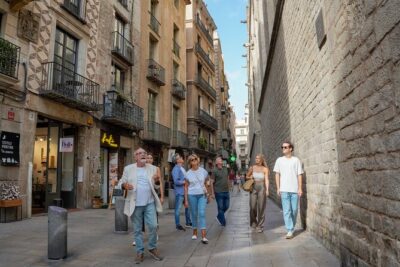
Barcelona Tapas and Wine Experience Small-Group Walking Tour
Read our review →
Tapas Walking Tour with Food, Wine, and History
Read our review →
Albaicín and Sacromonte Guided Sunset Walking Tour
Read our review →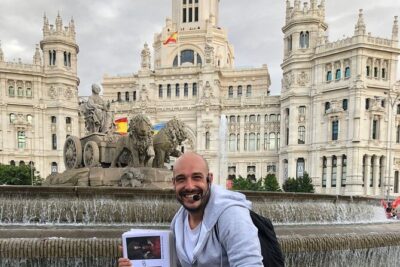

Madrid Old Town & Royal Palace Walking Tour Skip the Line Ticket
Read our review →

Gothic Quarter Ghosts and Legends Walking Tour
Read our review →
Spanish Inquisition and Legends Evening Walking Tour
Read our review →Browse the lists this tour appears in