

Reviewed · HOP-ON HOP-OFF BUS TOURS
City Sightseeing Barcelona Hop-On Hop-Off Bus Tour: 24 or 48-Hour
Barcelona’s Bus Turistic gives you a quick look at a very spread-out city, from Gaudí’s Sagrada Família and Park Güell to Montjuïc, the Olympic district, and the beaches. The open upper deck is the main draw: you see the streets, buildings, and hills far better than from the subway.
I like the way the two routes cover different sides of Barcelona, and I like the freedom to ride a full circuit first, then return to the places that catch your eye. The main drawback is traffic. A route that looks short on a map can take two hours or more, and finding the correct starting stop at Plaça de Catalunya can be confusing.
Key points to know
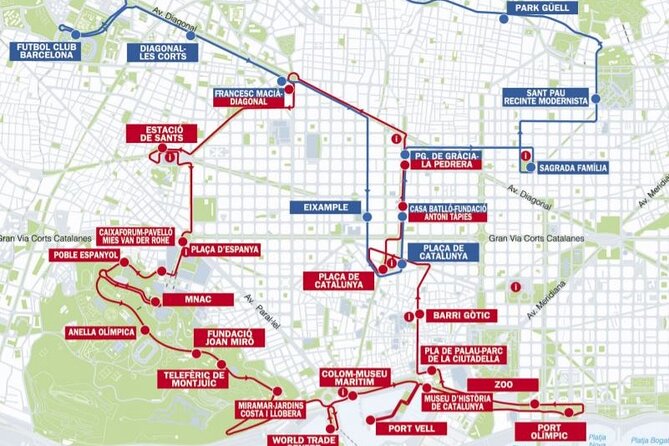
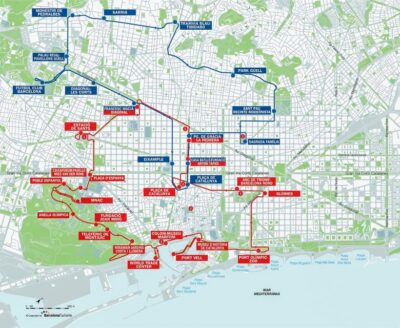
- Two routes cover the city: The red route handles Montjuïc, the waterfront, beaches, Sagrada Família, and the eastern districts, while the blue route reaches Park Güell, Tibidabo, Pedralbes, and Camp Nou.
- The upper deck gives the best views: It is excellent for photos, but the open sides can be cold, windy, or wet.
- A full loop takes time: The advertised tour duration is about 120 minutes, but traffic can make a circuit longer.
- Commentary comes through headphones: Audio is available in 16 languages, though some riders find it brief rather than highly detailed.
- You pay for transport, not attraction entry: Sagrada Família, Park Güell, museums, the cable car, and other sights require separate tickets.
- The pass works best with a plan: Use the first ride to learn the city, then hop off selectively instead of trying to see every stop.
A useful first look at Barcelona from Plaça de Catalunya

Start at Plaça de Catalunya if you can. This central square sits between the old city and the Eixample, making it a sensible place to begin, though the exact boarding point can be hard to spot. Two sightseeing companies operate around the square, and the red and blue buses may stop on different sides.
Once aboard, I would ride part of a route before getting off. You need a sense of direction here. Barcelona’s main sights are not lined up in one compact center, so the bus helps you understand how the Gothic Quarter, Eixample, Montjuïc, the waterfront, and the northern districts fit together.
The tour includes free Wi-Fi, headphones, and recorded commentary. The buses are pink and blue and are marked Bus Turistic. A mobile voucher or printed voucher is accepted, and you can redeem it at any stop along the routes.
Other sightseeing routes around Barcelona:
- Barcelona: 24 or 48-Hour Hop-On Hop-Off Bus Tour
★ 4.4 · 20,872 reviews - Barcelona: City Sightseeing Hop-On Hop-Off Bus Tour
★ 4.4 · 10,061 reviews - Barcelona City Tour Hop-On Hop-Off with Optional Boat
★ 4.0 · 3,012 reviews
Choosing between 24 and 48 hours

The 24-hour pass is enough if you have a single full day and mainly want an overview. It works especially well for a first ride around one route, followed by two or three carefully chosen stops.
I think the 48-hour pass is the better choice if you want to visit several attractions. Barcelona traffic eats time, and hopping off at Sagrada Família, Park Güell, Montjuïc, and the waterfront in one day can leave you doing more waiting than sightseeing.
A 48-hour pass also lets you separate orientation from sightseeing. Use the first day to ride both routes and note what interests you. Use the second day to return to the sights that deserve a closer look.
The listed price is $39.54 per person. That is reasonable if you use the bus for transportation between several distant districts, but it is not a bargain if you stay aboard for only one short ride. Attraction tickets are not included, so add those costs before deciding.
A coupon booklet promises more than 200 euros in discounts at Barcelona attractions. Its value depends on which places you plan to visit and whether the discount applies in a way that suits your schedule. Treat it as a possible bonus, not the main reason to buy the pass.
The red route: Montjuïc, the port, beaches, and Sagrada Família
The red route is the most useful circuit for a broad first look. It moves through central Barcelona, climbs toward Montjuïc, follows the waterfront, reaches the beaches and modern eastern districts, then returns through the Sagrada Família and Arc de Triomf areas.
Plaça de Catalunya to Plaça d’Espanya
From Plaça de Catalunya, the bus heads along Passeig de Gràcia. This is one of Barcelona’s grandest avenues, lined with Modernist buildings and high-end shops.
The Passeig de Gràcia stop puts you near Casa Batlló and the Fundació Antoni Tàpies. Casa Batlló is one of Antoni Gaudí’s most playful façades, with curved forms, bright tiles, and a roofline that looks almost alive. If you plan to enter, reserve enough time for the visit rather than treating it as a quick photo stop.
The next stops pass through Eixample and near Estació de Sants, Barcelona’s main rail station. These are useful stops if you are arriving by train or staying outside the old center.
Plaça d’Espanya is a major transport and sightseeing junction. From here, you can reach the Montjuïc museums and exhibition grounds, including CaixaForum and the Mies van der Rohe Pavilion. The broad square itself is worth seeing from the upper deck, with its monumental towers and long approach toward Montjuïc.
Same base, a different kind of day out:
- Barcelona: Sagrada Familia Entry Ticket with Audio Guide
★ 4.6 · 105,312 reviews - Barcelona: Park Güell Admission Ticket
★ 4.4 · 76,534 reviews - Barcelona: Casa Batlló Entry with Self-Audioguide Tour
★ 4.7 · 25,359 reviews - Barcelona: Park Guell Guided Tour with Skip The Line Entry
★ 4.7 · 17,563 reviews
Poble Espanyol and the art museums of Montjuïc
The Poble Espanyol stop serves an open-air complex built to present architectural styles from across Spain. It is designed for strolling, shops, and cultural displays, and it can take more time than its simple name suggests.
The next stop is near the Museu Nacional d’Art de Catalunya, usually called MNAC. Its position high on Montjuïc gives you one of the best city views along the route. Even if you do not enter the museum, the terrace and approach are strong reasons to hop off.
The Anella Olímpica stop reaches the Olympic Ring, a reminder of the 1992 Summer Olympics. This part of Montjuïc feels spacious and open compared with the tight streets of the old city.
The bus then serves the Fundació Joan Miró, dedicated to the Barcelona-born artist, and the Montjuïc cable car. The cable car is a separate attraction and is not included in the bus ticket. If you want to ride it, check your timing carefully because hopping off for Montjuïc can easily consume several hours.
Miramar and the Costa i Llobera Gardens offer another reason to leave the bus. This hillside area is known for views toward the port and Mediterranean plants. The route then descends toward the World Trade Center and the lower port.
La Rambla, the old port, and Port Olímpic
The Colom and La Rambla stop is handy for the lower end of La Rambla, the Gothic Quarter, and the waterfront. La Rambla is easy to reach but often crowded, so keep your belongings secure and do not expect a quiet stroll.
The Museu d’Història de Catalunya stop serves the old port area and the waterfront promenade. From here, you can walk toward Port Vell, restaurants, and the marina.
Port Olímpic marks the shift from the historic port to the modern waterfront created around the 1992 Olympics. The route continues to Bogatell Beach and Nova Mar Bella Beach. These stops are useful if you want sea air, a long walk, or a break from monuments and museums.
The Forum stop, Parc Diagonal Mar, and Poblenou show a newer side of Barcelona. Poblenou mixes former industrial areas with newer development and beach access. This section is less essential if your time is short, but it helps you see that Barcelona is more than its old center and Gaudí buildings.
Sagrada Família and Arc de Triomf
The Sagrada Família stop is one of the busiest and most useful on the entire system. Gaudí’s unfinished basilica is Barcelona’s signature sight, but the bus ticket does not include entry. A timed admission is needed to go inside, so plan that visit before building your bus day around it.
From the outside, you can study the contrasting façades and towers, but the interior is equally important. Light pours through colored windows onto the columns, giving the building a very different feel from the exterior.
The red route finishes near the Barcelona Bus Station North and Arc de Triomf before returning to Plaça de Catalunya. Arc de Triomf leads toward the Parc de la Ciutadella and the edge of the old city. It is a useful stop for combining the bus with a walk.
The blue route: Park Güell, Tibidabo, and the northern districts
The blue route covers the sights north of central Barcelona. It is the route to choose for Park Güell, Sant Pau, Pedralbes, and the areas around Tibidabo and Camp Nou.
Casa Batlló and La Pedrera
The blue route also begins around Plaça de Catalunya and Passeig de Gràcia. Its stops near Casa Batlló and La Pedrera place you in the heart of Barcelona’s Modernist district.
La Pedrera, officially Casa Milà, is another major Gaudí work. Its stone façade, twisting balconies, and rooftop sculptures make it very different from Casa Batlló. You can visit both, but I would not schedule them back-to-back unless architecture is your main interest.
This part of the city is easy to explore on foot, so the bus is most useful when you use it to continue north rather than simply ride between nearby Eixample stops.
Sant Pau and Park Güell
The Sant Pau Recinte Modernista stop serves the former Hospital de Sant Pau, a large Modernist complex designed by Lluís Domènech i Montaner. Its tiled buildings, gardens, and decorative details make it one of the most rewarding stops for architecture lovers.
The Park Güell stop is another major reason to choose the blue route. Gaudí’s park combines tiled structures, unusual stonework, and views across Barcelona. Parts of Park Güell require a separate ticket, and you should allow time for the uphill walk and the visit itself.
The stop information identifies the Park Güell boarding point as Encantos. Do not assume that the bus leaves you at every park entrance. Check the stop map and allow extra time to reach the area you want.
Tibidabo, Sarrià, and Pedralbes
The route continues toward Tramvia Blau and Tibidabo. This gives you access to Barcelona’s upper districts and the mountain area, though the historic blue tram and other attractions are separate from the bus ticket.
Sarrià offers a quieter, more residential side of the city. It feels quite different from the central avenues and can be a pleasant place for a short walk if you have extra time.
The Monestir de Pedralbes stop serves the former monastery, an important cultural site with a calmer setting than the central museums. The Palau Reial and Pavellons Güell stops continue the architectural theme. The Güell Pavilions are linked to Gaudí and are worth considering if you want something beyond the usual Casa Batlló and Sagrada Família circuit.
Camp Nou and Diagonal
The route passes the Futbol Club Barcelona stop, near Camp Nou. Entry to the stadium or any associated museum is not included. This stop matters most to football fans, and it can take a large part of your day if you choose to visit.
The blue route then returns along Diagonal through Les Corts and Francesc Macià before reaching Eixample and Sant Antoni. Traffic on Diagonal can be slow, but the ride gives you a good sense of Barcelona’s size and urban design.
What the open top is really like

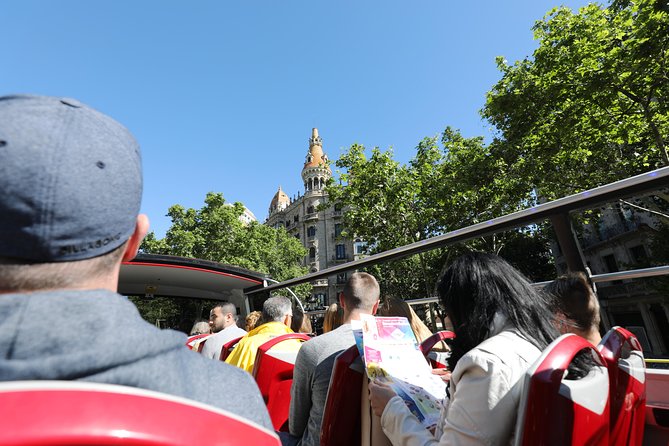
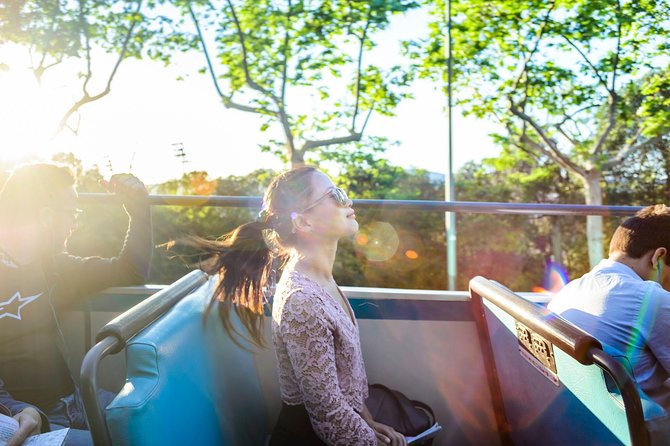
The upper deck is the best place for photos and city views. You can see building façades above street level, spot hills beyond the central avenues, and watch Barcelona change from old stone streets to modern waterfront districts.
The tradeoff is exposure. Wind can be strong, and even a covered upper deck may not protect you from rain blowing in from the sides. On a cold day, bring an extra layer. On a rainy day, the lower level is the safer choice if seats are available.
Keep your ticket with you. A replacement may require buying another ticket. Headphones are provided for the recorded commentary, but the audio is not a live guide. It gives useful context and stop information, yet it may feel thin if you want detailed storytelling about each building.
If you use CIC or ITE hearing aids, check the earphone arrangement before boarding. The supplied earbuds may not fit comfortably over those devices, and over-ear alternatives are not consistently available. This is an important practical issue that should be settled before you commit to the tour.
Timing, frequency, and city traffic
The published operating day begins with the first bus from Stop 1 at 9 a.m. The last bus from Stop 1 is listed at 7 p.m. Service runs all year except January 1 and December 25.
Buses are listed as arriving about every 20 minutes, with more frequent service during the busiest periods, sometimes every five minutes. Actual waits can feel longer when traffic or a full bus affects the service, so do not plan a timed attraction around the very last possible connection.
A complete route is advertised at about 120 minutes. In practice, traffic lights, narrow streets, and congestion can stretch the red route to two and a half hours. If you hop off, you also need to account for the next bus and the time spent walking to an attraction.
The bus is not always the fastest way across town. Barcelona’s subway and regular buses can beat it on long cross-city trips. The sightseeing bus earns its price when you want views, orientation, and a route that connects attractions without changing public transport lines.
Who should book this Barcelona bus tour?
I would recommend it to first-time visitors, families, cruise passengers with a limited day, and anyone who wants a broad city overview before choosing where to spend more time. It is especially useful if walking long distances or navigating several public transport connections would be tiring.
It also suits you if your priorities are spread across the city: Gaudí sites, Montjuïc, the waterfront, Park Güell, and Camp Nou are not close together.
I would skip it if you have only a short window and need the fastest possible transport. I would also think twice if rain is forecast, if you dislike recorded commentary, or if you want a personal guide who can answer questions as you ride.
The best approach is simple: ride one route for orientation, get off at one major sight, then use the bus as a scenic connection rather than trying to treat it like a normal city bus.
Should you book the Bus Turistic?
Book it if you want an easy overview of Barcelona and plan to visit sights on both sides of the city. The 48-hour option makes the most sense for a relaxed schedule, while the 24-hour pass works for a focused introduction.
Before booking, mark your must-see stops, check attraction entry times, and identify the exact boarding point at Plaça de Catalunya. Bring warm clothing for the upper deck, keep the ticket safe, and leave room for traffic.
For a first day in Barcelona, this is a useful orientation tool rather than a replacement for exploring on foot. Used that way, it can save energy, show you more of the city, and help you choose where to return.
FAQ
How long does the Barcelona hop-on hop-off tour take?
A full circuit is listed as approximately 120 minutes. Traffic can extend the journey, and one red route ride has taken about two and a half hours.
How many routes are included?
Your pass includes two routes, commonly identified as the red and blue routes. They cover different parts of Barcelona.
What are the main sights on the red route?
The red route includes Montjuïc, Poble Espanyol, MNAC, the Olympic Ring, the Joan Miró Foundation, the port, La Rambla, Port Olímpic, the beaches, Sagrada Família, and Arc de Triomf.
What are the main sights on the blue route?
The blue route includes Casa Batlló, La Pedrera, Sant Pau Recinte Modernista, Park Güell, Tibidabo, Sarrià, the Monastery of Pedralbes, the Güell Pavilions, Camp Nou, and Diagonal.
Does the ticket include entry to attractions?
No. The bus pass provides transportation, but entry to places such as Sagrada Família, Park Güell, museums, Camp Nou, and the Montjuïc cable car costs extra.
Is commentary available in English?
Yes. The audio guide is available in English and 15 other languages. Headphones are provided.
Can I cancel the booking?
You can receive a full refund if you cancel at least 24 hours before the experience start time. Cancellations or changes made within 24 hours are not refunded or accepted.
Just added in Barcelona
- Welcome to Barcelona: Private Tour with a Local★ 4.6 · 200 reviews
- Barcelona: White Rabbit Catalonia’s Top Immersive Experience★ 4.7 · 359 reviews
- Bean to Bar Chocolate Workshop in Barcelona★ 5.0 · 172 reviews
- Barcelona: Walking tour with Montjuic Castle & Cable Car★ 4.7 · 832 reviews
- Barcelona: Welcome to Barcelona Segway Tour★ 4.9 · 153 reviews
- Barcelona: Helicopter Flight with Optional Yacht Cruise★ 4.7 · 224 reviews
- Barcelona: The Original Barcelona Boat Party★ 3.9 · 254 reviews
- Barcelona Wine Tasting: Catalan and Spanish Wines★ 4.8 · 625 reviews
Hop-On Hop-Off Bus Tours, compared.

Granada City Train 1 or 2-Day Hop-On Hop-Off Ticket
Read our review →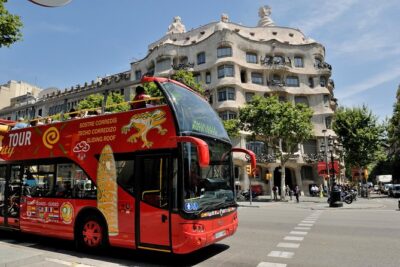
Barcelona City Tour Hop-On Hop-Off with Optional Boat
Read our review →
Browse the lists this tour appears in