Reviewed · TOURS IN BARCELONA
Barcelona & Gaudi. Regular Tour
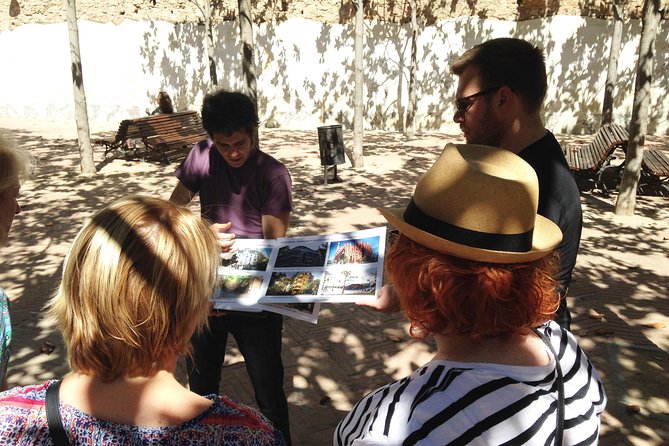
Gaudí’s Barcelona makes more sense when you stop treating the buildings as pretty oddities and start seeing them as arguments about society, faith, money, and modern life. This three-hour walk follows that thread through the Eixample, where a practicing architect guide explains why Casa Batlló, Casa Milà, and Casa Calvet look so different from one another.
I like the small maximum of 20, which gives you a better chance to ask questions at busy street corners. I also like the social and political setting: utopian socialism, bourgeois ambition, anarchism, the Spanish Civil War, and Gaudí’s religious turn all enter the story. The main consideration is simple: you do not go inside the buildings, so anyone hoping to visit La Pedrera or Casa Batlló’s interiors will need separate tickets.
Key points before you book
- A practicing architect leads the walk, bringing professional insight to Barcelona’s Modernist buildings.
- Pia is one named guide, praised for combining accurate Gaudí information with humor, warmth, and compassion.
- The route covers major Eixample façades, including Casa Milà, Casa Batlló, Casa Calvet, Casa Amatller, and Casa Lleó Morera.
- The tour puts architecture into social context, from the intellectual bourgeoisie to anarchism and the Spanish Civil War.
- The group is limited to 20 people, a useful size for an urban walking tour.
- The $54.44 price covers about three hours of guiding, but not interior entry to any building.
Why this walk is different from a basic Gaudí tour
A standard Barcelona architecture walk can easily become a parade of façades: look up, take a photo, hear the architect’s name, then move on. This experience aims for something more demanding and, for the right person, more rewarding. It follows the development of Modernism and Gaudí’s changing ideas rather than treating every building as an isolated masterpiece.
The route connects Gaudí’s social concerns with his later absorption in religion. That progression leads toward his reputation as the last great cathedral builder. You will also hear about eclecticism, positivist materialism, utopian socialism, the city’s intellectual bourgeoisie, anarchism, beatification, and the Spanish Civil War.
Those subjects can sound academic on paper. In practice, they give you useful questions to ask as you look at the buildings. Who commissioned this house? What did the owner want neighbors to think? Was the architect trying to make a practical home, a social statement, a religious work, or all three at once?
That approach suits you if you like architecture with a story behind it. It may feel too talk-heavy if you mainly want quick photo stops and a short biography of Gaudí.
Other trips people book in Barcelona:
- Barcelona: Sagrada Familia Entry Ticket with Audio Guide
★ 4.6 · 105,312 reviews - Barcelona: Park Güell Admission Ticket
★ 4.4 · 76,534 reviews - Barcelona: Casa Batlló Entry with Self-Audioguide Tour
★ 4.7 · 25,359 reviews
Starting at the Monument al Llibre
The walk begins at the Monument al Llibre on Gran Via de les Corts Catalanes, 634, in the Eixample, at 10:30 am. The meeting point is close to public transportation, which helps if you are crossing Barcelona from another neighborhood.
Starting in the Eixample is smart. The district gives the guide a broad urban setting in which to explain Barcelona’s growth, its planned blocks, and the ambitions of the people who commissioned these elaborate homes. You are not just looking at unusual doors and balconies. You are looking at a district shaped by expansion, wealth, politics, and changing ideas about city life.
The tour returns to the same meeting point after about three hours. Plan for an outdoor walk rather than a building tour. Comfortable shoes matter, and you should be prepared to pause on city streets while the guide points out details above eye level.
Casa Milà, La Pedrera, and Gaudí’s freer forms
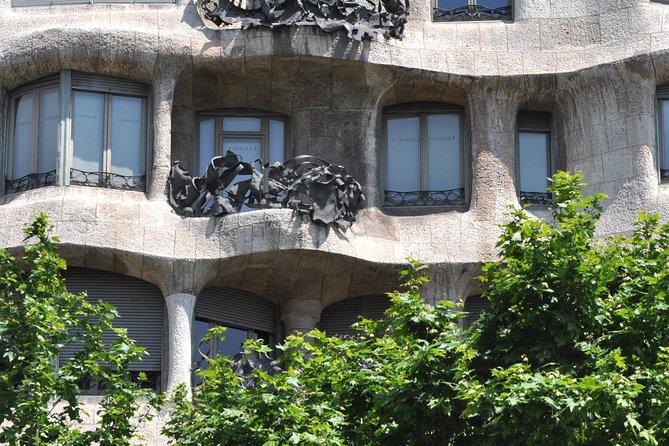
Casa Milà, better known as La Pedrera, is one of the strongest opening stops because its exterior quickly shows how far Gaudí was willing to push ordinary apartment-house design. The stone façade rolls and ripples instead of following a neat flat line. Ironwork at the balconies adds another layer of movement.
Here, your guide can help separate what looks chaotic from what was carefully planned. A practicing architect is particularly useful at a building like this because the visual drama comes from structure, surface, ventilation, light, and ornament working together.
You will see Casa Milà from outside, not tour its roof, courtyards, apartments, or exhibition spaces. That is an important limit. The exterior explanation may sharpen your interest, but it does not replace an interior visit if La Pedrera is high on your list.
Casa Batlló and the art of the street façade
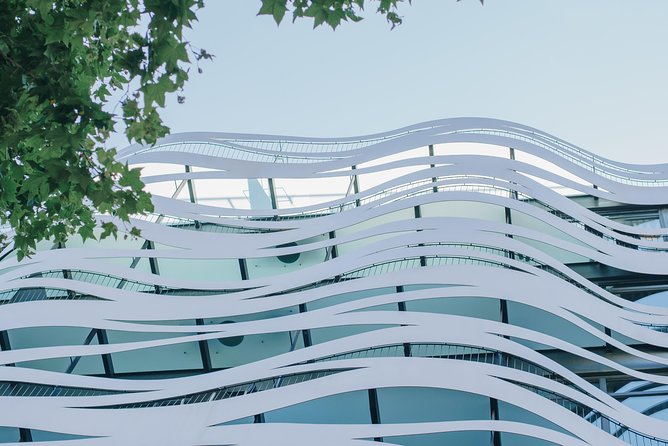
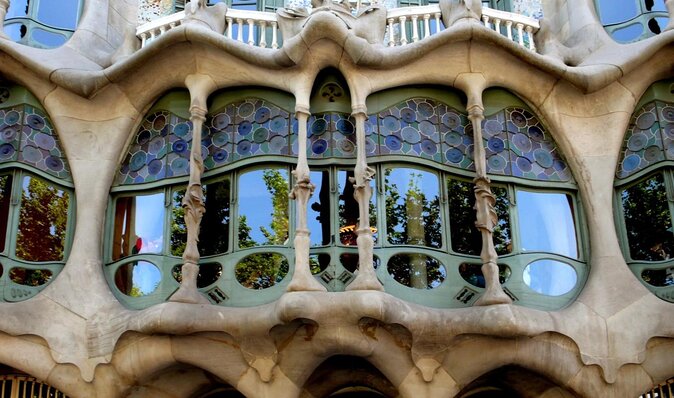
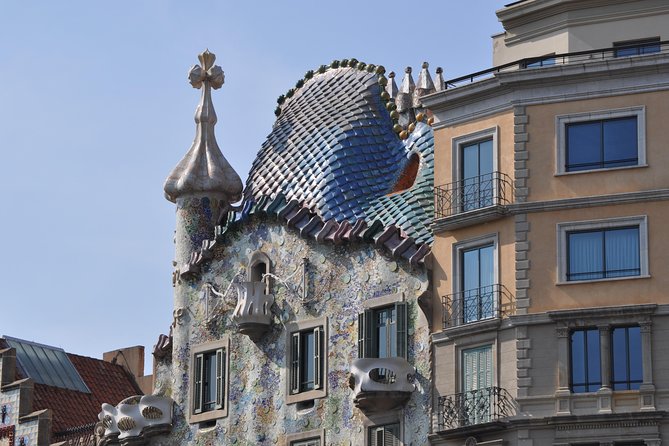
Casa Batlló brings a different mood. Its façade is crowded with color, curved forms, balconies, and details that can suggest bones, masks, scales, or sea life depending on how you read them. The building rewards patient looking, especially when the guide explains how its parts relate to the street and to the wider Modernist competition along the block.
This is one of the places where a guide can save you from reducing Gaudí to strange shapes. The building was made for urban display, and its position on Passeig de Gràcia matters. You can compare it with neighboring works and see how architecture became a public contest among Barcelona’s leading designers and wealthy clients.
Again, the visit is exterior only. Casa Batlló has a major interior experience, but admission is not part of this walk. If you plan to go inside later, this tour can give you a useful visual framework first. If you want only an interior visit, the walk may not be the best use of three hours.
Same base, a different kind of day out:
- Barcelona: 24 or 48-Hour Hop-On Hop-Off Bus Tour
★ 4.4 · 20,872 reviews - Barcelona: Park Guell Guided Tour with Skip The Line Entry
★ 4.7 · 17,563 reviews - Barcelona in 1 Day: Sagrada Familia, Park Guell,Old Town & Pickup
★ 5.0 · 13,541 reviews - Barcelona Aquarium: Entry Ticket
★ 4.3 · 13,335 reviews
Casa Calvet and the practical side of Gaudí
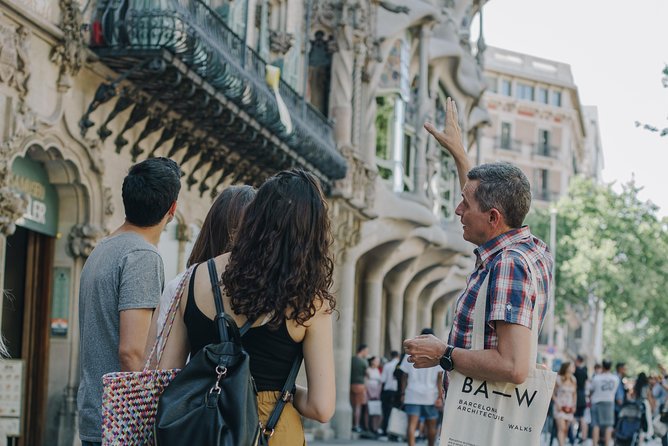
Casa Calvet is often less immediately famous than Casa Batlló or La Pedrera, which makes it a useful stop. It shows Gaudí working within a more formal urban setting while still adding his own language to the façade.
The building helps explain that Gaudí was not only a creator of dreamlike religious or residential spaces. He also worked with clients, city regulations, apartment layouts, and the demands of a functioning neighborhood. The guide can point out how Gaudí adapted his ideas to a more restrained commission without abandoning his attention to detail.
That contrast matters. Seeing Casa Calvet beside the more theatrical buildings gives you a fuller picture of his career. You begin to notice not just what is eccentric, but what changes from one project to the next.
La Mansana de la Discordia and Barcelona’s architectural rivalry
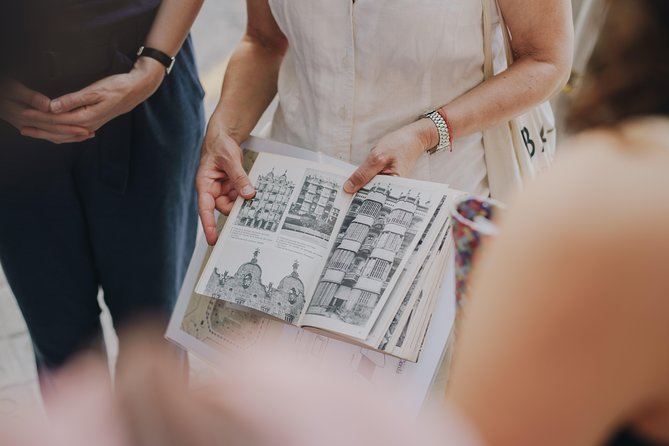
La Mansana de la Discordia, often translated as the Block of Discord, brings several important Modernist buildings into one stretch of city. The name fits the visual effect: neighboring façades compete for attention, each with a distinct personality.
This is a strong place for comparison. Casa Batlló appears alongside Casa Amatller by Josep Puig i Cadafalch and Casa Lleó Morera by Lluís Domènech i Montaner. You can see three major approaches to Modernism without traveling across the city.
The guide’s professional background should be especially useful here. A quick look may tell you which façade you prefer, but an architect can explain differences in composition, ornament, materials, and purpose. The stop also helps you understand that Barcelona Modernism was never just Gaudí’s personal show. Other architects made major contributions, and their work belongs in the same conversation.
The drawback is the city itself. Passeig de Gràcia is an active urban street, so traffic, pedestrians, and noise can interrupt the explanation. A group capped at 20 helps, but this is still not a quiet museum setting.
The Antoni Tàpies Foundation and modern echoes
The Antoni Tàpies Foundation adds a later artistic note to a route centered on Modernism. Its building connects the older architectural language of Barcelona with the work of Antoni Tàpies, one of the city’s important modern artists.
You should not expect a museum visit as part of this tour. The experience focuses on seeing the architecture from outside and placing it in the wider story of Barcelona’s artistic development. This gives the walk a broader reach than a strictly Gaudí-focused route.
It also prevents the city from being frozen in the early twentieth century. Barcelona kept changing after Gaudí, Domènech i Montaner, and Puig i Cadafalch. The foundation helps mark that continuing conversation between architecture, art, and the city.
Casa Amatller, Casa Lleó Morera, and the names behind the façades
The route also includes Casa Amatller and Casa Lleó Morera, two buildings that deserve attention beyond their role as neighbors to Casa Batlló. Casa Amatller was designed by Puig i Cadafalch, while Casa Lleó Morera was designed by Domènech i Montaner.
These stops are valuable because they widen your understanding of Barcelona’s Modernist period. If every unusual building is labeled Gaudí, you miss the competition and variety that made the Eixample so visually distinctive.
The walk also points out some less obvious Eixample courtyards. These details can be easy to miss on your own. They offer a break from the famous façades and show how the district works behind its grand street fronts.
The bigger story: religion, politics, and urban change
The strongest part of this tour is its attempt to place buildings inside the pressures of their time. Gaudí’s work did not develop in a vacuum. The route addresses the social concerns that shaped his earlier thinking and the religious devotion that increasingly defined his later work.
You will hear about utopian socialism and positivist materialism, two competing ways of thinking about how society should be organized and how progress should be understood. You will also hear about the intellectual bourgeoisie, the group that commissioned much of the architecture you see in the Eixample.
Anarchism and the Spanish Civil War add another layer. These subjects help explain why architecture in Barcelona can feel politically charged, even when you are simply looking at a doorway or rooftop. The tour also refers to Gaudí’s beatification and to the soft, dissolving surfaces associated with his later style.
The references to the Crypt of Colònia Güell and the Sagrada Família place Gaudí’s work within his larger religious and architectural project. They are part of the intellectual route of the talk, but the listed walking stops are in the Eixample, and the tour does not include interior visits.
What $54.44 buys you
At $54.44 per person, this is not the cheapest way to see Barcelona’s façades. It can still be good value if you want a serious explanation from a practicing architect rather than a general city walk.
You are paying for about three hours of guiding, a route through several major works, and a group limited to 20. That price makes more sense if architecture is a central reason for your Barcelona trip. It is less attractive if you only want photographs, because you can see many of these buildings from the street without joining a tour.
The value also depends on how much you use the guide. Ask questions. Compare the buildings. Notice what changes between Gaudí, Domènech i Montaner, and Puig i Cadafalch. A passive walk may feel expensive, while an active conversation can make the fee worthwhile.
The tour is offered in English. It is usually booked well ahead, with an average booking time of 41 days, so you should not assume a last-minute place will be available.
Pia’s guiding style and the right group for this tour
Pia is one named guide associated with the experience, and her approach is described as accurate, wide-ranging, kind, funny, and passionate. Those qualities matter on a subject that can become dry when it is reduced to dates and labels.
I would choose this walk if you want architecture explained in human terms. It should suit adults, students, design fans, and curious first-time visitors who want to understand why Barcelona looks the way it does. Most people can participate, and service animals are allowed.
I would be more cautious if you have limited walking tolerance, dislike stopping on busy sidewalks, or want guaranteed entry to major attractions. The published information does not give a precise walking distance or list interior access, so treat it as an outdoor architecture walk.
Free cancellation is available until 24 hours before the 10:30 am start time. Poor weather or failure to meet the minimum group size can also lead to a rescheduled experience or full refund.
Should you book Barcelona and Gaudí?
Book it if you want context, comparison, and an architect’s eye. The route covers enough major buildings to give you a solid introduction, while the political and religious discussion adds substance beyond Gaudí’s familiar visual tricks.
Skip it if your main goal is to enter Casa Batlló, La Pedrera, or another landmark. This tour does not include those interiors, and you would need separate admission.
For most architecture-minded visitors, the best plan is to use the walk early in your Barcelona stay. You will then look at the city with better questions, notice the non-Gaudí buildings, and know which interiors deserve your own time and ticket.
FAQ
How long is the Barcelona and Gaudí tour?
The walk lasts approximately three hours.
What time does the experience start?
It starts at 10:30 am.
Where does the tour begin?
It begins at the Monument al Llibre, Gran Via de les Corts Catalanes, 634, in Barcelona’s Eixample district.
Where does the tour end?
The experience ends back at the meeting point.
Does the tour include entry inside the buildings?
No. The tour visits the buildings from outside, and interior admission is not included.
How large is the group?
The group has a maximum of 20 participants.
Just added in Barcelona
- E-Bike tour in Barcelona with English Guide★ 5.0 · 128 reviews
- Barcelona: Wine Tasting and 5 Course Tapas Pairing Dinner★ 4.5 · 129 reviews
- Barcelona Gothic Quarter Walking Tour with Tapas★ 5.0 · 248 reviews
- Barcelona Luxury Yacht Cruise – Day or Sunset, Open Bar & Snacks★ 5.0 · 154 reviews
- Andorra Original History and Sightseeing Tour (Private, Pickup)★ 5.0 · 350 reviews
- Wine Tasting Experience in Barcelona★ 5.0 · 172 reviews
- Entrance to the Mirador Torre Glories Barcelona★ 4.5 · 193 reviews
- Barcelona Wax Museum Admission Ticket★ 4.5 · 237 reviews
Tours in Barcelona, compared.
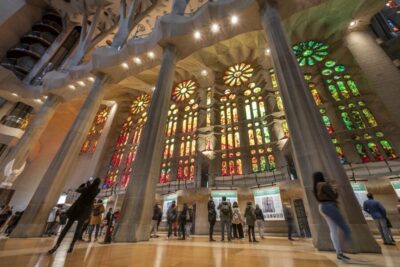
Sagrada Familia Entry Ticket with Audio Guide
Read our review →
Park Guell Guided Tour with Skip The Line Entry
Read our review →
Barcelona in 1 Day: Sagrada Familia, Park Guell,Old Town & Pickup
Read our review →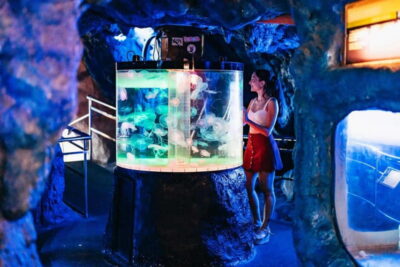
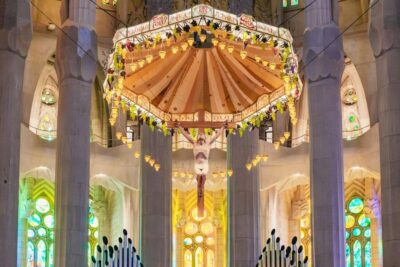
Sagrada Familia Skip-the-Line Entry Ticket & Tour
Read our review →