
Reviewed · CYCLING TOURS
From Seville: Half-Day Guided Bike Trip to Italica
Itálica is not just a pile of Roman stones outside Seville. It is a broad ancient city with mosaic-floored houses, public baths, and a huge amphitheater where up to 25,000 spectators once watched games. Getting there by electric bike makes the ruins part of a wider half-day outing, not a quick bus stop.
I like two things here: the ride uses bike paths for most of the route, and the guides add useful stories about Seville, Santiponce, Roman customs, and the site itself. The main consideration is weather. It can feel chilly on the ride in winter, while summer sun can make five hours outdoors tiring.
Key points
- The ride leaves central Seville by e-bike, so you can cover the distance without needing strong cycling legs.
- Itálica’s amphitheater is the headline sight, but the mosaics, houses, baths, and partly excavated streets make the whole site worthwhile.
- Santiponce adds a local stop and the option of a classic Andalusian breakfast before visiting the ruins.
- Most of the route follows bike paths, with some riding through Seville, countryside, villages, and part of the Camino de Santiago.
- Guides such as Rigo, Danny, Natasha, Tim, and Teun have led this experience, with English explanations throughout.
- The five-hour length gives the outing room to breathe, though you should dress for the season and expect time in the saddle.
Why Itálica Makes a Fine Half-Day Escape
Seville can keep you busy for days, but it is easy to spend all your time among palaces, tapas bars, and crowded lanes. Itálica gives you a different view of the region: Roman Andalusia, reached by bicycle through the modern city and its outskirts.
The ancient city was founded in 206 BC and became the birthplace of the emperors Trajan and Hadrian. The remains spread across a large archaeological area near Santiponce. You do not simply see one monument and leave. You walk through the traces of an entire Roman town, including large homes, public buildings, roads, baths, and finely decorated floors.
That scale is the surprise. The amphitheater gets most of the attention, partly because it appeared in Game of Thrones, but the residential area may be the more revealing part of the visit. The mosaics show how much money some residents had, while the size of the houses and public baths gives you a feel for daily life beyond the imperial names.
The site is also only partly excavated. Some ancient material is now in museums or private buildings in Seville, and parts of the old city lie beneath modern Santiponce. That means Itálica is impressive, but not a perfectly preserved Roman town with every building intact. You are seeing a large archaeological puzzle, with enough surviving detail to make the original city easy to picture.
A few more things to do in Seville worth a look
- Montserrat Half-Day Tour with Tapas and Gourmet Wines
★ 5.0 · 7,359 reviews - From Barcelona: Montserrat Half-Day Wine and Tapas Trip
★ 4.8 · 1,918 reviews - Montserrat: Morning or Afternoon Half-Day Trip with Pickup
★ 4.7 · 1,454 reviews
Leaving Seville by Electric Bike
The meeting point is the ATD Bikes shop on a pedestrian street in central Seville. The outing begins with the practical work of fitting helmets and getting used to the electric bikes. A bike-shop start is useful because you can ask questions and check the controls before heading into the city.
The e-bikes are a major reason this tour works for a wider range of people. You still pedal, but the motor reduces the effort, especially on a longer ride or when you are not used to cycling in warm weather. One useful feature is that you can use more or less assistance, so the ride can feel like gentle exercise rather than a powered sightseeing vehicle.
The route out of Seville is part of the experience. Guides have pointed out city sights along the way, and the ride takes you through areas many short walking tours miss. You may also follow part of the Camino de Santiago, the famous pilgrimage route, before reaching the villages and open areas beyond the city.
Most of the cycling takes place on bike paths, which removes much of the worry about sharing busy roads. Still, this is a cycling tour, not a chauffeured transfer. You need to feel comfortable steering, stopping, and staying with a group. The tour is not suitable for wheelchair users, and the provider does not describe it as an accessible vehicle excursion.
Santiponce and the Optional Andalusian Breakfast
Santiponce is more than a place to park the bikes. The village sits beside Itálica and gives you a short look at everyday life outside central Seville. Guides use the route and the village to explain local customs and the connection between modern Andalusia and the Roman settlement nearby.
There is an option to stop for a classic Andalusian breakfast before entering the archaeological area. Food and drinks are not included, so bring money if you want to take this break. The experience is not built around a full meal, and it is sensible to have something to eat before departure if you know you get hungry during active outings.
I like this stop because it slows the morning or afternoon down. You are not rushed directly from the bike shop to the ruins, and you get a small taste of local routine rather than only seeing monuments. The tradeoff is that the exact food stop and timing can vary, so do not book this expecting a fixed restaurant meal.
Some groups have also had a coffee or small bite after arriving near the ruins. That detail is not guaranteed, but it shows how the outing can include a little social time before the archaeological visit. Your main included refreshment is bottled water.
Walking Through Itálica’s Roman Streets
Once inside the archaeological area, the guide becomes especially valuable. Small signs can identify individual features, but they cannot easily explain how the pieces fit together. An English-speaking guide can connect the houses, public buildings, emperors, gladiatorial contests, and Roman customs into a readable story.
The residential quarter is one of the best parts of the visit. You can see the outlines of spacious homes and, in some places, complete rooms with patterned mosaic floors. These are not just decorative fragments. They show the wealth of the people who lived in Itálica and help you imagine how Roman homes were arranged around shared spaces.
The mosaics also reward a slow pace. From a distance, a mosaic can look like a patch of color. Up close, the patterns and scenes reveal the care that went into decorating a private home. Your guide can explain what you are looking at and why the artwork mattered in Roman society.
The baths are another important stop. A large communal bath complex points to the social side of Roman life, when bathing involved exercise, conversation, grooming, and public routine. The ruins do not give you a working bathhouse, of course, but the scale of the remains makes the building’s role clear.
Itálica is not uniformly preserved. Some structures are low walls or foundations, and some original artwork has been moved elsewhere. That is normal for an archaeological site, but it is worth knowing if you expect a complete Roman city. I find the partial state part of the appeal because it lets you see the layers of excavation and preservation rather than a fully reconstructed theme-park version of antiquity.
Same base, a different kind of day out:
- Seville: Live Flamenco Dancing Show Ticket at the Theater
★ 4.7 · 16,396 reviews - Seville: 1-Hour Guadalquivir River Sightseeing Eco Cruise
★ 4.2 · 10,281 reviews - Seville: Cathedral, Giralda, and Royal Alcázar Guided Tour
★ 4.7 · 9,165 reviews - Seville: Setas de Sevilla Entry Ticket
★ 4.6 · 8,901 reviews
The Amphitheater and Its Gladiator Gateways
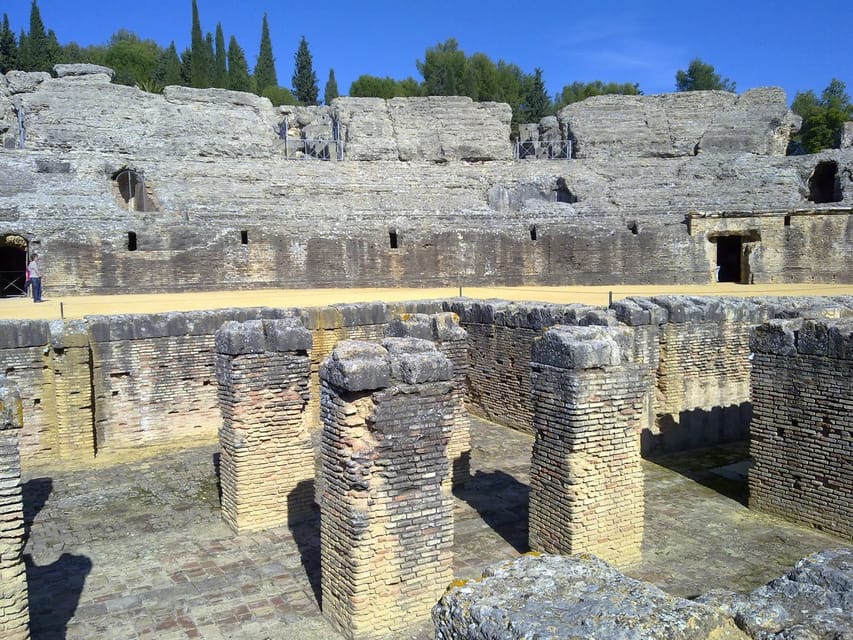
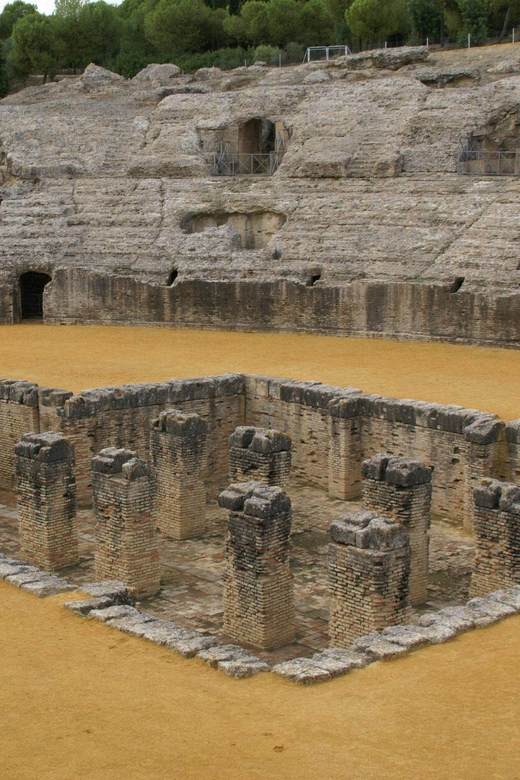
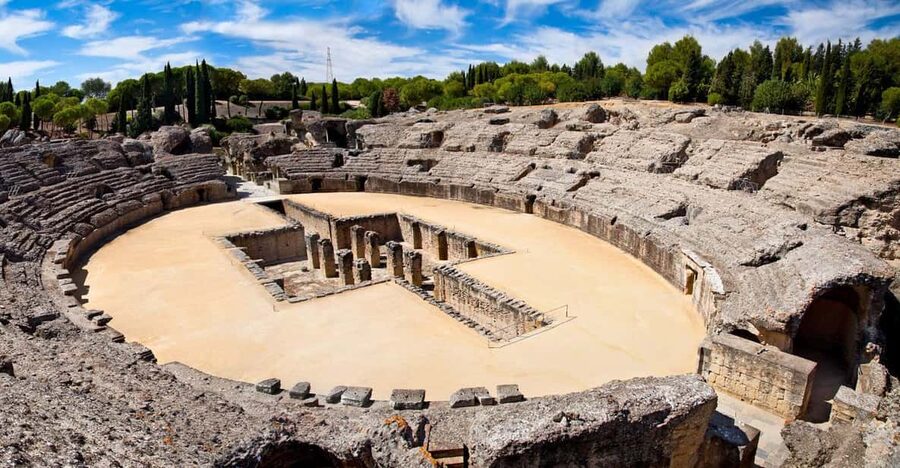
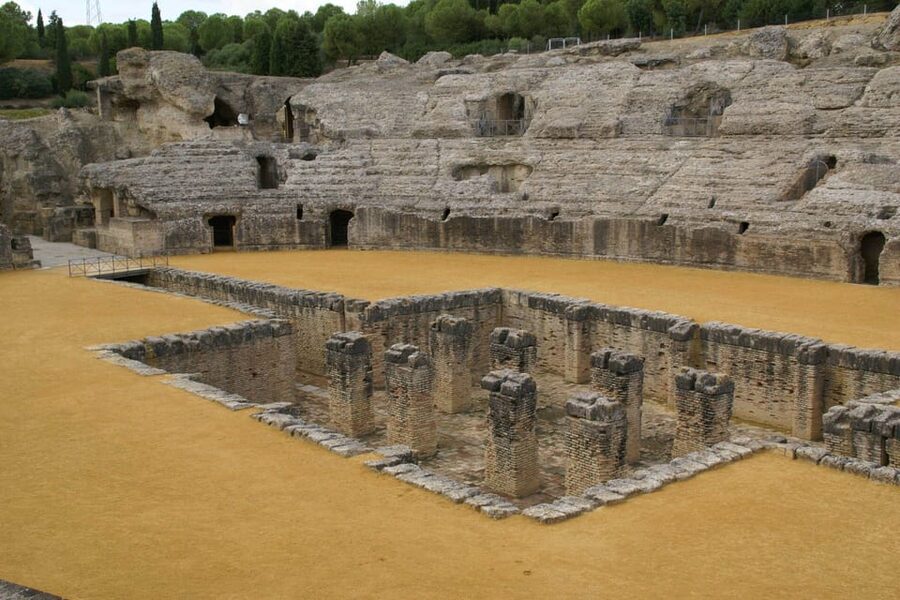
The amphitheater is the emotional high point for many people. Its size is hard to grasp until you stand inside the oval and look across the seating area. It could hold roughly 25,000 spectators, a striking figure for a city outside modern Seville.
You can walk through areas connected with the games, including the entrance used by gladiators and the room where fighters waited before going out. These spaces make the arena more immediate than a distant view from above. You are not watching a reenactment, but the layout gives you a clear sense of how people and animals moved through the building.
The amphitheater also helps explain Roman power. Public games were entertainment, but they were tied to status, politics, and the emperor. A guide can add the missing context, explaining why a city would invest in such a large venue and what the crowd expected to see there.
Do not rush through the rest of Itálica simply because you have reached the arena. The amphitheater is dramatic, but the mosaics and houses show the quieter side of Roman life. The best visit balances both: public spectacle on one side, private wealth and ordinary routines on the other.
The Guides Make the Difference
The quality of this tour depends heavily on the person leading it. Named guides on this experience have included Rigo or Rodrigo, Danny or Danni, Natasha, Tim, Teun, Eduardo, and Luce. You may not receive a particular guide, but the repeated pattern is clear: the guide handles both the cycling route and the interpretation of the ruins.
Rigo has been praised for combining useful site information with a relaxed, entertaining manner. Danny has led groups through Seville and Itálica, explaining Roman history in clear English. Natasha and Tim have also guided the ride, with Tim noted for his storytelling. Eduardo once helped a small group order a traditional breakfast in Spanish, a nice example of the practical help a guide can provide.
The guide’s job is not only to recite dates. You can ask questions about Seville, the villages, Roman society, or the route. Several guides have also used the ride into town as a moving introduction to Seville, pointing out places that you might otherwise pass without noticing.
Tour quality can vary slightly with the guide’s personality and the group’s pace. That is true of any guided outing. The strong point here is that the experience has two subjects, not one: the city and the Roman site. Even the ride becomes more interesting when someone explains what you are passing.
Is $53 Good Value for Five Hours?
At $53 per person, the price is reasonable if you want transport, equipment, guiding, and a major archaeological visit in one package. You receive the electric bike, helmet, guide, and bottled water. The tour also saves you from arranging your own route to Santiponce and working out how to combine the village with Itálica.
The value is strongest for visitors who would otherwise pay separately for transport and a guided visit. You also see more of Seville along the way, rather than spending the whole outing inside a vehicle. The cycling itself is part sightseeing and part transport.
Be careful when comparing the price with a simple self-guided visit. The archaeological entrance fee is not listed among the included items, and past visitors have referred to an admission price of €1.50. Check the current arrangements when booking rather than assuming every cost is covered. Food and drinks beyond the supplied water are also extra.
For a person who dislikes cycling, the calculation changes. You are paying for an active route, not just access to the ruins. If you would rather conserve your energy for walking around Itálica, a standard transport option may suit you better. If you enjoy bicycles and want a less ordinary half-day from Seville, the price makes sense.
Clothing, Weather, and Practical Comfort
Five hours sounds easy on paper, but the outing includes cycling, village streets, and time outdoors at an exposed archaeological site. Wear comfortable clothes that let you move freely. You do not need serious workout gear, since the electric assistance handles much of the effort.
Winter needs more thought than you might expect. The bike can feel cold even when Seville itself feels mild, especially at the start of the ride. Bring layers and gloves in cooler months. You can remove a layer later, but you cannot add one you left at the hotel.
In warm weather, bring sun protection and take the water seriously. The tour supplies bottled water, but the site and cycling route still involve outdoor exposure. Check the starting time and forecast before you go, as the exact departure times vary by availability.
The route is described as relaxed, but this is not a completely effortless outing. You will ride for part of the five hours and walk around the ruins. Comfortable shoes matter more than stylish ones.
Who Should Book This Ride
I would choose this tour if you like combining Roman archaeology with local cycling. It suits couples, friends, and families with older children who can ride safely and stay with a group. It is also a strong choice if you have already seen Seville’s central sights and want a change of pace.
History fans will get the most from the tour, especially if mosaics, amphitheaters, emperors, and Roman town planning interest you. You do not need specialist knowledge. The guide supplies the background, and the site provides plenty to look at even if your interest is casual.
It is less suitable if you have limited mobility, dislike bikes, or want a short, tightly timed monument visit. The route takes five hours, and the return ride is part of the deal. It is also not ideal if you need a fully predictable schedule, since the starting times and optional food stop can vary.
The tour has earned a 4.9 rating from 126 reviews, with praise focused on the e-bikes, safe-feeling paths, guide quality, and the scale of Itálica. The most useful takeaway is not the number itself. It is that the experience succeeds when you value the journey as much as the destination.
Should You Book the Itálica Bike Tour?
Book it if you want an active, well-rounded half-day that links Seville, Santiponce, countryside paths, and one of Spain’s most striking Roman sites. The e-bike keeps the route manageable, while the guide adds the context that makes low walls, mosaics, and arena passages come alive.
Skip it if you want a quick ride to the ruins, a fully accessible excursion, or a quiet self-guided visit without a fixed group pace. For everyone else, $53 buys more than entry to Itálica. It buys a practical route, a local guide, and a memorable way to leave Seville behind for a few hours.
FAQ
How long does the bike tour to Itálica last?
The tour lasts five hours, including the cycling from Seville, the visit to Santiponce, and time at the archaeological site.
What is included in the tour?
The price includes an electric bike, helmet, English-speaking guide, and bottled water.
Is the tour conducted in English?
Yes. The live tour guide speaks English, and English is the listed tour language.
Is breakfast included?
No. You can choose to have a classic Andalusian breakfast in Santiponce, but food and drinks are not included in the tour price.
Is the tour suitable for wheelchair users?
No. The activity is listed as unsuitable for wheelchair users.
Where does the tour meet?
The meeting point is the ATD Bikes shop on a pedestrian street in Seville.
Just added in Seville
- Seville: Authentic and Romantic Horse-Drawn Carriage Ride★ 4.5 · 341 reviews
- Seville: VIP Exclusive Early Access Tour of The Alcazar★ 4.8 · 276 reviews
- Seville: Sunset Roof Top Walking Tour★ 4.5 · 122 reviews
- Seville: Tapas, Taverns and History Guided Walking Tour★ 4.9 · 515 reviews
- Seville: Flamenco Show at Tablao Almoraima in Triana★ 4.6 · 483 reviews
- Seville: Tapas, Taverns, and History Walking Tour★ 4.9 · 676 reviews
- Seville: Stand Up Paddle Board Rental★ 4.6 · 134 reviews
- Seville: Small-Group Cathedral and Giralda Tour with Tickets★ 4.9 · 203 reviews
Cycling Tours, compared.
Barcelona 3-hour Bike or E-Bike Tour: Highlights and Hidden Gems
Read our review →
Best of Madrid: 3-Hour Guided Bike Tour in Small Groups
Read our review →
Highlights Bike Tour with Optional E-Bike or Tapas
Read our review →
Browse the lists this tour appears in